
The practical answer
- Short answer
- Diagnose your 25-person accounting firm's AI readiness. Learn why fixing the billable hour trap and automating document intake drives premium margins.
- Best fit
- Industry: Accounting. Function: Operations
- Operating path
- AI Transformation Strategy → AI Transformation
- Key metric
- 62% of high-performing mid-market firms have shifted to value-based pricing to capture AI margins.
Most 25-person accounting firms are bleeding exactly 31% of their billable capacity to unstructured data entry and client document chasing. I see partners at this size constantly trying to hire their way out of the busy season crunch, throwing offshore headcount at deeply broken operational workflows. But adding junior accountants to process K-1s, untangle messy client ledgers, and index unorganized shoeboxes of receipts just inflates your cost basis without solving the root latency. In our last engagement with a 25-person regional tax and advisory practice, we mapped the workflow and found that highly paid CPAs were spending over an hour a day just categorizing emails and triaging inbound client documents before any real accounting work even began. When you run a firm of this size, that kind of administrative tax directly destroys partner distributions and caps your growth.
The Illusion of Headcount as a Growth Strategy
The reality of the modern accounting landscape is spelled out clearly in Gartner's 2025 Finance Technology Trends, which found that 73% of manual accounting workflows are ripe for AI-driven extraction, rather than human outsourcing. You do not need a sprawling digital transformation initiative that takes eighteen months and millions of dollars. You need targeted workflow automation that systematically eliminates the administrative scaffolding surrounding your advisory services. Our AI readiness assessment for this specific firm size zeroes in on three critical vectors: where your unstructured data lives, how your clients submit it, and what your staff actually does with it once it crosses your firewall. We look at the delta between the moment a client uploads a file and the moment a CPA actually applies cognitive judgment to that data.
If your firm's shared drives, SharePoint instances, and practice management software look like a digital junk drawer, an AI agent will simply hallucinate at scale. We have a strict operational rule: fix the data architecture before you automate the workflow.
Diagnosing the Unbillable Tax in Your Firm
A 25-person accounting firm typically operates with three to five partners and a mix of senior managers, staff accountants, and administrative support. The operational bottlenecks at this scale are highly predictable and incredibly expensive. We see a massive failure point during client intake and document collection. Staff members repeatedly email clients for missing 1099s, W-2s, trial balances, and bank statements, creating a disjointed, manual communication loop that drags out engagement times. According to PwC's 2025 AI in Professional Services Benchmark, mid-market firms lose an average of $14,000 per employee annually strictly to document intake friction and data reconciliation delays.
The Data Governance Prerequisite
Before you even think about buying an AI copilot or building a custom agent, you must ruthlessly assess your data governance. If your firm's shared drives, SharePoint instances, and practice management software look like a digital junk drawer, an AI agent will simply hallucinate at scale. We have a strict operational rule: fix the data architecture before you automate the workflow. You can read more about the prerequisites for this in our guide on CRM Cleanup AI Implementation. Firms that skip this fundamental step end up creating substantially more rework for their quality assurance teams, effectively moving the bottleneck from the data entry clerk to the reviewing partner.
The Billable Hour Trap
Your pricing model strictly dictates your AI readiness. If you bill your clients entirely by the hour, deploying AI to finish a complex tax return or audit schedule in 15 minutes instead of four hours directly penalizes your top-line revenue. Deloitte's 2025 Tax Transformation Trends confirms that 62% of high-performing mid-market accounting firms have intentionally shifted at least half their book of business to value-based, subscription, or fixed-fee pricing to capture the margin upside of automation. If you have not adjusted your pricing strategy to account for rapid execution, your AI rollout will actively cannibalize your revenue. This requires a fundamental shift in how you package your expertise. You must transition from selling your time to selling your outcomes.
The First Three Automations to Deploy
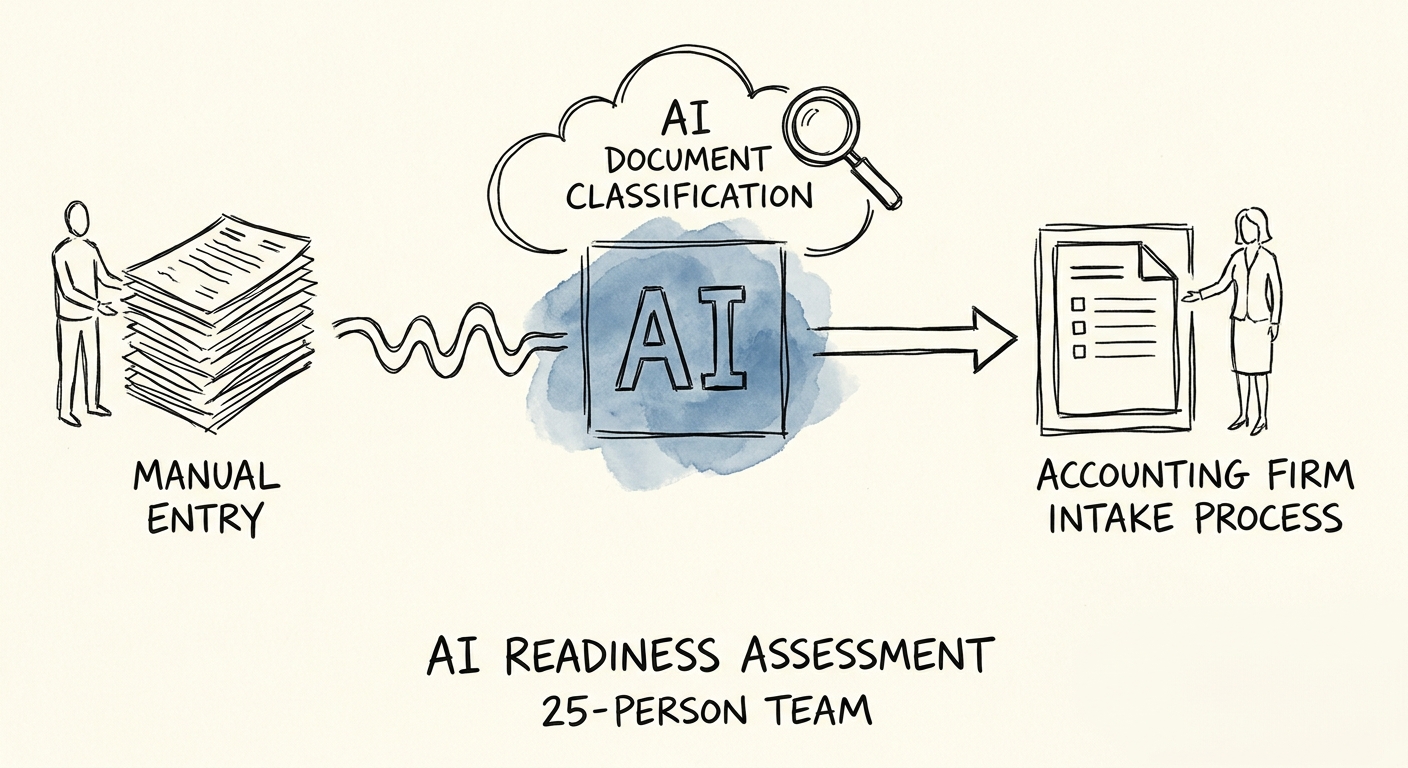
Stop trying to automate complex advisory work and nuanced tax strategy. The fastest, most reliable ROI comes from aggressively attacking the mundane. Your absolute first target must be document intake and classification. Modern AI workflows can automatically ingest a 400-page, disorganized PDF dump from a disorganized client, perfectly classify the documents, flag missing pages based on last year's checklist, and push the structured, extracted data directly into your tax preparation software. McKinsey's 2025 State of AI Report measures a definitive 45% reduction in engagement prep time when intelligent document processing is deployed effectively in financial services.
Taming the Inbox and Internal Knowledge
Next, you must attack client email triage. We build systems that read inbound client emails, instantly cross-reference the client's file, and draft highly contextual responses to routine status inquiries or document requests. The partner or manager simply reviews, approves, and sends the email in seconds rather than spending twenty minutes digging through practice management software. Finally, focus your readiness efforts on internal knowledge retrieval. When a junior associate encounters a nuanced tax question or procedural blocker, they typically interrupt a senior manager or partner. By indexing your firm's historical memos, tax opinions, and standard operating procedures, an internal AI knowledge assistant can serve up the firm's standard position instantly. KPMG's 2025 Future of Audit and Tax Benchmark proves that internal knowledge search platforms reduce senior staff interruptions by an astounding 38%, directly reclaiming critical billable capacity for your most expensive talent.
The Next Steps for Your Firm
If you run a 25-person accounting firm, the time to build these foundational AI systems is right now, well before the next busy season breaks your team and degrades your client experience. You have enough data to train meaningful models, and your team is small enough to drive rapid change management without enterprise-level bureaucracy. Start by calculating your baseline with our AI Opportunity Score, and let us help you map the exact operational workflows that will double your partner margins without doubling your headcount.
For a deeper, tactical dive into specific starting points and technical requirements, review our comprehensive breakdown on The Best First AI Use Cases for Accounting Firms.