
The practical answer
- Short answer
- A 250-person accounting firm bleeds massive margin to unbillable data triage. Here is the operator's guide to assessing AI readiness and stopping the 69% rework tax.
- Best fit
- Industry: Accounting. Function: Operations
- Operating path
- AI Transformation Strategy → AI Transformation
- Key metric
- 59% of finance leaders are currently using AI, but many are hitting scale limits due to poor data silos.
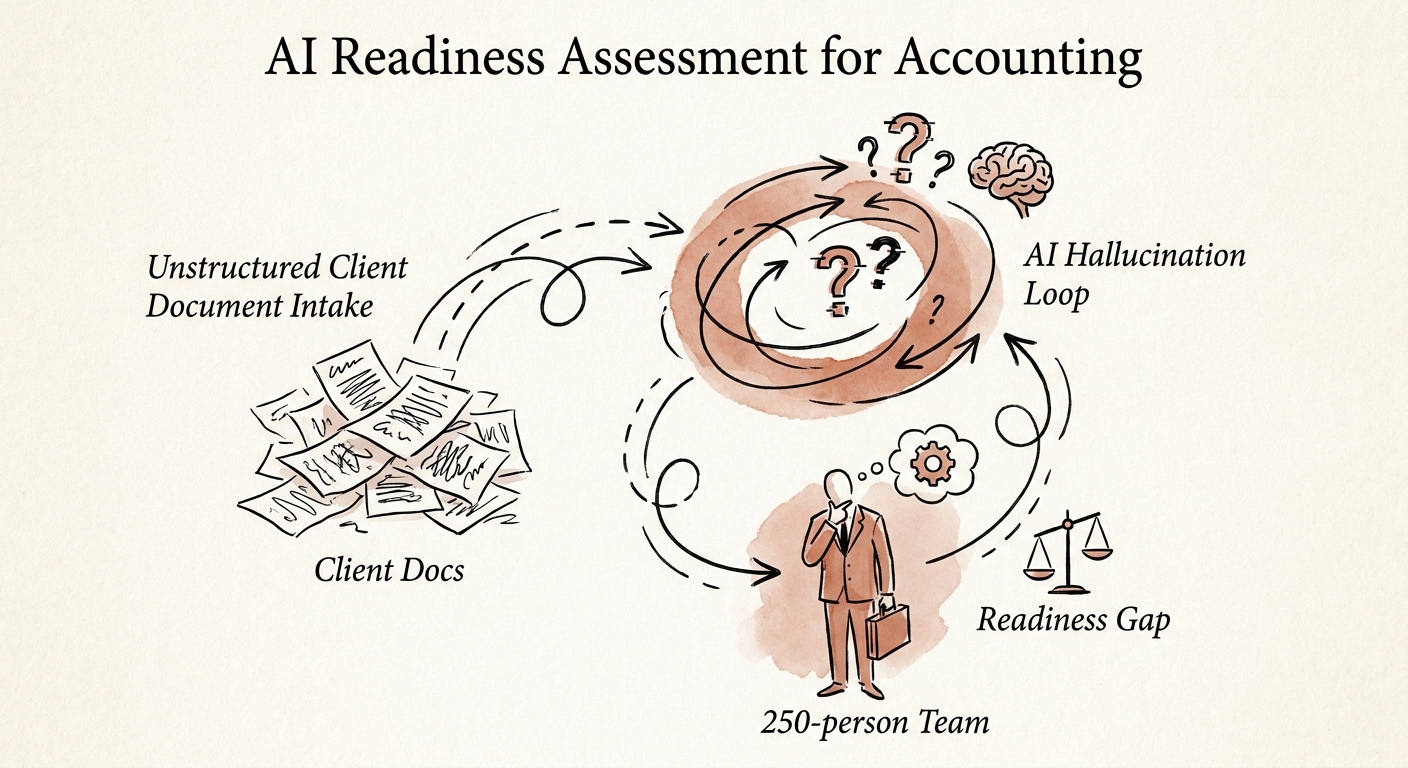
Right now, CPA.com's 2025 AI in Accounting report found that roughly 69% of the gross time savings generated by AI in finance and accounting teams is being actively destroyed by manual rework, training deficits, and new non-value-added tasks. In a 250-person accounting firm, that means your partners are buying software licenses to buy back capacity, only to watch their staff burn those exact hours fixing AI hallucinations, chasing down unformatted client documents, and re-keying data into legacy ERPs. The promise of artificial intelligence is seamless automation, but the reality for most mid-market firms is just a faster version of their existing operational chaos.
I have rebuilt this operational layer three times for mid-market financial services clients, and the pattern is always the same. Leadership sees the burnout of busy season, looks at the turnover rate among junior accountants, and mandates an immediate AI transformation. They skip the readiness assessment entirely. They buy an AI copilot or a fancy generative AI wrapper before they fix their broken document intake workflows. As a result, the AI simply accelerates their existing inefficiencies, creating a higher volume of errors that expensive senior staff must manually review and correct.
While TalentBridge's 2026 analysis of AI in finance and accounting operations reports that 59% of finance leaders are using AI in their functions, the firms actually seeing margin expansion are the ones who audited their data infrastructure first. You cannot build a high-margin advisory practice on top of unstructured, messy client data. If your data is garbage, your AI output will be garbage, and your partners will end up doing the data janitor work that the software was supposed to eliminate. We see this margin leak constantly when assessing mid-market professional services firms for AI implementation.
You cannot build a high-margin advisory practice on top of unstructured, messy client data. If your data is garbage, your AI output will be garbage.
Assessing Your Data Intake and Triage Workflows
Before you evaluate a single vendor or sign a software contract, you must ruthlessly assess how data enters your firm. In a 250-person firm, you likely have dozens of partners managing hundreds of distinct client relationships. If clients are sending tax documents, payroll registers, and bank statements via unstructured email threads, personal text messages, or unorganized cloud drives, your AI initiative will fail immediately. An AI agent cannot reliably parse a poorly scanned, upside-down PDF attached to a forwarded email from a client's bookkeeper. It requires structure.
In any well-run firm, operations must be cleanly separated from technical accounting work. You need a dedicated, standardized, and enforced intake portal. We saw this exact failure pattern at a regional firm last year: they tried to deploy an AI tax categorization tool, but because their intake was completely fragmented across five different channels, the AI misclassified 40% of the transactions. They had to pull their highest-paid senior accountants off billable advisory work just to manually QA the AI's output. The automation actually drove their realization rates down.
Your first AI readiness milestone is achieving 100% standardized document intake across every practice group. If you haven't mastered this foundational step, I strongly recommend reading our guide on What IT and Data Teams Should Automate First with AI: Document Intake. You must force clients into a structured workflow before you apply a language model to their data. Every exception to your intake rule is a breakpoint for your AI, and every breakpoint requires human intervention. Until you eliminate the exceptions, you are not ready for AI transformation.
The Governance and ROI Readiness Check
The next phase of your AI readiness assessment is establishing unshakeable data governance. Deloitte's State of AI in the Enterprise report indicates that 63% of finance leaders have fully deployed AI solutions, but a significant portion are hitting a wall due to siloed data and poor access controls. If your firm is using QuickBooks Online for one division, NetSuite for another, and bespoke Excel models for high-net-worth advisory, your data environment is fundamentally too fragmented to support a unified AI knowledge system.
To pass a rigorous AI readiness assessment, a 250-person firm needs a single source of truth for client data and a strict, role-based permissions model. You cannot risk an AI assistant exposing confidential M&A advisory data or sensitive payroll details to a junior audit associate simply because your internal access controls were built on loosely managed SharePoint folders five years ago. Fixing these governance gaps post-implementation is a nightmare. If you want to understand the true financial implications of getting this wrong, review our breakdown on AI Consulting Cost for a 250-Person Business: The Hidden Fees.
With Gartner's AI spending forecast projecting a massive 47% increase in global AI infrastructure investments by 2026, the competitive pressure to adopt is immense. Do not let vendor hype push you into buying tools before your operational foundation is secure. You must systemize your processes, clean your data, and lock down your governance first. Start by taking our AI Opportunity Score to identify exactly which workflows in your firm are mature enough for automation right now, and which processes need a complete operational overhaul before the bots arrive.