
The practical answer
- Short answer
- A 200-person architecture firm leaks millions to unbillable administrative tasks. Learn how an AI readiness assessment fixes your data foundation and reclaims margins.
- Best fit
- Industry: Architecture. Function: Operations
- Operating path
- AI Transformation Strategy → AI Transformation
- Key metric
- $4.2M Annual Administrative Tax
The $4.2 Million Administrative Black Hole
A 200-person architecture firm hemorrhages roughly $4.2 million annually in unbillable administrative capacity simply because highly paid design professionals are acting as expensive data janitors. The architectural industry is facing a severe margin collapse, driven not by a lack of design demand, but by an absolute explosion of project management bureaucracy. We see firms rushing to buy generative design tools for concept rendering, completely missing the fact that rendering takes up a microscopic fraction of a project lifecycle. The real margin killer is the administrative scaffolding: submittal reviews, RFI responses, specification cross-referencing, quality assurance checks, and local building code compliance. Deltek's 45th Annual A&E Clarity Industry Study reveals a staggering 39.5 percent unbillable utilization rate for senior architectural staff. This is an unsustainable operating model. When your principals and senior project managers are spending two full days a week manually hunting through unstructured project folders to answer contractor questions, your firm is failing at scale. Furthermore, AIA's 2024 Firm Survey Report shows that 43 percent of architecture firms fail to standardize building information modeling workflows across their own project teams, leading to massive internal data fragmentation. You cannot automate fragmented, chaotic data. If you attempt to layer artificial intelligence over an unorganized file directory, you will just accelerate the production of bad information and hallucinated building specs. We focus our AI Transformation Services for Engineering Services Firms on automating this administrative tax, not replacing the creative design process. Your architects want to design buildings, not manage metadata.
Until you centralize your unstructured project communications, AI is entirely useless. You cannot automate fragmented, chaotic data.
The Illusion of Digital Maturity
A 200-person firm typically has the operational complexity of a global enterprise but the back-office staffing of a boutique agency. In our last engagement with a regional architecture practice of exactly this size, we discovered that project principals were spending 15 hours a week manually cross-referencing incoming submittals against outdated specification books. I have rebuilt these operational foundations three times over the past year, and the pattern never changes: until you centralize your unstructured project communications, AI is entirely useless. Firms believe they are digitally mature because they use Revit, Newforma, and Procore, but their actual decision-making data lives in disconnected email threads, scattered PDF markups, and unrecorded meeting transcripts. McKinsey's Global Construction Productivity Report proves that rework caused by poor document control and communication failures costs 5 percent of total project value. Your margin is evaporating in the dark gap between your design intent and the contractor's execution. Automating this gap requires a ruthless AI readiness assessment. We evaluate firms on their data hygiene, security governance, and workflow standardization. When a firm lacks standardized naming conventions for RFIs, an AI agent cannot accurately triage or route them to the correct engineering consultant. Dodge Construction Network's 2025 SmartMarket Report states that architects waste an average of 14 hours per week managing RFIs and submittals instead of designing. By implementing an AI knowledge assistant to pre-process, categorize, and route these documents automatically, we instantly reclaim that capacity, directly impacting the bottom line. For more on targeting these exact operational bottlenecks, see our guide on the Best First AI Use Cases for Engineering Services Firms. Fixing the data foundation is the non-negotiable prerequisite to capturing this ROI.
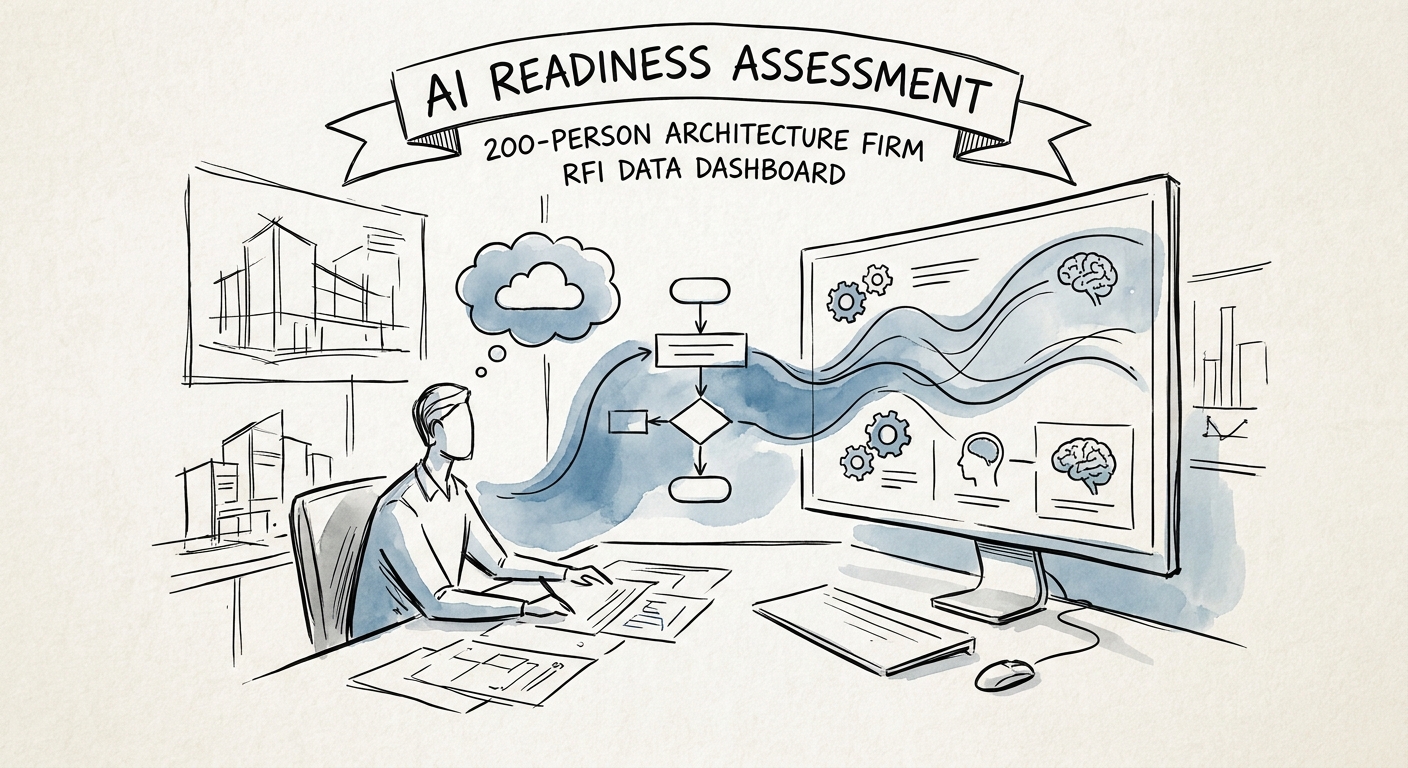
Executing the Readiness Assessment and Workflow Automation
Deploying AI in an architecture firm is a governance challenge masquerading as a technology implementation. Without strict access controls, your staff will inevitably paste proprietary floorplans and sensitive financials into public language models. Gartner's 2025 Professional Services AI Benchmark warns that 61 percent of mid-market services firms are already suffering margin compression due to unmanaged, shadow AI tool sprawl. An AI readiness assessment must identify these liabilities immediately before they result in a data breach or intellectual property loss. We start by mapping the firm's most painful, high-frequency manual workflows: code compliance research, meeting summary follow-up, and specification drafting. Then, we lock down the environment. We establish clear acceptable-use policies and deploy closed, private AI environments where models interact solely with your vetted project archives and standard operating procedures. This approach transforms a reactive liability into a competitive moat. When you integrate a custom AI workflow automation system into your project management stack, you permanently stop paying licensed architects to do administrative data entry. The result is a fundamental shift in your firm's unit economics. You can finally decouple revenue growth from headcount growth, allowing you to take on larger, more complex projects without proportionately scaling your overhead. We measure the success of these implementations strictly by the reduction of non-billable administrative hours and the accelerated velocity of project delivery. To understand how these principles apply across the broader professional services sector, review our AI Readiness for a 150-Person Services Firm playbook. The architecture firms that ruthlessly assess their readiness and automate their administrative scaffolding today will command premium acquisition multiples tomorrow. The rest will simply be priced out of the competitive market by the sheer weight of their own operational overhead.