
The practical answer
- Short answer
- Architecture firms with 25 employees are burning $450,000 annually on unbillable administrative work. Here is the AI readiness assessment to fix your margins.
- Best fit
- Industry: Architecture. Function: Operations
- Operating path
- AI Transformation Strategy → AI Transformation
- Key metric
- 39% Average unbillable time across A&E firms, representing massive margin erosion through administrative tasks.
Architecture firm owners are burning over $450,000 annually by deploying AI to generate conceptual design renderings while completely ignoring the 39% unbillable time tax suffocating their project managers. At 25 employees, an architecture firm transitions from a founder-led boutique into a complex project delivery machine. Yet, when I ask principals about their AI strategy, they proudly show me image generators or automated mood boards. This is a fundamental misallocation of capital. The true margin erosion in a mid-sized practice does not happen on the drafting table; it happens in the administrative scaffolding required to keep projects moving.
In our last engagement with a regional 25-person architecture firm, we found their senior architects were spending up to 12 hours a week manually cross-referencing local building codes and municipal zoning guidelines, drafting responses to Requests for Information (RFIs), and compiling project status updates. According to Deltek's 2024 Clarity Architecture & Engineering Industry Study, average utilization rates hover around 61%, meaning nearly four out of every ten hours worked cannot be billed to a client. If you want to transform your firm's profitability, you must point your AI readiness assessment directly at this unbillable administrative burden.
Before you invest a single dollar in generative design software, you must evaluate how your firm handles textual and operational data. The leap from 10 to 25 employees is where informal communication breaks down and process documentation becomes mandatory. We frequently see firms struggling with this transition, which is why a foundational best first AI use cases for professional services firms strategy focuses on workflow automation rather than creative generation. If your project managers are acting as human routers for emails, CAD files, and meeting transcripts, your firm is not ready for advanced AI. You are simply preparing to automate chaos.
Automation in a mid-sized architecture practice is not about replacing your designers; it is about protecting their billable time from the crushing weight of administrative scaffolding.
The Infrastructure of Readiness: Data, Proposals, and Overhead
Assessing AI readiness for a 25-person team requires a ruthless audit of your firm's knowledge management. Most mid-sized architecture practices treat their past projects as static archives rather than training data. Proposals, feasibility studies, and construction administration logs sit unstructured in scattered SharePoint folders. The AIA's 2024 Firm Survey Report reveals that overhead rates for firms of this size frequently exceed 150% of direct labor costs. To compress this overhead using AI, your systems must be able to securely query past project data to generate new insights. If your team cannot instantly search your historical RFP responses, an AI assistant will fail.
Proposal drafting and RFP response support represent the most immediate path to AI ROI for architecture firms. Principals and senior designers burn countless unbillable hours tailoring past proposals to fit new municipal bids. According to PSMJ's 2024 A/E Financial Performance Benchmark Survey Report, industry average proposal win rates sit stubbornly around 48%, meaning more than half of this exhaustive administrative effort yields zero revenue. Implementing AI to parse a 100-page municipal RFP, extract the compliance requirements, and draft a first-pass response based on your firm's historical wins can reclaim hundreds of hours per quarter. But achieving this requires stringent data hygiene and governance.
We see this pattern constantly: a firm attempts to build a custom GPT to answer proposal questions, only to discover their underlying data is riddled with outdated fee structures and obsolete personnel bios. Readiness means having a single source of truth. As we mapped out in our framework for AI Readiness Assessment for a 10-Person Architecture Firm: Fixing the 39% Unbillable Tax, the principles of data centralization apply exponentially as headcount grows. Furthermore, McKinsey's research on generative AI in professional services indicates that current technologies can automate up to 30% of the time absorbed by these exact types of administrative and reporting tasks. But that 30% capacity expansion is only unlocked if your operational data is structured, tagged, and governed correctly.
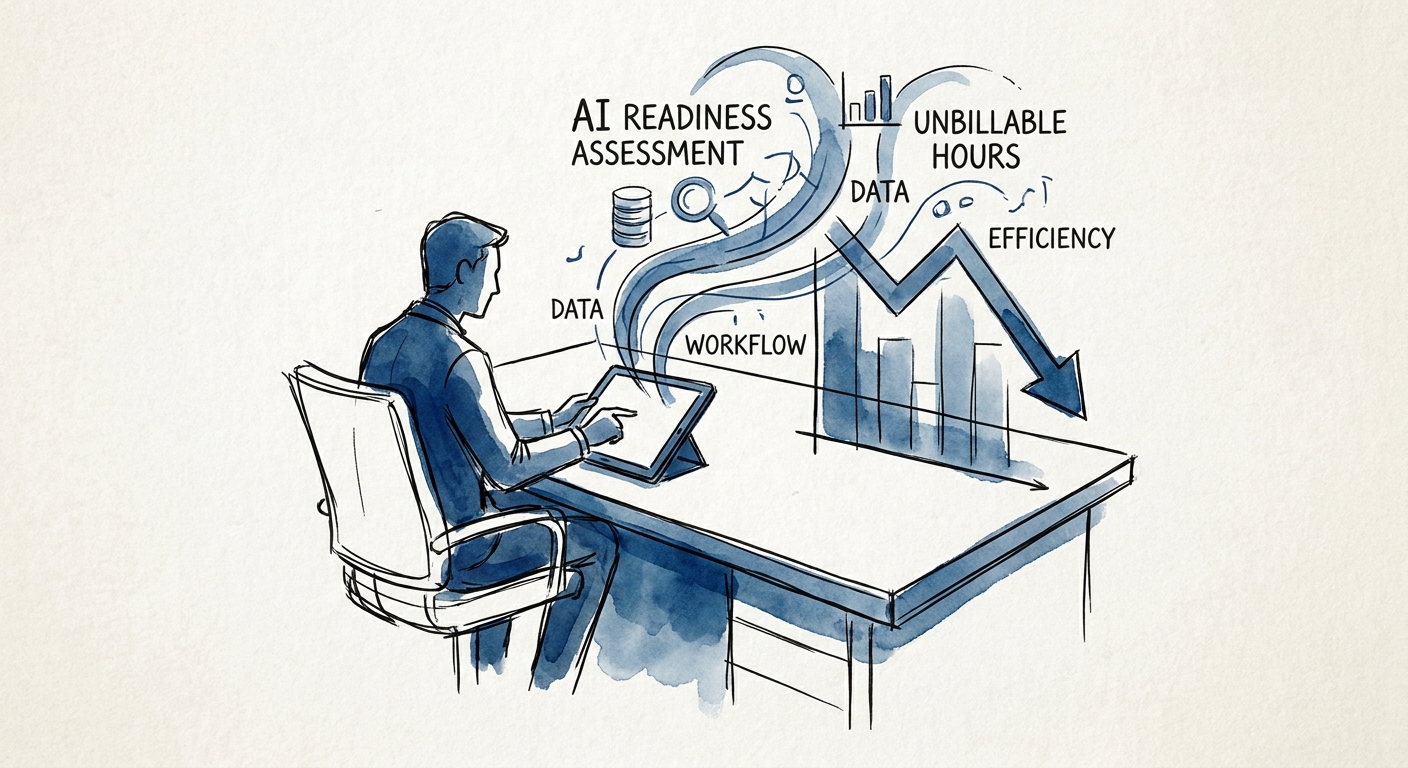
Escaping Pilot Purgatory in Construction Administration
The final pillar of your AI readiness assessment must address operational governance and execution capacity. A 25-person firm is large enough to afford software experimentation, but small enough that a failed rollout can permanently damage team morale. The construction administration phase—specifically RFI handling, submittal reviews, and weekly operations reporting—is ripe for automation. Yet, most firms lack the internal governance to deploy these tools without exposing themselves to liability. You cannot simply unleash an unconstrained large language model on confidential client blueprints and expect compliance.
The data confirms this systemic failure. KPMG's 2024 AI in Professional Services survey found that over 60% of firms struggle to move AI initiatives beyond the pilot phase, citing a lack of clear governance and poorly defined success metrics. In a 25-person architecture firm, the Principal cannot be the sole bottleneck for AI adoption. You need a structured AI acceptable-use policy, designated data owners, and a clear distinction between internal knowledge search tools and client-facing deliverables. If an AI hallucinates a building code interpretation on an RFI response, the liability rests entirely on the Architect of Record. Readiness means having a human-in-the-loop quality assurance framework built into the workflow before the software is ever turned on.
To capture real enterprise value, stop treating AI as a design toy and start treating it as an operational wedge. Focus your first 90 days on a highly constrained, text-based workflow. What Knowledge Management Teams Should Automate First with AI: Proposal Drafting is often the most reliable starting line. By conducting a rigorous readiness assessment that prioritizes data hygiene, standardizes operating procedures, and targets the 39% unbillable administrative tax, your 25-person architecture firm can break through the margin ceiling. Automation is not about replacing your architects; it is about protecting their billable time from the crushing weight of administrative scaffolding.