
The practical answer
- Short answer
- Discover how 10-person architecture firms can use an AI readiness assessment to escape the 39% unbillable time tax, reduce rework, and increase profit margins.
- Best fit
- Industry: Architecture. Function: Operations & Transformation
- Operating path
- AI Transformation Strategy → AI Transformation
- Key metric
- 61% Median utilization rate, meaning nearly two days a week are completely unbillable.
Right now, your 10-person architecture firm is forfeiting exactly 39% of its total capacity to unbillable administrative tasks, proposals, and chaotic client revisions. When I speak with founders of boutique design firms, they often assume AI transformation is a luxury reserved for massive global engineering conglomerates. But the reality of the market tells a completely different story. According to AIA's 2024 Firm Survey Report on firm demographics, approximately 75% of all architecture firms operate with fewer than 10 employees. This means the vast majority of the industry is battling the exact same resource constraints you are, and whoever figures out how to automate the administrative tax first will absorb the market share of those who do not.
The math is unforgiving. Based on Deltek's 45th Annual Clarity A&E Industry Study on utilization, the median utilization rate for architecture firms is just 61%. That means nearly two full days out of every architect's week generate zero direct revenue. In our last engagement with a regional design firm, we saw this exact pattern: highly paid licensed architects spending ten hours a week hunting through local servers for past code compliance notes, manually redrawing standard ADA details, and reconciling disconnected spreadsheets just to keep the project schedule accurate. I have rebuilt this workflow three times for technical service firms, and the lesson is always the same: you cannot scale your profit margin if your most expensive talent is doing administrative data entry. Every hour spent doing low-value data retrieval is an hour stolen from billable design work.
Firms at this size typically hit an artificial ceiling. You bring in more projects, but the sheer volume of unbillable coordination eats the upside. It is why Deltek's 45th Annual Clarity A&E Industry Study on operating profit found that median operating profit on net revenue retreated to just 16.7%. When you operate at a sub-20% margin, one delayed project phase or one bad fee estimate can wipe out your profitability for the quarter. If you want to survive the coming margin collapse, you need AI Transformation Services for Growing Businesses. But before you buy a single AI copilot, you must accurately assess your team's structural readiness to absorb this technology.
You cannot scale your profit margin if your most expensive talent is doing administrative data entry. Every hour spent doing low-value data retrieval is an hour stolen from billable design work.
The Rework and Proposal Death Spiral
In a 10-person firm, every hour lost to project rework or proposal generation is an hour stolen directly from your EBITDA. The core operational problem in architecture isn't a lack of creativity; it is the staggering cost of fixing preventable mistakes and chasing down fragmented communications. According to Autodesk and FMI's 2024 Report on project rework, rework accounts for up to 20% of total project costs. This isn't just bad drafting—it is the inevitable outcome of what happens when client requirements, complex local zoning codes, and strict engineering constraints aren't synthesized perfectly before construction documents are finalized. When a change order hits during construction because a structural column conflicts with a mechanical shaft, the financial penalty always rolls downhill to the architect.
This is where an AI readiness assessment exposes your biggest workflow vulnerabilities. A ready firm isn't one that just bought an AI plugin for Revit or Rhino. A ready firm is one that has digitized its historical project data so that an AI agent can instantly run a quality assurance check against local building codes or past Requests for Information (RFIs). If your principal architects are still manually checking egress widths against municipal PDFs, you are burning billable capacity. When we implement these systems, we don't start with flashy generative design—we start with hardcore risk mitigation. By deploying an internal AI knowledge assistant to pre-screen models for common clashes and code violations, we structurally reduce that 20% rework penalty and protect the project's baseline profitability.
The front-end of your business is just as broken and just as ripe for automation. PSMJ's 2024 Quarterly Market Forecast on AEC proposal activity shows that the pipeline for new work remains highly competitive, requiring intense, unbillable proposal generation efforts to maintain your backlog. Small firms often bleed their top talent dry just putting together customized RFP responses, chasing down sub-consultant resumes, and formulating fee estimates. If your firm is truly ready for AI, this is your primary automation target. A well-trained AI workflow can analyze past successful proposals, extract the relevant firm experience, format the exact deliverables required, and draft an 80% complete response in minutes rather than days.
How to Run Your 10-Person AI Readiness Assessment
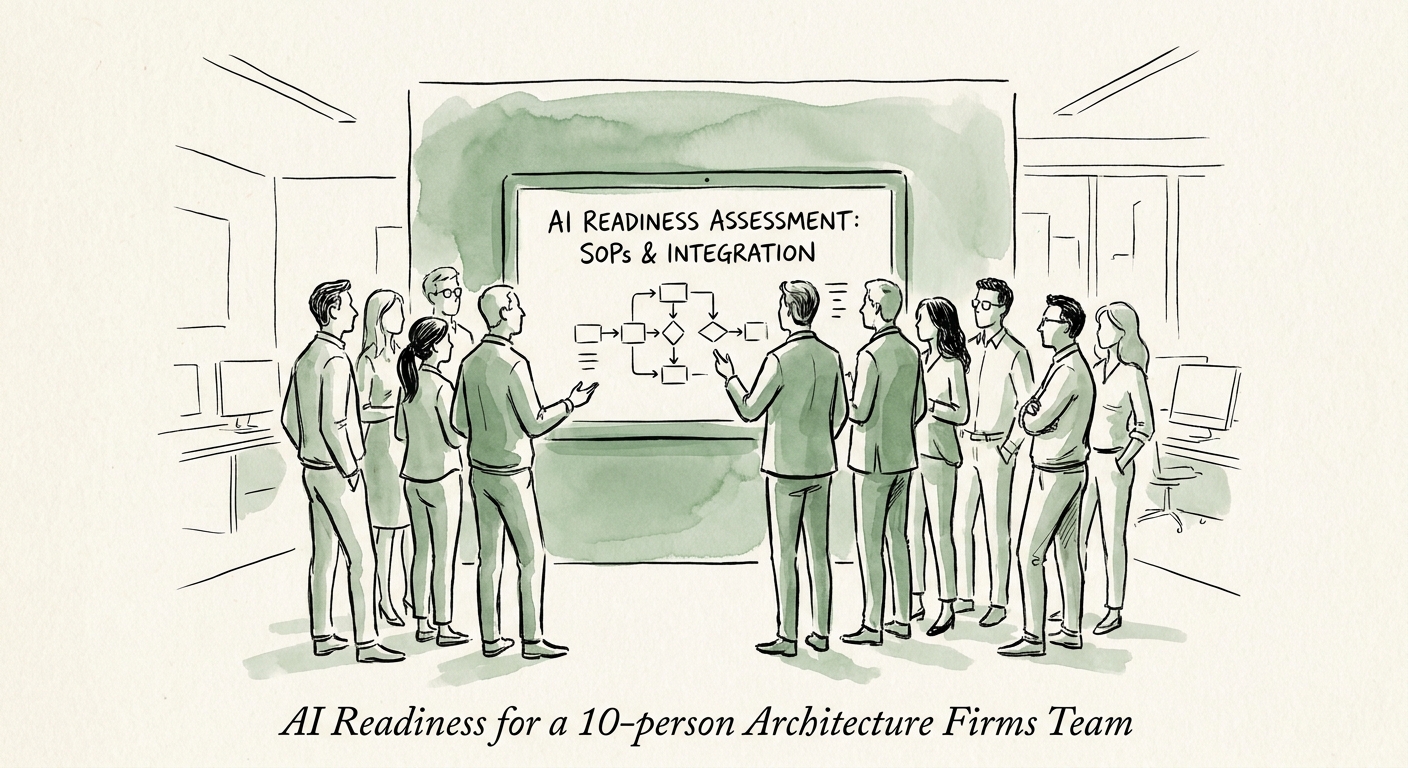
Evaluating AI readiness for a small architecture team requires a ruthless, objective look at how you handle your data and standard operating procedures (SOPs). You cannot automate chaos. If your past project files are scattered across personal desktops, disorganized cloud folders, and siloed email inboxes, no AI tool in the world will save you. The very first step in our readiness diagnostic is the Data Structuring Audit. We evaluate whether your firm has a centralized, clean repository of past specifications, contracts, meeting minutes, and design narratives that a Large Language Model (LLM) can actually read and securely index.
Once your data is clean, you must evaluate your process maturity. The firms that win with AI are the ones that have relentlessly documented their workflows. You need to identify the exact moments where licensed architects are stepping down to do administrative work. I highly recommend reviewing Best First AI Use Cases for Professional Services Firms to map your current processes against proven automation targets. Are you automatically generating your meeting summary follow-ups? Are you using AI to extract structural requirements from dense client briefs? If you cannot clearly define the manual steps in these processes, you are absolutely not ready to automate them. You must map the workflow before you apply the technology.
Finally, you need to establish a rigid governance framework. Even a 10-person firm needs strict, documented rules about what client data can be fed into an AI system and what must remain confidential. You are handling sensitive floor plans, tight financial constraints, and proprietary design concepts that belong to your clients. Your readiness assessment must include the implementation of an acceptable-use policy and a zero-trust data architecture to prevent accidental data leaks. Taking these deliberate steps moves your firm from playing with expensive software toys to building a scalable, high-margin delivery engine. Stop letting unbillable hours dictate your growth ceiling, take control of your operations, and start automating the administrative tax today.
When you complete this readiness assessment and deploy your first AI workflows correctly, the financial impact is immediate. Recovering just 10% of that 39% unbillable time translates directly into hundreds of thousands of dollars in net-new billable capacity for a 10-person team. You don't need to hire more junior draftspersons or administrative assistants; you simply need to unlock the capacity that is currently trapped inside your broken processes. I strongly encourage you to take the AI Opportunity Score to benchmark your firm against your peers and identify exactly where your deepest margin leaks are hiding.