The practical answer
- Short answer
- Discover how 50-person architecture firms can assess AI readiness, fix their 39% unbillable capacity tax, and automate administrative triage safely.
- Best fit
- Industry: Architecture and Design. Function: Operations & Business Development
- Operating path
- AI Transformation Strategy → AI Transformation
- Key metric
- 60% Failure rate for AI pilots that bypass strict data hygiene and governance phases.
For a 50-person architecture firm, the true cost of unbillable administrative triage—searching for past project details, drafting RFIs, and formatting proposals—is a hidden 39% capacity tax that AI can reclaim today. When you lead a firm of this size, you occupy a challenging middle ground. You are competing with large corporate design firms for major civic and commercial projects, but you lack their massive back-office support infrastructure. Every hour your senior architects spend hunting for a specific door hardware schedule from a three-year-old project is an hour they aren't billing for high-value design, site visits, or critical client management.
According to BLS 2024 Architectural Services Labor Productivity Data, highly compensated design professionals lose massive portions of their workweeks to non-core administrative duties, dragging down overall firm margins. In our last engagement with a mid-sized regional architecture firm, we discovered their principals and senior project managers were spending nearly two days a week exclusively on proposal scoping, contract review, and managing the intake of submittals. They thought they had a hiring problem; in reality, they had a data retrieval problem.
This isn't just an anecdotal observation from our consulting practice. McKinsey's 2024 Generative AI in Real Estate and Design analysis highlights that generative AI could unlock up to $180 billion in value for the broader construction and design ecosystem by directly automating these exact pre-construction and design administration bottlenecks. The question isn't whether AI can parse your old drawing sets or RFP documents; it's whether your firm is structurally ready to deploy it. Without a rigorous baseline assessment, you will likely buy off-the-shelf tools that hallucinate because they cannot interface securely with your specific proprietary history. For firms looking to aggressively protect their margins, diagnosing these unbillable leaks is the first step toward building AI Transformation Services for Engineering Services Firms. You simply cannot automate chaos.
We thought they had a hiring problem; in reality, they had a data retrieval problem. You cannot automate chaos.
Taking Stock of Your Firm's Data Infrastructure
To properly assess your AI readiness, we must look at the three critical data pillars that govern an architecture firm: your proposal archive, your standard specification library, and your historical project communications (including RFIs and submittals). Consider the burden of LEED certification documentation or compiling code compliance matrices. These tasks require parsing hundreds of pages of municipal codes and matching them against your project specifications. When an AI tool attempts to draft a response to a complex client RFP, it relies entirely on the cleanliness of the data it retrieves. If your firm has five different versions of a "past performance" summary scattered in various project folders, the AI will arbitrarily select one, potentially generating inaccurate or outdated claims.
Gartner's 2024 Enterprise Generative AI Deployment Forecast reveals that organizations that bypass data hygiene and governance phases experience a 60% failure rate in their initial AI pilots. Readiness at the 50-person scale means establishing a "single source of truth" for your intellectual property. We recommend starting with a narrow, highly structured dataset. For example, aggregating your last three years of successful RFP responses and fee proposals into a sanitized, searchable vector database. This creates an immediate foundation for a Retrieval-Augmented Generation (RAG) system, enabling your business development team to generate first-draft proposals in minutes rather than days.
PwC's 2024 Global AI Economic Impact Study emphasizes that middle-market professional services firms that implement strict data governance before AI deployment achieve ROI three times faster than those that skip this step. This structural readiness is exactly why evaluating the Best First AI Use Cases for Engineering Services Firms matters so deeply. If you start with a highly complex, unstructured workflow—like having an AI try to interpret raw CAD files or BIM models without human oversight—you will fail. You must begin by automating the text-heavy, repetitive administrative burdens that surround the design process, ensuring your AI models have a clean, walled garden of text to operate within.
Implementing Security Governance and Execution Roadmaps
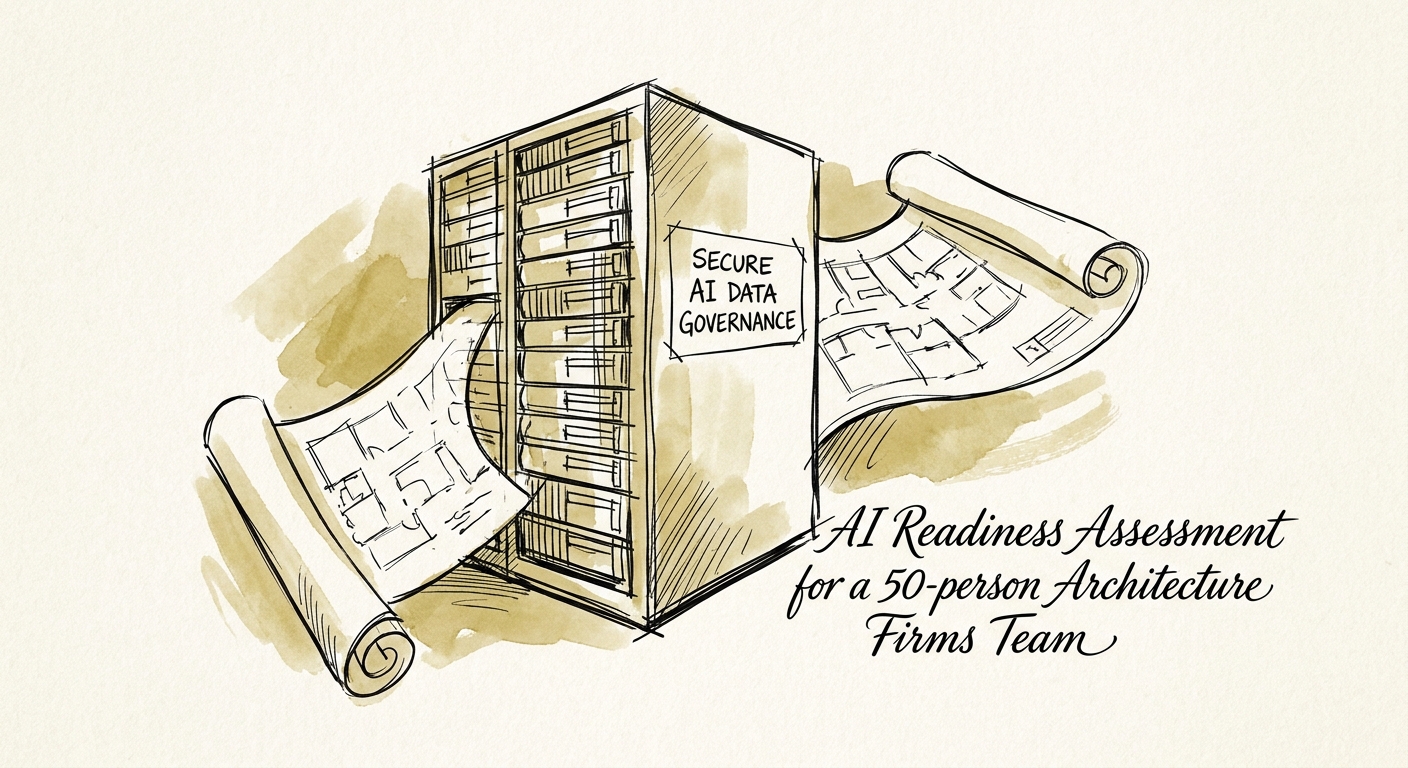
Once your data hygiene is addressed, a 50-person architecture firm must urgently focus on deployment governance. Who has access to the AI tools? What client data is permissible to feed into public or private models? We frequently see well-meaning project architects uploading confidential client floor plans, proprietary cost estimates, or unreleased civic bids into public instances of ChatGPT to summarize data quickly. This represents a massive professional liability. Establishing a strict acceptable-use policy and deploying a private, ring-fenced AI environment is a non-negotiable step in your readiness journey.
MIT Sloan's 2024 AI Organizational Readiness Framework points out that 74% of mid-market executives cite security and intellectual property leakage as their primary barrier to scaling AI, yet fewer than half have enacted formal AI governance policies. A comprehensive readiness assessment must also evaluate your technology stack’s interoperability. If your firm relies on legacy on-premise servers rather than modern cloud-based environments, integrating AI workflows becomes significantly more expensive and complex.
The path forward requires a systematic approach. A readiness assessment should map exactly where your senior staff spends their non-billable time, index the state of your historical project data, and identify the specific governance gaps exposing you to risk. By isolating the 10-15 hours a week that your principals spend on administrative triage, you can build a highly specific business case for your first pilot. We typically advise firms to follow a structured rollout, much like The Operator's AI Roadmap for a 50-Person Business, prioritizing high-frequency, low-risk text workflows first.
AI is not going to replace the professional judgment, spatial creativity, or licensure of your architects. However, architecture firms that successfully deploy AI to eliminate this massive administrative tax will simply out-bid, out-deliver, and out-earn the firms that continue to force their most expensive talent to act as highly paid data-entry clerks. Capturing this value starts with an unflinching assessment of your current operational reality.