
The practical answer
- Short answer
- Stop bleeding unbillable hours. Learn how 10-person accounting firms assess their AI readiness, fix data governance, and automate administrative workflows.
- Best fit
- Industry: Accounting & Financial Services. Function: Operations & Administration
- Operating path
- AI Transformation Strategy → AI Transformation
- Key metric
- 7.5 Day reduction in monthly close time achieved by deploying generative AI for structured financial tasks.
The Hidden Cost of the Pitch-In Culture
A ten-person accounting firm bleeds roughly $450,000 in unbillable capacity every year simply chasing client signatures, mapping trial balances, and drafting routine variance notes—yet most partners assume they aren't big enough for AI transformation. I hear this hesitation constantly when we assess boutique firms. Partners believe that artificial intelligence is a playground reserved for the Big Four, requiring massive IT budgets and dedicated data science teams. This is a fundamental misunderstanding of what AI readiness actually means in 2026. Readiness at this scale is not about building custom large language models; it is about establishing the operational discipline to stop your highest-paid professionals from acting as glorified administrative assistants.
In our recent engagements, we have consistently found that as boutique firms grow, the "everyone pitches in" culture creates a massive margin leak. Highly compensated tax managers spend hours manually categorizing unstructured client expense data or hunting down missing W-2s. AICPA's 2024 CAS Benchmark Survey reveals that accounting professionals lose roughly 17% of their total time to non-billable administrative tasks. For a 10-person firm billing at average market rates, that 17% represents nearly half a million dollars in lost revenue capacity.
When we step in to conduct an AI readiness assessment, the first thing I look at is how the firm currently handles this unstructured chaos. You cannot automate a broken process. Partners mistakenly assume that simply purchasing the latest AI add-on for their existing tax software will magically resolve their capacity issues. But technology only amplifies your underlying workflow. If your client intake process relies on seven different email threads and fragmented PDF attachments, an AI tool will simply hallucinate faster. The firms that are actually prepared for transformation are the ones willing to standardize their data ingestion first. In fact, PwC's 2025 AI in Accounting study found that firms deploying generative AI for structured monthly close tasks achieved a 7.5-day reduction in close time, fundamentally shifting their capacity from routine back-office work to high-margin advisory services. To get there, you need a baseline of process hygiene. Check out our guide on The Best First AI Use Cases for Accounting Firms to see where this journey typically begins.
The golden rule of AI transformation in professional services is this: automate the administration, not the advice. Your clients pay you for your professional judgment and fiduciary oversight, not for your ability to collate PDFs.
The Shadow IT Reality for Boutique Firms
Assessing the AI readiness of a 10-person team requires looking past the software and directly at the firm's talent and governance models. At this size, you do not have a dedicated Chief Information Officer or an internal IT helpdesk to govern tool usage. Instead, you have accountants who are likely experimenting with public AI tools on their own. This creates a massive shadow IT problem and severe data privacy risks. We saw this exact pattern at a regional firm last quarter: junior staff were pasting sensitive client financial data into public ChatGPT windows to generate variance explanations, completely unaware that they were violating confidentiality agreements.
A true readiness assessment identifies these gaps before they become liabilities. You need at least one tech-forward champion within the 10-person team who can own the deployment, security, and standardization of the AI tools. Gartner's 2025 Finance AI Readiness research indicates that less than 30% of finance teams possess the necessary digital talent to govern AI securely. If you do not have someone who understands the difference between a secure, enterprise-tenant AI environment and a public web interface, you are not ready to deploy these tools.
Furthermore, the market is moving incredibly fast, and your competitors are not waiting for you to feel comfortable. A Thomson Reuters' 2025 AI in Accounting Survey revealed that over 20% of tax professionals are already actively using generative AI to handle research, document summarization, and preliminary data extraction. If your team is still manually typing data from scanned receipts into a ledger, your firm will quickly find itself priced out of the market by competitors operating with AI-augmented margins. The readiness diagnostic forces partners to confront their own operational bottlenecks. We evaluate whether the firm has documented standard operating procedures for routine tasks. If the steps to reconcile a specific client's accounts live entirely inside a senior manager's head, an AI agent cannot replicate that work. For a deeper dive into evaluating these exact dimensions, I highly recommend reading our AI Readiness Assessment for SMBs: The 8 Dimensions That Matter.
The Automation Roadmap: Administration Over Advice
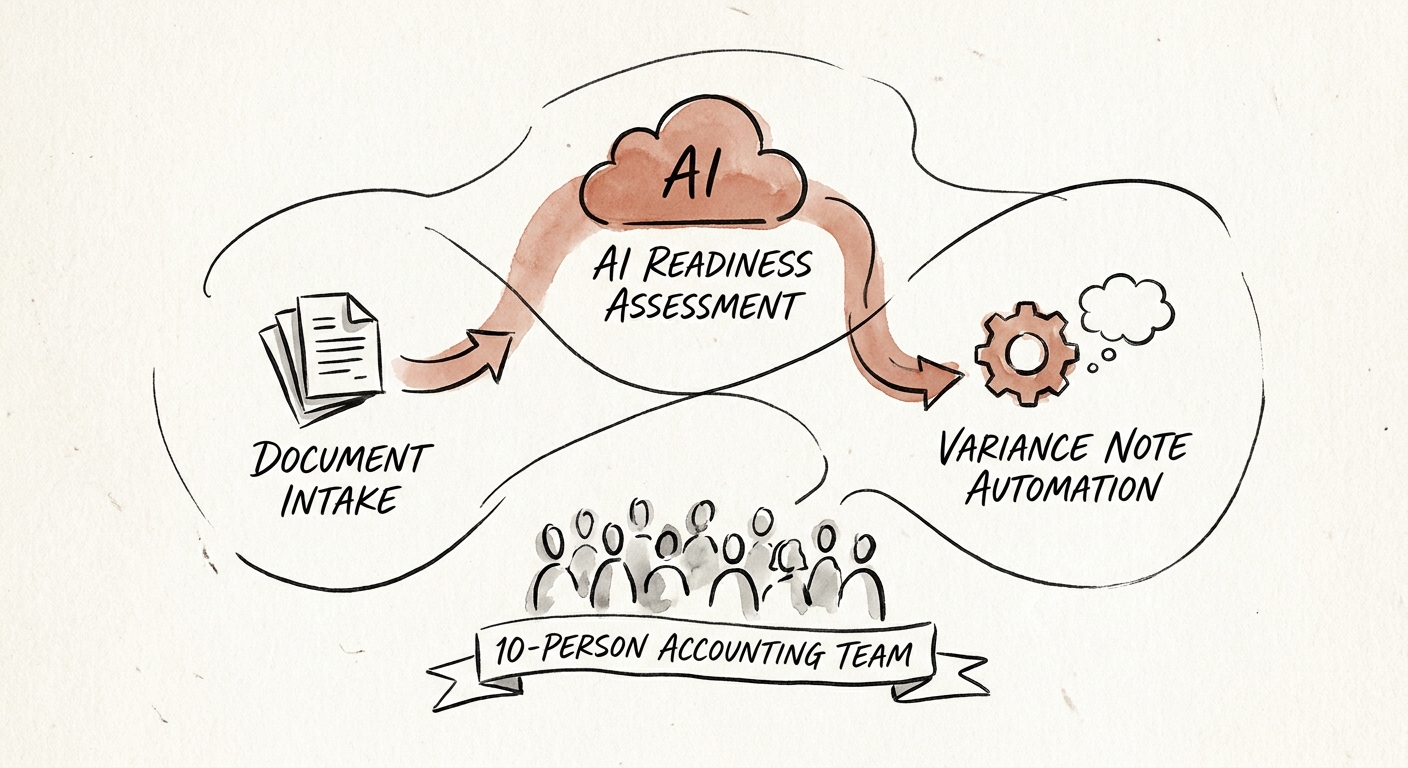
The final phase of a 10-person firm's AI readiness assessment focuses on roadmap sequencing. The most common mistake I see partners make is attempting to automate complex, high-risk advisory work right out of the gate. They want the AI to generate complete tax strategies or write finalized audit opinions. This is a recipe for disaster. The golden rule of AI transformation in professional services is this: automate the administration, not the advice. Your clients pay you for your professional judgment and fiduciary oversight, not for your ability to collate PDFs.
We build roadmaps that target the mundane, repetitive tasks that drain your team's energy and utilization rates. Document intake, client email triage, initial variance note drafting, and basic account reconciliations are the perfect starting points. By pointing AI at these operational friction points, you buy back the capacity needed to grow your advisory practice without increasing headcount. McKinsey's 2025 survey of finance leaders underscores this reality, showing that 44% of proactive CFOs are already deploying generative AI across more than five distinct operational use cases to drive efficiency. They are not replacing their accountants; they are augmenting them.
For a 10-person accounting firm, the ROI of getting this right is transformational. Reclaiming just 10 hours a week per employee effectively adds more than two full-time equivalents to your capacity, allowing you to take on new clients or launch higher-margin advisory services. But this requires you to treat your firm's internal operations with the same rigor you apply to a client's tax return. Start by locking down a secure, ring-fenced AI environment, documenting your highest-volume workflows, and training your team on prompt engineering for specific administrative tasks. If you are wondering which specific administrative workflows yield the highest immediate return, start by reviewing our guide on automating your finance variance notes with AI. Transformation is entirely achievable at your scale, but it demands that you stop acting like a technician and start operating like an owner.