
The practical answer
- Short answer
- Discover why 100-person accounting firms bleed $2.4M annually in data entry, and learn how an AI readiness assessment protects your margins and governance.
- Best fit
- Industry: Accounting. Function: Operations
- Operating path
- AI Transformation Strategy → AI Transformation
- Key metric
- $2.4M Annual unbillable data extraction tax for a typical 100-person accounting firm.
The $2.4M Data Janitor Trap
A 100-person accounting firm is currently bleeding roughly $2.4M annually in unbillable data extraction—chasing down K-1s, reconciling messy bank feeds, and standardizing client uploads—long before a single hour of advisory work begins. Partners read about generative AI and immediately assume they can buy a copilot to instantly automate their tax prep and audit reviews. The first readiness question is not which model to buy; it is whether client documents, permissions, and review workflows are stable enough for automation to improve margin without increasing risk. When highly credentialed professionals spend their mornings playing hide-and-seek with client bank statements or manually keying data from scanned PDFs into your tax software, your firm's profitability collapses. When you attempt to overlay advanced language models onto chaotic, unstructured client folders, you simply accelerate the creation of errors. According to McKinsey's 2024 analysis on the economic potential of generative AI, these models can automate up to 31% of accounting and auditing workflows, but only if the underlying data is machine-readable. Right now, yours is not.
In our last engagement with a mid-market regional accounting firm, we found their CPAs were acting as highly-paid data janitors. They were spending up to 15 hours a week just normalizing trial balances and renaming client PDFs before touching the actual tax strategy. The opportunity cost is massive; every hour spent on data entry is an hour not spent on high-margin tax strategy or fractional CFO services. This is the manual tax that destroys margins during busy season. The problem is widespread. PwC's 2025 AI Business Survey reveals that 62% of finance leaders cite unstructured data as their primary bottleneck for AI readiness. Before you spend a single dollar on an AI transformation initiative, you must assess whether your firm's data ingestion process can actually support automation. If clients are still emailing sensitive documents with random file names to individual partner inboxes, your AI readiness score is zero. You must fix the ingestion layer first. For a deeper dive on this structural shift, review our guide on AI transformation services for growing businesses.
You cannot automate a broken foundation. When you attempt to overlay advanced language models onto chaotic, unstructured client folders, you simply accelerate the creation of errors.
The Governance Prerequisite: Stop Indexing Chaos
The second pillar of an AI readiness assessment for a 100-person accounting team is strict data governance. When a firm deploys an internal AI knowledge assistant or a document extraction tool, that AI needs a perimeter. If your file permissions are loose, a junior accountant's prompt could inadvertently pull up the compensation details of a partner or the highly confidential M&A financials of a flagship client. According to Deloitte's 2025 Mid-Market AI Adoption Study, a staggering 65% of mid-market firms lack the necessary data governance frameworks for secure AI agent deployment. The security implications are severe. Accounting firms hold the most sensitive financial data on the planet. A data breach caused by a misconfigured internal AI tool is an existential threat to your firm's reputation. You must enforce role-based access controls at the document level before you let an LLM index your shared drives.
We consistently see firms trying to skip this step because governance feels like an administrative burden rather than a revenue driver. But poor governance is exactly what causes the rework loops that destroy realization rates. A readiness assessment maps these vulnerabilities before you expose a single document to an algorithmic layer. Gartner's 2024 Autonomous Finance Report indicates that mid-market finance teams spend 30% of their capacity on manual data reconciliation and rework caused by bad inputs. If you do not standardize how documents are tagged, stored, and verified, the AI will confidently hallucinate financial summaries based on outdated drafts. We evaluate this heavily during our readiness assessments. We look at your document intake portals, your naming conventions, and your client communication protocols. As detailed in our breakdown of When Not to Automate Document Intake with AI: The Governance Guide, if human operators cannot follow a standardized intake workflow, a machine certainly cannot.
The Pragmatic Roadmap: What to Automate First
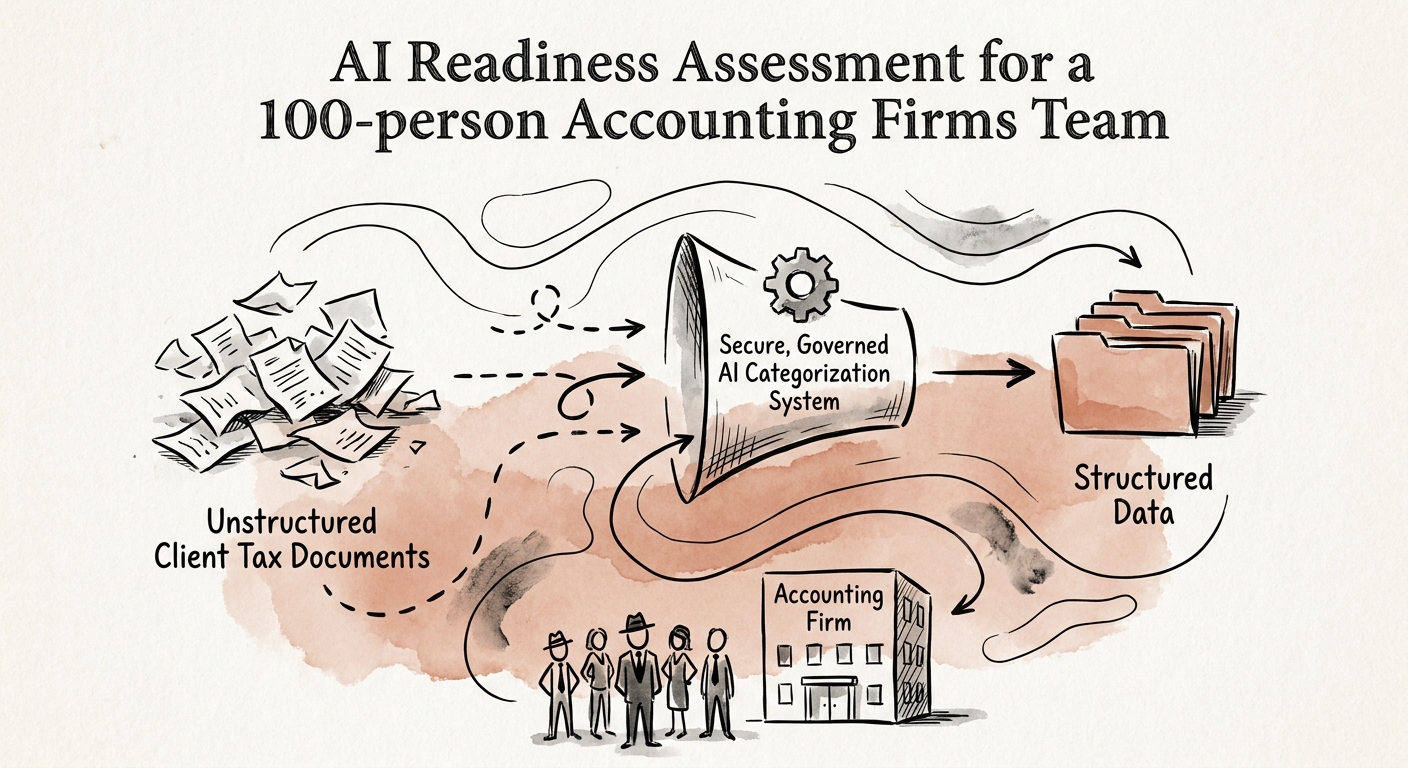
Once you have standardized intake and locked down governance, you can begin deploying AI workflows that actually expand your margins. For a 100-person firm, the goal is not to replace the CPA; the goal is to extract the CPA from the administrative scaffolding of the engagement. However, you must choose your first use cases based on structured predictability, not hype. KPMG's 2024 Tax Reimagined Survey found that 59% of tax and finance leaders identify data quality as the biggest barrier to AI deployment, which is why your first workflow should focus on structuring that data. We recommend starting with automated document categorization and data extraction from standard IRS forms.
Moving from Assessment to Execution
Your readiness assessment should yield a specific 90-day roadmap. In month one, you standardize the client portal and eliminate email-based document submission. In month two, you deploy an AI workflow to automatically classify incoming PDFs—identifying W-2s, 1099s, and K-1s—and routing them to the correct client folder with a standardized naming convention. In month three, you implement extraction models to pull key-value pairs from those documents directly into your tax software preparation queue. This sequence reclaims the unbillable hours that burn out your staff. Firms that attempt to run before they walk inevitably end up with frustrated staff and skeptical partners who declare that AI doesn't work for accounting. It works perfectly well, provided you respect the operational prerequisites. To explore the exact sequence we use, read The Best First AI Use Cases for Accounting Firms.
The firms that win in the next five years will not be the ones with the flashiest language models; they will be the ones with the cleanest data pipelines. Do not buy a $60,000 enterprise AI pilot until you know exactly which manual workflow it will replace and how you will measure the recovered capacity. A proper AI readiness assessment stops you from buying a solution in search of a problem. If your 100-person firm is serious about escaping the billable hour trap and transitioning to higher-margin advisory work, you need to know exactly where you stand today. Start by taking our AI Opportunity Score to quantify your operational baseline, and then we can build the infrastructure required to scale your firm securely.