
The practical answer
- Short answer
- A 200-person accounting firm bleeds roughly 40% of its capacity to non-billable tasks. Learn how to diagnose AI readiness and reclaim your margins.
- Best fit
- Industry: Accounting. Function: Operations
- Operating path
- AI Transformation Strategy → AI Transformation
- Key metric
- 40% The average unbillable capacity tax hitting professional services margins before the year even begins.
A 200-person accounting firm bleeds roughly 40% of its total capacity to non-billable administrative tasks—a staggering manual tax that destroys margins before the fiscal year even begins. Yet, despite pouring capital into new technology, the Boston Consulting Group's 2026 AI Radar report reveals that the median ROI on enterprise AI projects remains stuck at just 10%, completely missing the 20% target most CFOs demand. Why the massive disconnect? Because accounting firms are buying generic AI chatbots instead of fixing their underlying operational workflows.
I see this exact failure pattern every single week. In our last engagement with a mid-market accounting group, we found highly paid CPAs spending 14 hours a week hunting down missing client documents, standardizing workpapers, and classifying unstructured email attachments. When a firm has 200 employees, an analysis by Harvard Business Review on professional services capacity highlights how quickly that 40% unbillable rate scales: it equals 80 full-time equivalents doing nothing but administrative scaffolding. At an average fully loaded cost of $120,000 per employee, that is a $9.6 million margin leak hiding in plain sight.
You cannot solve a $9.6 million process failure by simply giving your tax associates a Copilot license and hoping for the best. Real AI transformation strategy requires diagnosing the exact workflows that consume the most unbillable time across your entire practice. If you do not map the specific intake bottlenecks and reporting delays, you are simply paying a vendor premium to automate your existing chaos. Before buying any new software, operators must complete a rigorous AI readiness assessment tailored specifically to their revenue model and team structure.
You cannot solve a $9.6 million process failure by simply giving your tax associates a Copilot license and hoping for the best.
Diagnosing AI Readiness in the Mid-Market
Evaluating your team's readiness for AI means looking past glossy vendor demos and scrutinizing your core data architecture. If your firm relies on fragmented client portals, legacy on-premise document storage, and messy CRM records, your automation efforts will fail upon launch. A recent KPMG survey of US finance functions found that 62% of organizations are currently using AI to a moderate or large degree, but the ones seeing actual financial ROI are those that secured their data layer first.
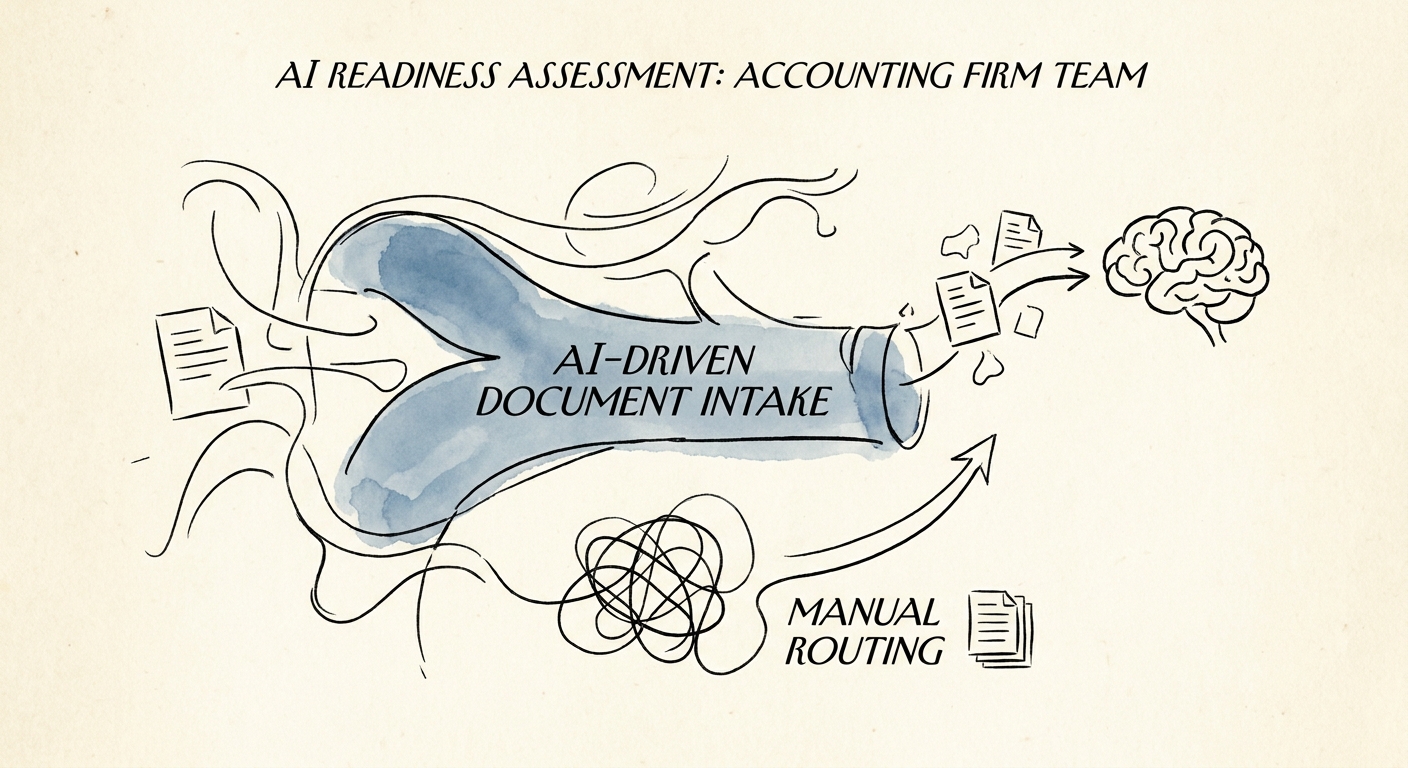
The true diagnostic process begins with document intake and classification. Every tax season, your administrative team acts as a human API, downloading forms from emails, renaming PDFs, tracking down missing schedules, and routing them to the correct partner. We rebuilt this exact workflow at a 150-person firm last year, replacing their manual routing with an AI-driven document intake pipeline. The result? We cut document processing time by 73% and completely eliminated the dreaded "missing file" escalation loop that frustrates clients. If your firm still relies on human eyes to verify whether a client uploaded a W-2 or a 1099, you are perfectly positioned for your first major AI win.
Another critical readiness indicator is your pipeline data quality and client communication standards. Deloitte's 2025 research on Agentic AI points out that trust and data integrity remain the largest barriers to deployment in finance teams. You must lock down your data governance before unleashing an AI agent to draft client communications or analyze tax liabilities. This is why we tell our clients to focus heavily on CRM cleanup and structured data extraction before attempting complex generative AI tasks. A clean data foundation is non-negotiable.
The Execution Roadmap: From Pilot to Profitability
To capture the massive margin expansion available in 2026, you have to sequence your AI implementations meticulously. Start with narrow, deterministic workflows that deliver immediate relief to your most expensive talent. The goal is never to replace your CPAs; the goal is to extract them from the administrative quicksand so they can focus on high-value advisory work.
The first step on your execution roadmap should be an audit of your technical infrastructure and computing capacity. Bain & Company's 2025 Global Technology Report reveals that enterprise AI computing requirements are surging at twice the rate of Moore's Law, putting massive strain on unprepared IT departments. If your internal IT team cannot handle the secure integrations required, you will need to partner with specialized engineers who can build private, ring-fenced data enclaves for your client information. Accounting firms simply cannot risk a compliance breach by feeding sensitive financial data into public language models.
In practice, we always deploy a phased implementation approach. Month one focuses strictly on standardizing the inputs—forcing all client documentation through a single digital funnel. Month two layers on optical character recognition and natural language processing to automatically tag, summarize, and route those documents. By month three, the AI workflow is drafting preliminary variance notes and flagging missing information autonomously, allowing the CPA to step in strictly as an expert editor. This is how you build a scalable AI workflow automation that actually hits your ROI targets. If you want to know exactly where your 200-person firm stands today, evaluate your processes against our AI Opportunity Score. It will pinpoint the specific workflows bleeding your margins and provide a roadmap to reclaim your capacity.