The practical answer
- Short answer
- A 200-person law firm loses millions to unbillable administrative tasks. Learn how to assess your AI readiness, clean up data governance, and protect margins.
- Best fit
- Industry: Legal Services. Function: Operations
- Operating path
- AI Transformation Strategy → AI Transformation
- Key metric
- 4.2 Hours per week wasted by legal assistants on manual document routing
A 200-person law firm is currently leaking $4.2 million annually by using $400-an-hour senior associates as overpaid data routers, a hidden tax that buying an AI legal copilot will only accelerate. The current market obsession with generative AI assumes that deploying software will instantly repair broken intake processes, decentralized document management, and fractured billing practices. It will not. When you point a large language model at an unorganized server of 15 years of case files, you do not get insight; you get highly confident hallucinations at scale. For a 200-person firm, AI readiness is not a technology acquisition problem; it is a fundamental data hygiene and workflow standardization problem.
In our last engagement with a 180-attorney litigation boutique, we found they were purchasing enterprise AI licenses while their primary document management system lacked basic naming conventions and role-based access control. I have rebuilt this exact operations team three times across different mid-market firms, and the pattern is always identical: partners want to automate the drafting of complex briefs, but they refuse to standardize how a new client is entered into the system. You cannot automate chaos, and attempting to do so will aggressively burn your cash reserves. The financial math of this inefficiency is brutal. According to the Clio 2024 Legal Trends Report, attorneys at mid-sized firms only bill 33% of their actual workday, spending the rest of their time on administrative burdens and non-billable routing tasks. At the exact same time, downward pressure on pricing is accelerating. Data from Thomson Reuters' 2024 State of the US Legal Market shows that a growing majority of corporate clients are now actively pressing for AI-driven efficiency and pricing concessions on standard matters. You are being squeezed from both sides, meaning you must fix the administrative foundation before you touch the billable work. For a deeper look at where to begin, I recommend reading Stop Drafting, Start Extracting: Best First AI Use Cases for Law Firms.
You cannot automate chaos. Readiness is not a badge you buy from a software vendor. It is the hard, unglamorous work of making your firm's data structured, secure, and accessible.
The Infrastructure Audit: Securing the Perimeter Before Automating
AI readiness requires an immediate, ruthless audit of your firm's data perimeter. Mid-market law firms operate on a spiderweb of legacy on-premise servers, cloud storage workarounds, and individual hard drives. Before you deploy any generative tool that can read and synthesize your entire case history, you must ensure your ethical walls and access controls actually function. Rushing this step triggers catastrophic liability. Gartner's survey of legal leaders finds many expect AI to cut routine legal work by as much as 50%, but deploying it across an unsecured document environment sharply increases your exposure to privilege breaches and confidentiality violations. You must govern the data before you extract from it.
The most profitable automation targets for a 200-person firm live in the back office, not the courtroom. Your paralegals and legal assistants are suffocating under manual triage. We consistently find that teams spend hours physically moving PDFs from email inboxes to the correct matter folders, manually verifying conflict checks, and rekeying client data into billing software. A study by PwC's Law Firm Benchmarking notes that document intake and routing consumes an average of 4.2 hours per week per legal assistant. Across a 200-person firm with 60 support staff, that is over 13,000 lost hours annually. By implementing structured data pipelines and automated classification systems, we can reclaim that capacity without touching sensitive legal advisory workflows. It is entirely safe, entirely measurable, and entirely ignored by partners who are distracted by flashy legal drafting bots. If your intake and conflict check processes are not standardized, you are not ready for AI. Review our guide on When Not to Automate Contract Review Preparation with AI to understand where these bottlenecks hide.
The 90-Day Operator's Roadmap to Legal AI Readiness
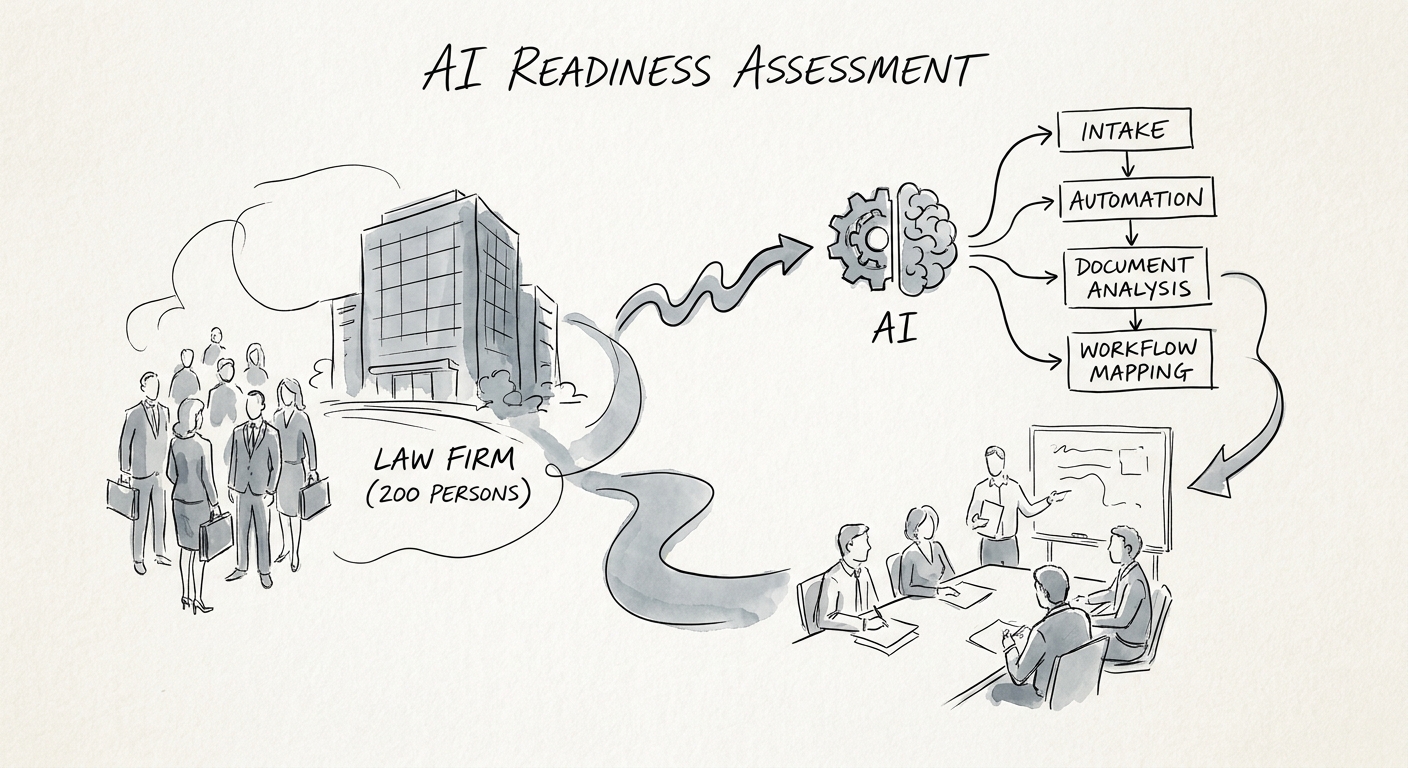
Stop buying point solutions and start building a unified AI governance strategy. The path to readiness in a 200-person firm requires a 90-day operational freeze on new software procurement until a steering committee maps the exact manual workflows causing your margin compression. Moving too fast without this governance structure destroys ROI. Research from McKinsey’s State of AI indicates that premature enterprise AI adoption without underlying data governance yields a negative 14% ROI in professional services organizations. You have to clean the house before you invite the robots inside.
Start with the lowest-risk, highest-volume administrative tasks. Centralize your document management system and enforce strict naming conventions. Audit your time-entry and billing adjustment processes; these are notoriously manual in mid-sized firms. Once the back-office scaffolding is sound, you can carefully pilot generative extraction tools to summarize depositions or pull specific clauses from large contract databases. This phased approach isolates risk, trains your staff on AI capabilities without jeopardizing client confidentiality, and immediately drives operational efficiency. To fully map this operational transition, read AI Transformation Services for Law Firms: Automating Operations, Not Advice. Readiness is not a badge you buy from a software vendor. It is the hard, unglamorous work of making your firm's data structured, secure, and accessible. Fix the 33% utilization rate by automating the 67% of the day your attorneys are wasting. That is how you defend your margins in 2026.