
The practical answer
- Short answer
- A 100-person architecture firm forfeits 39% of its capacity to unbillable time. Learn how to conduct an AI readiness assessment to defend your profit margins.
- Best fit
- Industry: Architecture. Function: Operations
- Operating path
- AI Transformation Strategy → AI Transformation
- Key metric
- 61% Average utilization rate for architecture firms, leaving 39% of capacity unbillable.
The 39% Unbillable Tax in Architecture
A 100-person architecture firm quietly forfeits roughly 39% of its total operational capacity—exceeding $4.5 million in payroll annually—to unbillable administrative tasks, RFP generation, and scattered document search. We are currently watching regional design firms suffocate under the weight of administrative bloat while managing partners wonder why their EBITDA remains flat despite record pipeline volume. The problem is not your fee structure. The problem is how you manage project data and allocate senior talent.
In our last engagement with a regional architecture firm of exactly this size, I rebuilt their project administration workflows from the ground up because their most expensive architects were spending 15 hours a week processing RFIs and cross-referencing submittals instead of designing. This is a systemic failure of operations, not a failure of individual time management. According to Deltek's 45th Annual Architecture & Engineering Clarity Study, firm utilization rates are stubbornly stuck at 61%, meaning nearly four out of every ten hours worked cannot be billed to a client.
Before you evaluate generative design tools or AI rendering engines, you must address this unbillable tax. An AI readiness assessment for a mid-sized firm must strip away the hype and focus purely on margin defense. I consistently tell managing partners that their first AI use case should not touch CAD or Revit. It should focus entirely on the administrative scaffolding that surrounds the design process—the meeting minutes, the site observation reports, and the code compliance checks. If you want a deeper look at this dynamic, we recently detailed the first AI use case that pays for itself in a professional services firm. Until you fix the 39% leak, adding AI to your design process only helps you lose money faster.
Stop treating AI as a design toy and start treating it as your primary margin defense strategy.
Evaluating Your Firm's Data Infrastructure
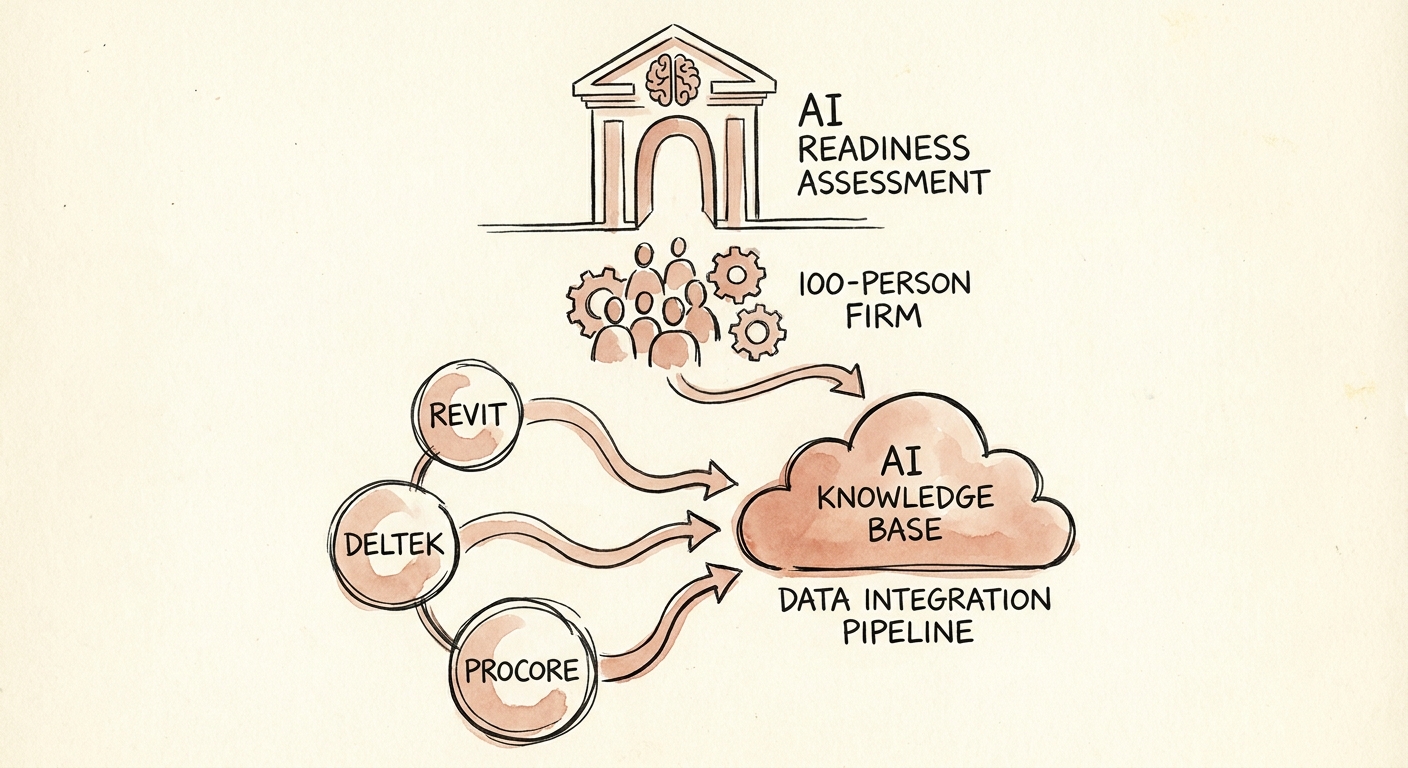
Artificial intelligence is not a magic solution that sits on top of broken processes; it is a direct reflection of your underlying data pipeline. At 100 employees, an architecture firm typically runs a highly fragmented technology stack. You likely have financial data locked in Deltek Vantagepoint, project communications in Procore or Newforma, and 3D models in Revit, with thousands of disorganized PDFs and emails scattered across SharePoint. If these systems are not integrated and standardized, an AI agent will simply hallucinate answers based on incomplete data.
We saw this exact pattern at a commercial architecture client last year. The partners wanted to implement an AI assistant to cross-reference local building codes against their schematic designs. However, their past project data was completely unstructured, and their naming conventions changed depending on which project manager was assigned to the job. McKinsey's 2024 Generative AI in Construction Analysis reveals that 72% of AEC firms operate with highly fragmented data environments, making enterprise AI deployment nearly impossible without foundational cleanup. You cannot automate chaos.
Your readiness assessment must begin with a ruthless audit of your project lifecycle documentation. You must standardize how RFPs, meeting minutes, submittals, and site observation reports are tagged and stored before you ever buy an AI license. With the Bureau of Labor Statistics 2024 Wage Data for Architects showing accelerating compensation costs, you cannot afford to pay licensed professionals to act as data janitors. If your firm is struggling to centralize this knowledge, implementing an Internal Knowledge Search AI Implementation for Professional Services Firms is the prerequisite to profitability. We enforce a strict data governance framework before deploying any large language models, ensuring that the AI has a clean, validated source of truth to pull from.
The 90-Day AI Transformation Roadmap
A successful AI transformation for a 100-person firm requires a 90-day sprint focused entirely on high-friction, low-value workflows. I have rebuilt this operational team structure three times for mid-market AEC clients, and the playbook is identical every single time. You must target the areas where your principals and senior associates are bleeding the most administrative time: proposal drafting, contract review preparation, and RFI response triage. Month one is entirely about data hygiene and use-case scoring. Month two is for deploying a secure, private knowledge base. Month three is for user adoption and workflow integration.
Do not attempt to automate the creative process. Instead, build an AI knowledge system that indexes your last five years of winning proposals, standard contract clauses, and master specifications. Harvard Business Review's 2024 analysis of AI in professional services highlights that knowledge-intensive firms achieve a 43% time reduction in document-heavy workflows when they deploy targeted AI extraction tools. By pointing a secure, private language model at your historical project archive, your marketing team can generate 80% of a new RFP response in minutes rather than days. This immediately frees up your principals to focus on closing deals rather than writing project methodology sections.
The governance layer is equally critical. You must establish strict data security protocols to ensure client IP and proprietary design methodologies are not fed back into public models. PwC's 2024 AI Business Predictions states that 68% of companies achieving sustainable ROI from AI focused heavily on secure, administrative automation first, locking down their governance before scaling. For a 100-person architecture firm, survival in the next decade depends on your ability to decouple revenue growth from headcount growth. While the AI Readiness Assessment for a 10-Person Architecture Firm deals with similar core issues, at 100 employees, the financial bleed is exponential. Stop treating AI as a design toy and start treating it as your primary margin defense strategy.