
The practical answer
- Short answer
- Why 80% of consulting firms fail their first AI readiness assessment by trying to automate billable advice instead of administrative drag. Learn how to diagnose your firm.
- Best fit
- Industry: Consulting. Function: Operations
- Operating path
- AI Transformation Strategy → AI Transformation
- Key metric
- 95% of organizations deploying generative AI saw absolutely zero measurable return due to broken operational foundations.
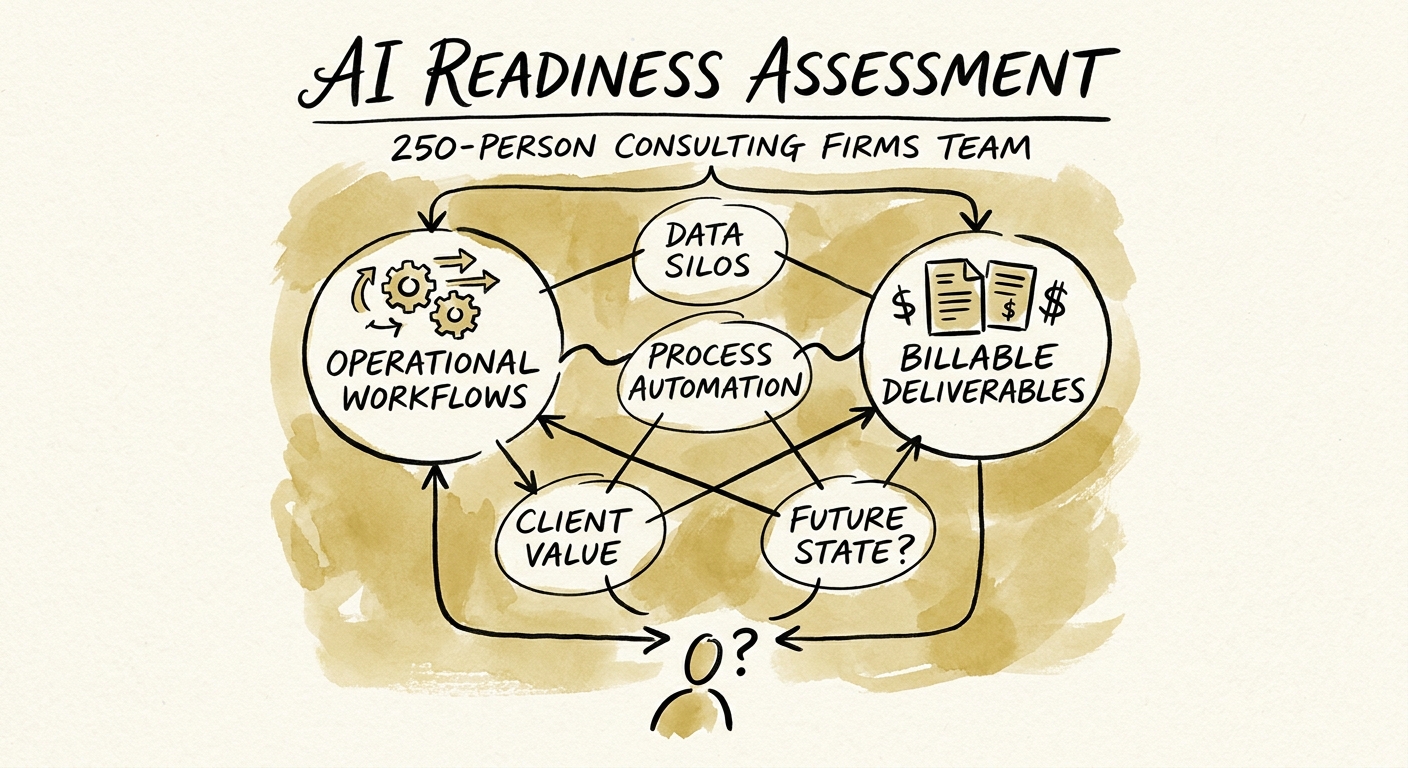
A 250-person consulting firm bleeds up to nine hours per employee every week just searching for internal information according to McKinsey's research on employee search time and communication, an administrative tax that quietly erodes millions in billable utilization. Yet, when these mid-market firms rush to buy generative tools to fix their margins, they run straight into a brick wall: RAND Corporation's 2025 enterprise AI failure analysis found that 80.3% of enterprise AI projects fail to deliver their promised business value. The failure rate in professional services is often higher because managing partners completely misdiagnose the problem. They immediately try to build a "Consultant Copilot" to write proprietary strategy deliverables, completely ignoring the fact that their underlying data architecture is a mess. The allure of instantaneous client deliverables blinds them to the operational realities of data governance and process standardization.
Diagnosing the Core Problem
In our last engagement with a 250-person consultancy, I watched the partnership burn $150,000 trying to build an AI agent that generated bespoke market entry proposals. It was an unmitigated disaster. The model hallucinated prior case studies because the firm's SharePoint was littered with draft documents, outdated methodologies, and duplicate client files. This is the definition of failing an AI readiness assessment. You cannot automate your intellectual property if your operational foundation is broken. It is no surprise that MIT Project NANDA's 2025 generative AI ROI study concluded that an astonishing 95% of organizations deploying generative AI saw absolutely zero measurable return. They are trying to run before they know how to walk, and in consulting, that means trying to automate the advice rather than the scaffolding that holds the firm together.
You cannot automate your intellectual property if your operational foundation is broken. You must earn the right to automate your core product by first automating your internal operations.
The Dimensions of True AI Readiness
An effective AI readiness assessment for a mid-market firm evaluates your operational maturity, not your enthusiasm for technology. True readiness demands a rigorous audit of your firm's data hygiene, process documentation, and governance frameworks before writing a single line of code or signing a vendor contract. If your firm still manages resource allocation via a massive, undocumented spreadsheet that only the Chief Operating Officer understands, you are not ready for AI. If your customer relationship management system is full of un-updated opportunity stages and stale pipeline data, deploying an AI agent to forecast revenue will only generate faster, more convincing lies. AI is an accelerator; it will scale your existing dysfunction just as rapidly as your core competencies.
Separating the Elite from the Pack
The gap between the winners and losers in this space is widening aggressively. According to PwC's April 2026 AI Performance study, just 20% of companies are currently capturing 74% of all financial returns generated through AI adoption. These elite firms succeed because they focus their initial AI investments on structured, high-volume operational drag. They look at the non-billable tasks that consume their analysts and project managers—contract review preparation, CRM cleanup, meeting summary follow-ups, and project variance reporting. By diagnosing the exact bottlenecks where manual data entry throttles capacity, operators can apply the AI project use-case scoring model to guarantee they tackle workflows that actually move the needle on EBITDA. They treat AI as an operational lever, not a magic bullet for top-line revenue.
Automating Operations Before Advice
The path to AI transformation requires extreme discipline and a willingness to say no to shiny objects. Stop buying general-purpose chatbots and hoping your consultants will intuitively figure out how to use them safely. Instead, you must identify the specific administrative choke points where your firm bleeds capacity on a daily basis. Gartner's April 2026 I&O AI readiness research confirms that 20% of AI infrastructure projects fail outright precisely because organizations expect the technology to magically fix long-standing operational dysfunction. If a process is fundamentally broken when humans do it, accelerating it with an artificial intelligence model only creates a faster broken process that fails at a much larger scale.
The Proven Sequence for Implementation
For a 250-person firm, the best first AI use cases for consulting firms almost always live in the back office. Before you attempt to automate client-facing deliverables or proprietary research, build a closed-domain knowledge retrieval system for your internal employee onboarding. Automate the intake of vendor documents. Systematize the extraction of commercial terms from master service agreements. These operational use cases are low-risk, highly measurable, and do not threaten your firm's hard-earned reputation if the model requires human-in-the-loop correction. I have rebuilt these operational workflows dozens of times for growing consultancies, and the pattern is absolute: you must earn the right to automate your core product by first automating your internal operations. Stop guessing about your firm's maturity. Find out exactly where your firm stands and which process to target first by taking our AI Opportunity Score today.