
The practical answer
- Short answer
- A 150-person architecture firm bleeds $1,080 on every RFI. Learn how to conduct an AI readiness assessment to eliminate the 39% unbillable time tax.
- Best fit
- Industry: Architecture and Engineering. Function: Operations and Technology
- Operating path
- AI Transformation Strategy → AI Transformation
- Key metric
- 71% Architecture firm billings that stem entirely from repeat clients.
The Hidden Margin Collapse in Mid-Market Architecture
Every time a general contractor submits a Request for Information (RFI), it costs an architecture firm an average of $1,080 and 8 hours of unbillable technical review time, according to Navigant Construction Forum's RFI cost benchmark—a hidden administrative tax that quietly devours the profit margin of your most lucrative projects. For a 150-person architecture firm, these routine administrative bottlenecks are no longer just an annoyance; they are an existential threat to your EBITDA. At this size, your firm has outgrown the founder-heroics and boutique agility that got you to $15 million in revenue. Yet, you lack the massive, dedicated back-office infrastructure of global behemoths. You are caught in the mid-market squeeze, where every unbillable hour directly erodes your competitive advantage.
In our last engagement with a 140-person regional design firm, we found that senior project architects were spending 40% of their week triaging emails, formatting proposal narratives, and hunting down legacy CAD files instead of actually designing. This operational drag destroys the client experience, which is catastrophic in an industry that relies heavily on relationship retention. This dynamic is explicitly validated by AIA's 2024 Firm Survey Report, which shows that a staggering 71% of architecture firm billings stem entirely from repeat clients. When your senior talent is buried in RFIs and submittals, they aren't proactively nurturing the relationships that secure your future pipeline.
Firms are waking up to this reality, but many are paralyzed by the sheer volume of emerging tools. Deltek's 45th Annual Clarity A&E Industry Study revealed that 76% of firms struggle to prioritize relevant technology trends while battling compressed margins. They hear "artificial intelligence" and immediately think of generative design tools like Midjourney. But for firm owners, the real financial ROI of AI is not in generating concept art—it is in eradicating the 39% unbillable time tax that strangles your bottom line. Assessing your firm's AI readiness is the essential first step to reclaiming those lost margins.
For firm owners, the real financial ROI of AI is not in generating concept art—it is in eradicating the 39% unbillable time tax that strangles your bottom line.
Beyond Generative Design: Identifying the Real AI Use Cases
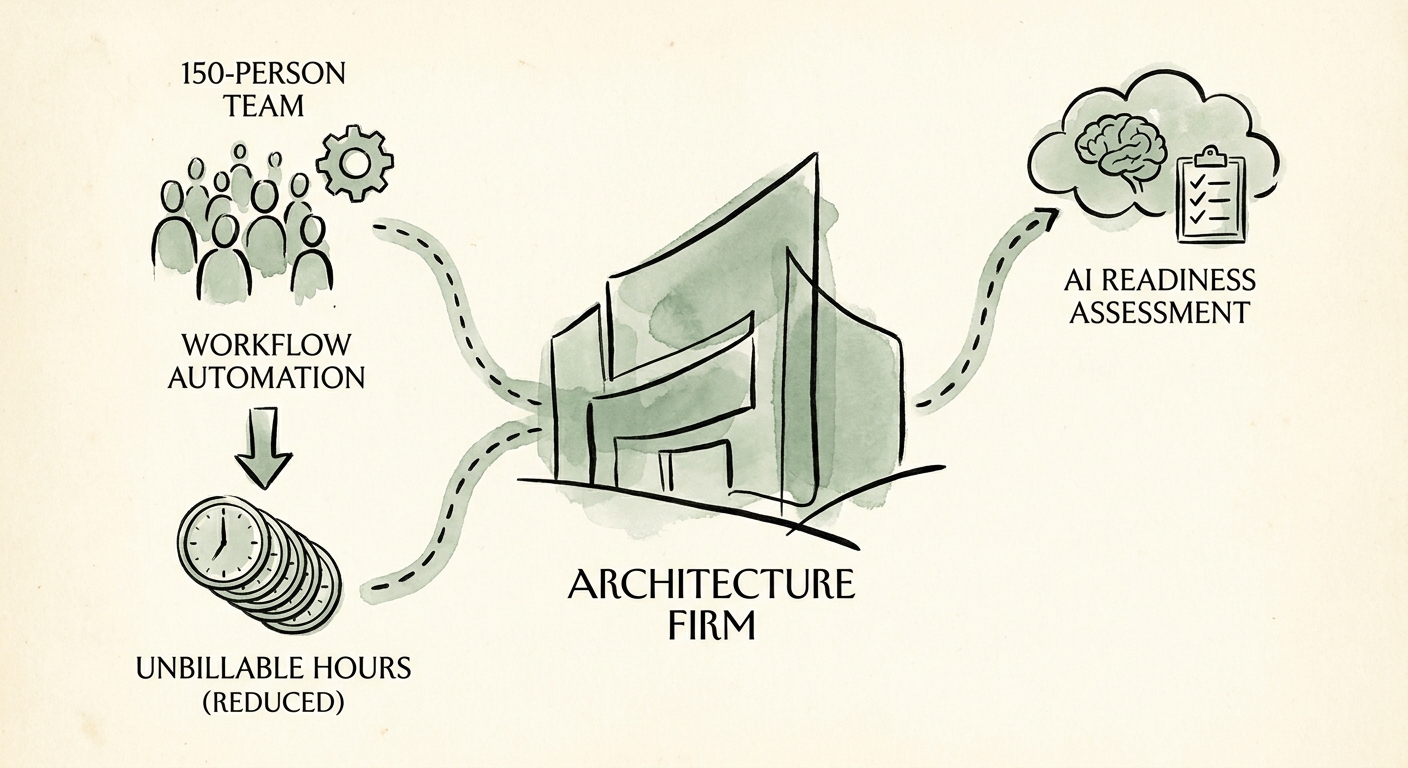
When evaluating the first AI use cases for engineering services firms, you must pivot your perspective from design innovation to operational execution. AI transformation in architecture is fundamentally about knowledge retrieval and workflow automation. At 150 employees, you generate an enormous amount of unstructured data: proposals, code compliance checklists, and historical RFI responses. This data is usually trapped in disconnected folders, SharePoint drives, and the heads of your senior partners.
A true AI readiness assessment ruthlessly exposes these data silos. We frequently see mid-market architecture firms miss their target utilization rates because their teams are reinventing the wheel on every new project. Falling below the standard 65% utilization threshold outlined in PSMJ's A/E Financial Performance Benchmark means your architects are effectively functioning as unbillable overhead. To correct this margin leak, you must build an internal AI knowledge assistant capable of instantly querying past project documentation. When a junior architect can ask an internal bot how a past HVAC clearance issue was resolved and receive a cited answer with drawing references, you instantly eliminate six hours of unbillable research.
Moreover, true AI readiness demands strict governance around how sensitive client data is handled. You cannot simply buy a handful of ChatGPT Team licenses and hope for the best. Without a secure, private instance of a large language model (LLM), your staff will inevitably upload confidential client blueprints, proprietary pricing models, and strategic RFP responses into public AI tools. As outlined in our broader guide on AI Readiness for a 150-Person Services Firm: Escaping the Data Trap, establishing an acceptable-use policy and deploying enterprise-grade, ring-fenced AI infrastructure is a non-negotiable prerequisite for enterprise transformation.
The 90-Day Path to AI Transformation
For a 150-person architecture firm, AI readiness is an immediate operational imperative for the executive team. You must begin with a thorough audit of your current digital workflows and data hygiene. Do your project managers follow standardized naming conventions across all servers? Is your ERP or project management software fully adopted, or are teams still running shadow spreadsheets to track their deliverables? The foundation of AI is robust, structured data. Without it, AI agents simply hallucinate answers based on garbage inputs.
The good news is that investing in this foundational digital infrastructure pays off directly and measurably. Dodge Construction Network's 2025 project management study found that 77% of firms with mature digital workflows successfully raised both their productivity and overall project margin. Your AI readiness assessment should highlight exactly which systems need to be integrated and which manual workflows—such as proposal drafting or consultant coordination—are ripe for immediate automation.
In the next 24 months, the architectural landscape will undergo a severe bifurcation. On one side will be firms that leverage AI to automate their back-office operations, enabling their architects to focus entirely on design, client advisory, and business development. On the other side will be firms that continue to manually process RFIs and burn their profit margins on administrative overhead. We have engineered AI transformation services for engineering and design firms to ensure our clients land on the right side of this divide. The transition begins by confronting your unbillable time tax and accurately scoring your firm's AI Opportunity. Stop paying highly skilled designers to do rote data entry, and start building the operational leverage that drives premium exit valuations.