
The practical answer
- Short answer
- Discover how to evaluate your 10-person law firm's AI readiness, fix unbillable time leaks, and prioritize first use cases before investing in legal tech.
- Best fit
- Industry: Legal Services. Function: Operations & Practice Management
- Operating path
- AI Transformation Strategy → AI Transformation
- Key metric
- 33% Average billable utilization rate for law firms, revealing a massive unbillable administrative burden.
Every 10-person law firm believes buying an AI legal assistant will instantly transform their margins, yet they bleed cash daily because attorneys actually only bill 33% of their working hours according to Clio's 2024 Legal Trends Report. We see this administrative trap constantly. In our last engagement with a boutique litigation firm, the founding partners were evaluating six-figure generative AI tools while their paralegals were still manually renaming thousands of discovery PDFs and struggling to keep up with basic calendar coordination. Before you can automate your practice, you must admit that your current workflow is fundamentally broken. AI readiness is not about testing the smartest large language model on the market; it is about structuring your proprietary firm data so that an algorithm can actually read, analyze, and retrieve it without hallucinating fake case law.
The gap between the work you do and the work you get paid for is your first and most urgent target. The Thomson Reuters Institute's 2024 Law Firm Rates Report revealed that collection realization against standard rates has slipped to 81.9%. When 18% of your value vanishes into write-downs and uncollected bills, adding a faster drafting tool simply accelerates your ability to do unbillable work. For a 10-person team, this margin erosion usually manifests in partner time wasted on initial case assessment, contract extraction, and endless email triage. If your attorneys are acting as highly-paid data routers instead of strategic advisors, your firm is failing the foundational readiness test.
The realization gap isn't just a billing issue; it is a workflow issue. Every time an attorney has to hunt for a precedent contract, re-read a 50-page deposition because the paralegal's notes were incomplete, or manually format a demand letter, you are burning inventory. In a 10-person firm, you don't have the luxury of a massive back-office support team to absorb these inefficiencies. Every hour lost to administrative friction is an hour that cannot be billed to the client, directly impacting partner distributions at the end of the year. A proper assessment starts by quantifying this unbillable time tax, not by watching vendor demos. You need to focus on automating operations, not advice.
AI readiness for a law firm is not about testing the smartest large language model on the market; it is about structuring your proprietary firm data so that an algorithm can actually read, analyze, and retrieve it without hallucinating fake case law.
Diagnosing Your Information Architecture
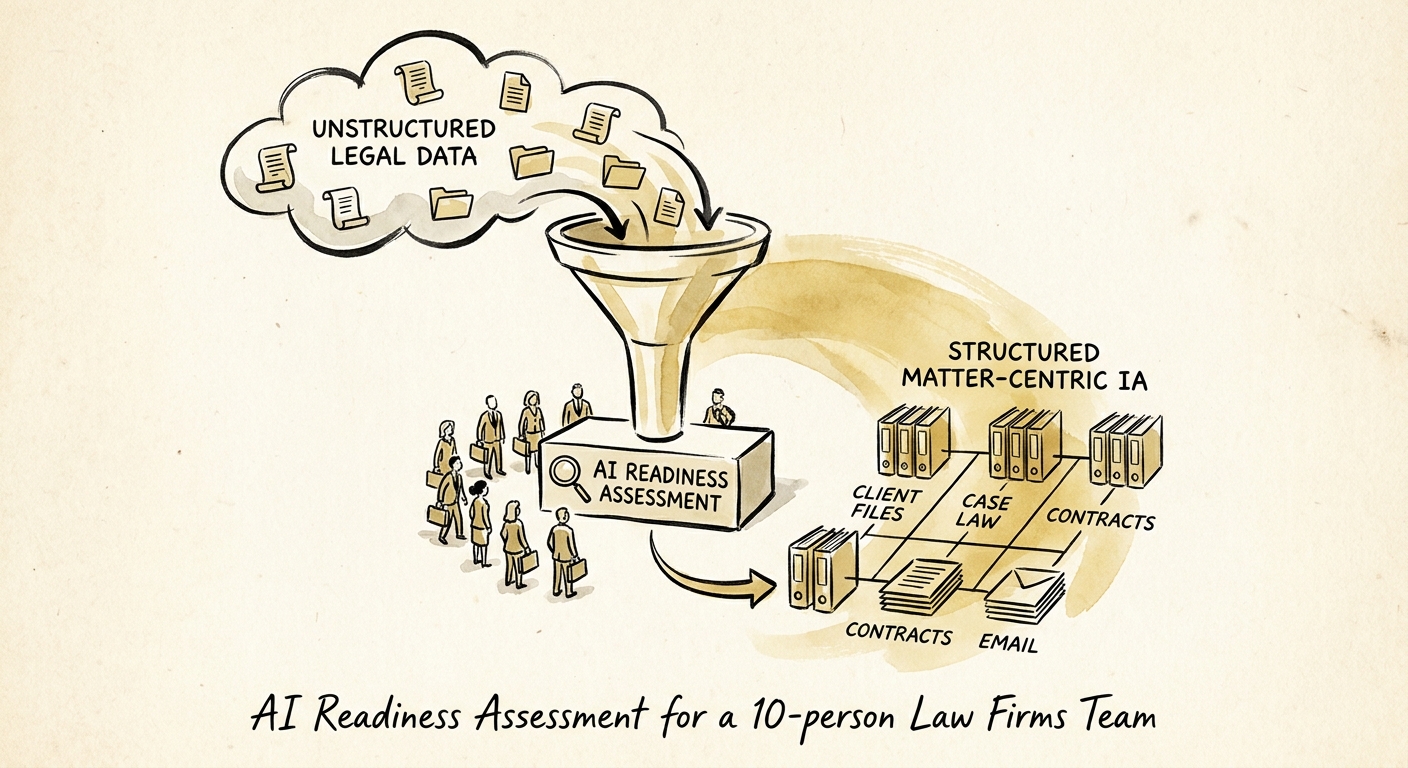
To successfully deploy AI, a 10-person firm must aggressively evaluate its document management system (DMS) hygiene. If your firm relies on a tangled web of local hard drives, fragmented personal Dropbox folders, and siloed email inboxes, no AI tool in the world can securely synthesize your case history. Goldman Sachs estimated in 2023 that 44% of legal tasks could be automated, but that bold statistic completely assumes your unstructured data is actually accessible to the automation engine. If your data is not centralized and properly tagged by matter, you are simply training an expensive bot to produce highly confident errors. An AI readiness assessment exposes these fractures before you spend a dime on software.
We systematically assess readiness across three specific vectors for boutique practices: intake standardization, evidence extraction, and matter-centric security. First, does client intake generate structured data in your practice management system, or does it create a 12-page narrative email that a paralegal has to re-key? Second, can your support staff automatically extract dates, entities, and obligations from massive discovery dumps, or are they manually building case chronologies in Excel? Third, do you have granular, role-based access controls in place? Without strict permission governance, deploying an internal AI search tool risks exposing sensitive partner compensation details, HR records, or ethically walled matters to the entire staff.
We also look closely at your integration maturity. If your billing software cannot talk to your case management system, and neither can speak to your email client, injecting AI into that ecosystem will only create faster bottlenecks. A true readiness assessment maps the flow of data from the moment a prospect calls your office to the moment the final invoice is paid. Only when that pathway is mapped can you identify where an AI extraction layer will actually remove a human bottleneck rather than just creating a new software dependency. This operational reality is exactly why we always tell our clients to stop drafting, start extracting when selecting their very first automation targets.
The 90-Day Transformation Roadmap
You simply cannot buy your way out of bad internal processes. While Gartner reports that 64% of legal and compliance leaders plan to increase spending on AI-driven legal technology, the teams that actually see a measurable return on investment are spending that budget on workflow orchestration first. In fact, Gartner also predicts the global legal technology market will hit an astonishing $50 billion by 2027, driven largely by firms racing to out-automate their competitors. But buying a commercial off-the-shelf tool does not equal a strategic transformation. Your first critical step in the roadmap is to implement a strict naming and filing convention inside a unified, cloud-based DMS. Once your foundational data is clean and standardized, you can target the low-hanging fruit.
Focus your initial AI initiatives on the high-volume, low-margin tasks that drain morale. Automate your conflict-check data gathering so that it takes minutes instead of hours. Standardize your new document intake pipelines so that inbound court filings are automatically routed and summarized. Deploy AI for first-pass discovery extraction to build rapid chronologies. Stop trying to automate the bespoke legal advice that clients pay premium hourly rates for. Instead, aim the technology squarely at the administrative scaffolding that supports that advice. We typically structure this journey into 30-day sprints. Days 1 through 30 are exclusively dedicated to data cleanup and access governance. Archive irrelevant files and enforce strict matter ID tagging.
Days 31 through 60 focus on piloting a single, highly constrained use case—like automating the extraction of key clauses from opposing counsel's standard contracts. Finally, Days 61 through 90 are about user adoption and measuring the actual hours saved against your baseline. Do not move to a second use case until the first one is demonstrably saving your paralegals at least five hours per week. I highly recommend conducting a formal operational audit before evaluating vendors, or working with an AI use-case consultant who actually understands the brutal unit economics of a smaller firm. By ruthlessly eliminating the administrative drag, you reclaim the billable capacity that transforms your bottom line and future-proofs your practice.