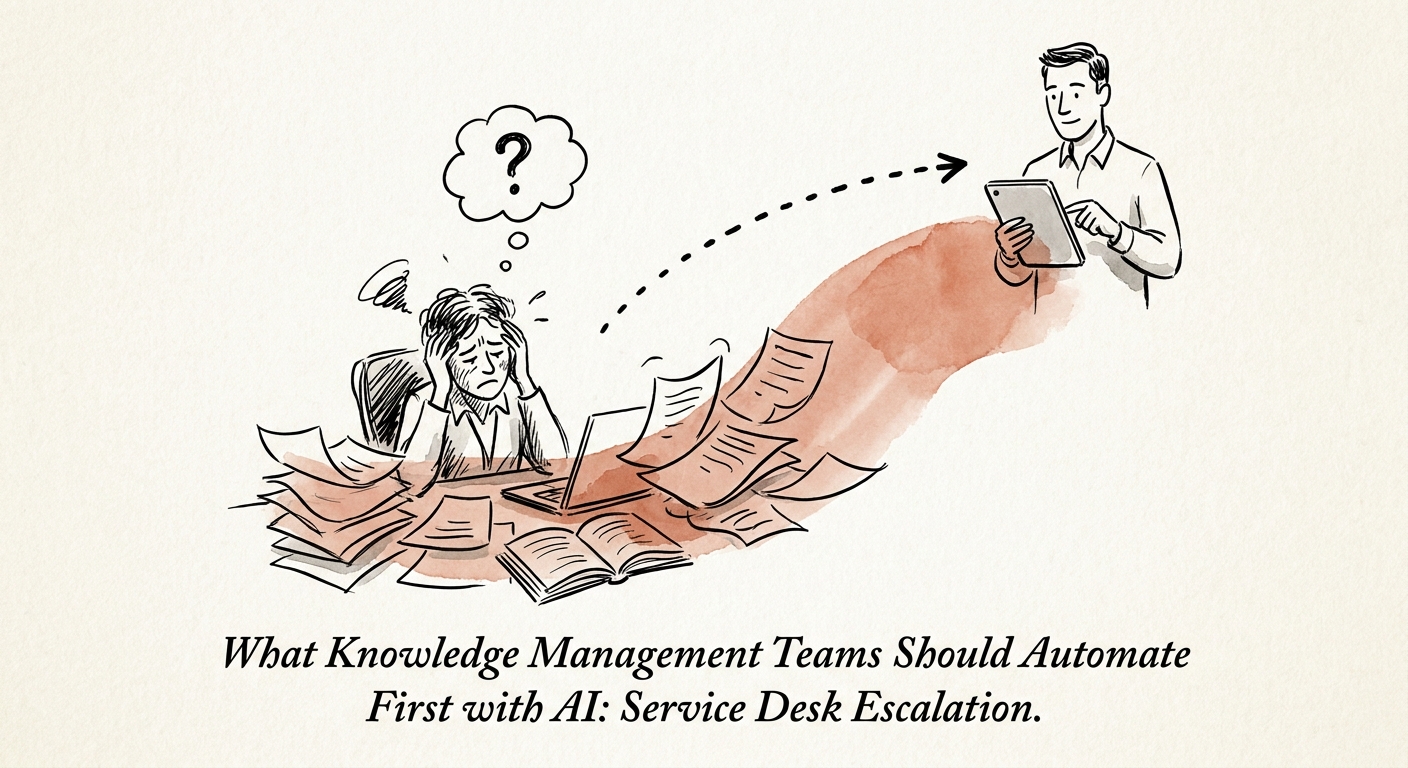
The escalation that gets reopened three times
Watch a Tier-1 rep escalate a ticket on a busy Tuesday and you'll see the failure mode in real time. They paste a one-line summary, attach the ticket, and hit assign. The specialist who picks it up forty minutes later has no idea the customer already sent logs in a separate email thread, that a similar issue was fixed two weeks ago in a closed ticket nobody linked, or that the integration touched is on an old API version. So the specialist re-asks the customer everything, the customer gets irritated, and the ticket bounces. Multiply that across a 60-rep support floor and you're not running a service desk, you're running a relay race where everyone drops the baton.
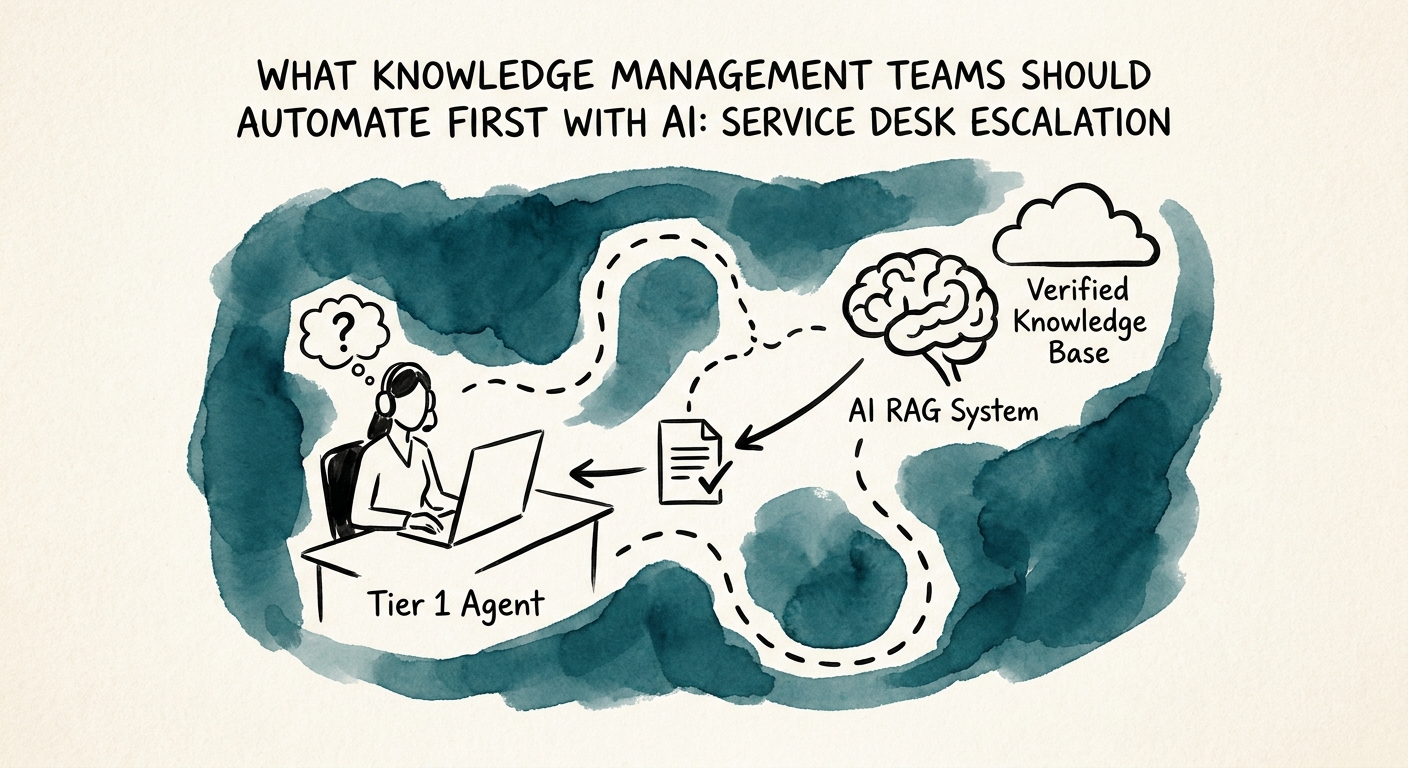
This is exactly why service desk escalation is the right first AI workflow for an IT-services or customer-support knowledge team. Salesforce State of Service research keeps pointing at the same squeeze: rising case volume, rising expectations, flat headcount. The leverage isn't in answering faster at Tier 1, it's in making sure that when a ticket has to move up, it moves up complete. And escalation is automatable precisely because a good packet is definable. You can write down what it must contain: full ticket history, the customer's environment and entitlement, every prior touch, attempted fixes and their outcomes, relevant known-issue articles, and the actual logs and screenshots, not a link that 404s.
The AI's job is assembly and gap-detection: pull those pieces together and flag what's missing before a specialist ever sees the ticket. It should never paper over a gap or quietly route a security-sensitive incident outside the approved path. Use the service desk escalation workflow guide to draft your first packet definition.
The packet contains customer data, treat it that way
Here's the part teams skip in their rush to automate: an escalation packet is one of the most sensitive objects on your service desk. It bundles customer system evidence, account details, sometimes auth tokens buried in pasted logs, and incident specifics. The moment you let an AI assemble that automatically, you've built a small data-aggregation engine, and you owe it the same scrutiny you'd give any system touching customer data. CISA AI Data Security Best Practices is the right checklist here, it forces you to ask where each fact came from, who's allowed to see it, and whether the assembled packet just exposed something a Tier-1 rep shouldn't have surfaced.
Three non-negotiables make this work on a real desk. First, every fact in the packet carries a source link back to the system it came from, the ticket field, the log file, the KB article, so the specialist can verify, not just trust. Second, permission checks run before assembly, so a packet doesn't pull in records the assigned engineer isn't cleared to view. Third, the workflow captures the specialist's corrections on the way out: when they fix the root cause and note that the known-issue article was wrong, that correction flows back so the next escalation of the same issue is sharper.
The blunt test for whether you built the right thing: if your senior engineers still rebuild the packet by hand the moment a hard ticket lands, the automation is decorating the problem, not solving it. A packet a specialist immediately trusts and acts on is the only acceptable output.
Measure the handoff, not the summary length
The trap is measuring the wrong thing. It's easy to celebrate that the AI now writes a tidy escalation summary in two seconds. That's vanity. The number that matters is what happens after the handoff. Track five things over your first 90 days: missing-context rate (how often a specialist still has to ask for something the packet should have included), specialist rework, time-to-assign, time-to-resolution, and the one most teams forget, whether the knowledge article actually got updated after the ticket closed. That last metric is the difference between a service desk that learns and one that re-solves the same problem forever.
Run this with governance from day one. The NIST AI Risk Management Framework gives you the loop to keep the assembly behavior honest as ticket types drift, and the OECD report on AI adoption by small and medium-sized enterprises is a useful reality check that smaller support orgs win by picking one practical workflow and proving it, not by boiling the ocean.
Start Monday with one thing: pick your single highest-volume escalation type, say, the integration-broke-after-an-update ticket that always bounces, and write down, on one page, exactly what a complete packet for it contains. That definition is your spec; the AI is just the assembler. From there, connect it to the bigger picture with the 100-person IT services readiness guide, then map the full sequence in our AI transformation blueprint.