
The practical answer
- Short answer
- Discover how a 10-person Managed Service Provider can assess AI readiness, eliminate manual ticket triage, and reclaim thousands in unbillable capacity.
- Best fit
- Industry: IT Services. Function: Customer Operations
- Operating path
- AI Transformation Strategy → AI Transformation
- Key metric
- 60-70% of routine employee support activities can be automated by generative AI, eliminating the administrative bottleneck of manual triage.
The Hidden Tax of Manual Ticket Triage
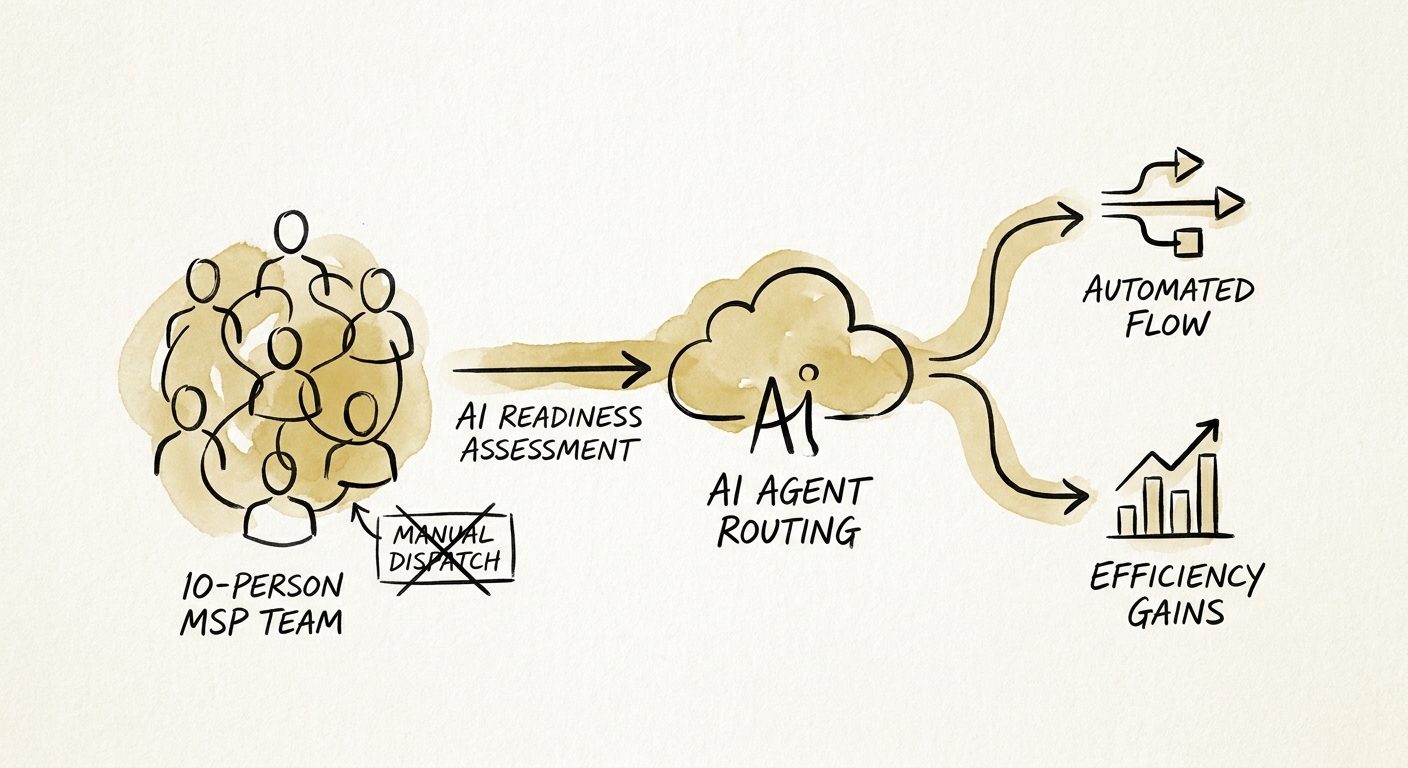
For a 10-person managed service provider, manually triaging and dispatching tier-1 support tickets burns between 3 to 15 minutes per request—a hidden administrative tax that quietly erodes up to $50,000 in billable engineering capacity every year before a single technical problem is actually solved. I see this margin leak constantly when evaluating IT service firms. You hire elite technical talent to solve complex infrastructure problems, but instead, your highest-paid engineers are stuck playing calendar Tetris, deciphering vague "my printer is broken" emails, and manually categorizing routine alerts. It is a catastrophic misuse of human capital that caps your firm's growth and accelerates technician burnout.
When we run an AI readiness assessment for a growing MSP, the first target is never a flashy customer-facing chatbot. We go straight for the service desk queue. Gartner's 2024 IT Service Management analysis explicitly warns that traditional, manual ITSM ticket triage is unsustainably labor-intensive and artificially inflates mean time to resolution (MTTR). If your dispatch process relies on a human reading every incoming email to guess the severity, check the client SLA, and cross-reference technician availability, you are fundamentally unready to scale your managed services business. You are paying a premium for a human API.
In our last engagement with an 8-person regional MSP, the founder was convinced they needed to hire two more tier-1 technicians to handle a 20% spike in ticket volume. We ran our comprehensive AI readiness diagnostic and found the real bottleneck: their engineers were collectively spending over three hours a day just organizing the work. We stopped the hiring process immediately and implemented an automated triage workflow instead. By addressing the operational rot at the front of the queue, we reclaimed enough capacity to absorb the new volume without adding a single dollar to payroll.
AI readiness for a lean managed service provider isn't about deploying a flashy chatbot. It's about ending the manual dispatcher tax and transforming unbillable triage time into highly profitable engineering capacity.
Data Maturity: The Prerequisite for AI Routing
Assessing your firm's AI readiness requires looking past vendor hype and taking a brutal inventory of your data maturity. You cannot automate a process that you have not standardized. Before you can deploy intelligent routing or predictive resolution models, your Professional Services Automation (PSA) tool must house clean, structured historical data. Forrester's 2024 Total Economic Impact study on AI-driven IT management found that organizations utilizing natural language processing for workflow automation achieved a staggering 204% ROI, largely by eliminating the complexity of manual catch-and-dispatch routing. But that return on investment is a mathematical impossibility if your historical tickets lack accurate, consistent categorization.
We evaluate an MSP's readiness across three critical dimensions: data structure, process documentation, and operational discipline. If half of your tickets are currently closed with a single time entry lazily labeled "fixed it," an AI model will learn absolutely nothing. It will simply automate your incompetence at a higher speed. MetricNet's 2023 IT Service Desk Benchmarking Study proves that businesses using structured technical support levels see their mean time to resolution drop from 4.2 hours to 2.8 hours. We force our clients to build this structured taxonomy first.
Once the categories, sub-categories, and resolution codes are locked into a rigid framework, an AI agent can instantly read an incoming ticket, check the client's specific configuration items (CIs), assign the correct priority based on contractual SLAs, and route it to the specific technician whose skills match the problem. This is not science fiction; it is the baseline requirement for operating a profitable IT services firm in 2026. The technical assessment separates the disciplined operators from the reactionary break-fix shops.
Operational Leverage and the Bottom Line
The ultimate goal of this transformation is operational leverage. At a 10-person firm, you do not have the luxury of bloated management layers or dedicated dispatch teams. Every hour recovered from administrative purgatory drops straight to the bottom line as billable capacity or proactive project time. McKinsey's 2025 analysis on generative AI in business revealed that advanced agents can technically automate 60% to 70% of routine employee support activities. For an MSP, this means your tier-1 desk stops resetting passwords and provisioning basic accounts, and starts acting as a proactive service engine that actually drives client value.
Furthermore, the impact on client satisfaction and retention is entirely measurable. When a client submits an urgent ticket, they do not want it sitting in an unmonitored general inbox while your team handles a morning rush. HDI's 2024 Support Center Practices Report demonstrates that organizations with well-defined, automated IT help desk tiers achieve a 72% first-call resolution rate, compared to an abysmal 45% for those relying on ad-hoc, manual triage processes. When we help operators implement AI ticket triage, the human dispatcher is elevated to an exception-handler. They manage only the complex, high-stakes escalations that require white-glove service and genuine technical empathy.
If you are running a lean Managed Service Provider, you must stop treating unbillable administrative time as the unavoidable cost of doing business. You are bleeding margin by deploying humans to do a machine's job. I highly recommend running a rigorous use-case scoring model on your ticket triage and dispatch process today. Reclaiming that lost capacity is the only sustainable way to break through your current revenue ceiling without destroying your profitability. The firms that refuse to assess their readiness now will find themselves priced out of the market by competitors who have already automated the busywork.