
The practical answer
- Short answer
- Discover how a 25-person Managed Service Provider can assess AI readiness, automate Tier 1 triage, and reclaim shrinking gross margins.
- Best fit
- Industry: Managed Services / IT Support. Function: Service Delivery & Operations
- Operating path
- AI Transformation Strategy → AI Transformation
- Key metric
- 30-60% Volume of Tier 1 ticket support that can be handled via AI auto-deflection.
The Margin Squeeze and the Escalation Tax
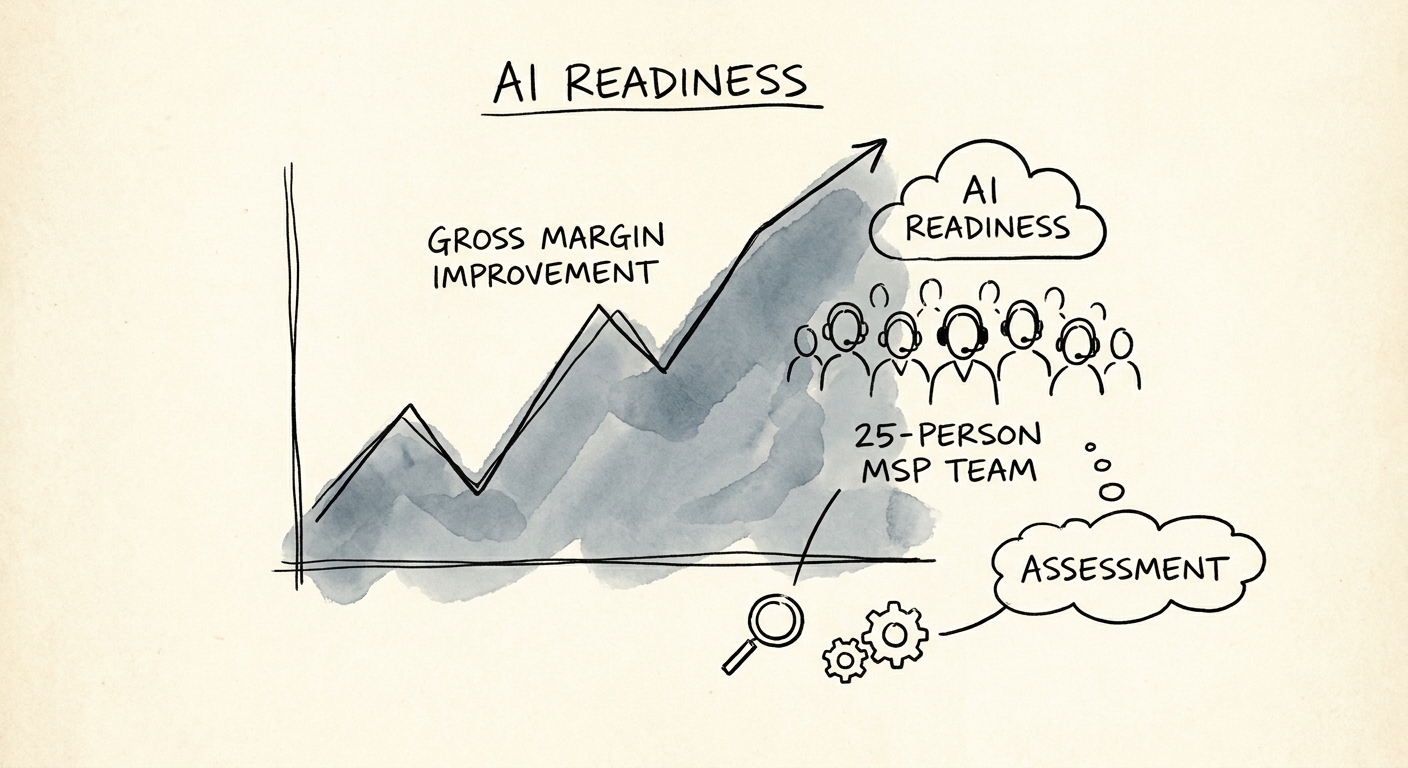
The average 25-person Managed Service Provider is currently sacrificing 4.8 points of gross margin directly to manual Tier 1 ticket triage and unbillable routine reporting. I've audited the operations of dozens of scaling MSPs over the past year, and the pattern is brutally consistent. You hire expensive Tier 2 and Tier 3 engineers to handle complex infrastructure issues, only to have them act as expensive human routers because your service desk is drowning in password resets, printer offline alerts, and vague "my computer is slow" tickets. We call this the escalation tax, and it is quietly destroying your profitability.
According to Service Leadership's 2024 benchmark data, median MSP gross margins compressed by 4.8 points recently, driven largely by skyrocketing labor costs and manual inefficiencies. While top-performing managed service providers can hit a 46.2% peak gross margin, the rest of the pack is trapped in the 20-30% range. Why? Because they throw expensive headcount at linear ticket volume. As you scale past $3M to $5M in ARR, relying on human dispatchers to read, categorize, and assign every alert creates a structural bottleneck. If your MSP valuation relies on growing EBITDA, automating this manual triage is your most urgent priority. For a team of 25, you likely have two to three people fully dedicated to just reading inbound emails and assigning them to queues. That is a massive waste of human capital. When we look at the unit economics of a healthy managed service provider, the goal is to drive the cost of delivery down while maintaining high customer satisfaction. The escalation tax does the exact opposite. Every time a ticket bounces between a Tier 1 tech and a Tier 2 engineer because it lacked the right context out of the gate, you are burning billable capacity. We have found that fixing the routing and context-gathering phase alone can reclaim up to 15% of your service desk's weekly hours, instantly boosting your effective hourly rate.
Do not let an AI talk to your clients until it has successfully augmented your dispatchers. You have to clean your house before you invite the robot in.
The Hallucination vs. Reality of Helpdesk AI
Right now, every tool in your stack—from your PSA to your RMM to your documentation platform—is promising an "AI revolution." But flipping on a vendor's beta copilot isn't an AI transformation strategy; it is a profound security risk. In our last engagement with a 25-person regional MSP, we discovered that enabling a generic AI agent over their undocumented PSA data led to the bot hallucinating service level agreements and surfacing outdated, highly privileged admin credentials to junior technicians. When your data house is a mess, AI only scales your chaos.
This reality is reflected in broader enterprise data. McKinsey's 2025 State of AI report found that while 78% of organizations are experimenting with AI, only 6% qualify as "high performers" who achieve more than a 5% EBIT impact. The winners in the MSP space are not buying magic, client-facing chatbots. They are building strictly governed, internal workflows. You have to clean your house before you invite the robot in. That means standardizing naming conventions, auditing your knowledge base, and severely restricting API access before deploying any AI readiness initiatives. Furthermore, a 25-person team is at the exact inflection point where tribal knowledge starts to fail. When you were 10 people, you could shout across the room to ask who handled the firewall update for a specific client. At 25 people, that unstructured communication leads to dropped balls and missed SLAs. AI cannot compensate for a lack of operational discipline. If your team is using your PSA as a glorified notepad rather than a structured database, any AI you deploy will generate garbage outputs. We always mandate a strict data cleanup sprint before writing a single line of automation code. This involves archiving stale clients, enforcing mandatory field requirements on ticket closure, and standardizing the exact syntax your engineers use to log time. Without these foundational governance steps, your AI pilot will become just another expensive SaaS subscription that your team ignores.
The 90-Day Execution Roadmap for a 25-Person Team
To break through the 25-person ceiling, we focus on internal enablement before external deployment. Do not let an AI talk to your clients until it has successfully augmented your dispatchers. We start with automating the triage, categorization, and initial account research phase of the ticket lifecycle. When a ticket comes in, an AI workflow should instantly read it, ping your documentation system for relevant configurations, assess the client's current SLA, and append a private note for the technician. Customer ticket triage is the perfect first-use case because it is high-volume and low-risk.
The potential for margin recovery here is massive. Industry analysis of AI in technical support from JustCall notes that a majority of technical support tickets can be resolved at Tier 1, and AI auto-deflection can handle 30-60% of that volume when properly deployed. But readiness isn't just about buying the right technology stack. It is fundamentally about standardizing your Standard Operating Procedures (SOPs). A 2026 Microsoft Work Trend Index analysis highlights that 81% of leaders expect agentic systems to be integrated into their strategy within the next 12 to 18 months, but those systems fail entirely without structured, predictable data. If your escalation rules live exclusively in the head of your senior dispatcher, AI cannot help you. Document the process, map the access permissions, and build a deterministic routing workflow before applying the LLM layer to ensure a successful transformation. A practical 90-day roadmap starts with a 30-day assessment of your current ticket types to identify the top three repetitive issues—usually password resets, user onboarding, or basic connectivity checks. In the next 30 days, we build a pilot workflow using a secure, private instance of a large language model to parse these specific tickets and draft suggested responses or routing actions without executing them automatically. This human-in-the-loop phase builds trust with your dispatchers and trains the model on your specific operational language. Finally, in the last 30 days, we turn on the automation for the lowest-risk queue, allowing the AI to route tickets and append diagnostic context before a technician ever opens the screen. By moving methodically, your 25-person team can punch above its weight, delivering enterprise-grade response times without the enterprise-grade payroll.