
The practical answer
- Short answer
- Discover why a 50-person software implementation team needs an AI readiness assessment to eliminate unbillable overhead, prevent scope creep, and scale margins.
- Best fit
- Industry: Professional Services / IT Consulting. Function: Operations & Implementation
- Operating path
- AI Transformation Strategy → AI Transformation
- Key metric
- 71.0% Average billable utilization for IT consulting firms, revealing massive capacity lost to unbillable overhead.
The Margin Squeeze and Utilization Reality
In a 50-person software implementation firm, the biggest threat to your profitability isn't your hourly bill rate, your competitor's pricing, or the software vendor's partner program changes—it is the 29% of your team's capacity burned on unbillable administrative overhead. When I walk into a mid-market systems integrator, the founders and partners usually point proudly to their massive project backlog and tell me that business is booming. But when we look at the actual timesheets and utilization metrics, the narrative completely changes. According to Service Performance Insight's 2024 IT Consulting Utilization Benchmark, average billable utilization for IT consulting firms has stalled at an underwhelming 71.0%. That means nearly a third of your expensive, highly trained technical talent's time is evaporating into pre-sales scoping, manual quality assurance checks, rewriting project requirements, and chasing down meeting summaries that should have been logged in the CRM days ago.
I have rebuilt implementation teams three times in my career, and the operational pattern is always the exact same: as you scale past the 50-employee mark, you start throwing highly compensated solutions architects and senior developers at rudimentary data entry problems. You rely on hero culture to drag delayed projects across the finish line. In our last engagement with a boutique NetSuite implementation partner, we discovered their senior technical architects were spending 15 hours a week just documenting custom scripts, compiling weekly status reports for the steering committee, and manually comparing client change requests against the original statement of work. This is the very definition of a margin leak. An AI readiness assessment begins right here: not by buying an off-the-shelf chatbot and hoping for the best, but by identifying exactly where your firm is bleeding billable capacity and clawing back that unbillable time through targeted, secure workflow automation.
AI readiness for an implementation partner isn't about buying a chatbot. It is about industrializing your delivery model so your most expensive engineers stop doing data entry.
Identifying the AI Use Cases that Actually Move Margins
When we assess a 50-person integration firm for AI transformation, we look directly at project failure rates, rework loops, and the silent killer of services margins: scope creep. The reality of software delivery is brutal and unforgiving. Gartner's analysis on ERP implementation failure rates shows that 70% of implementations fail to meet their original objectives, often due to undocumented scope creep and poor requirements tracking. Your project managers sit on weekly status calls, the client casually asks for one more custom field or a quick integration tweak to our legacy billing system, and because the PM doesn't instantly cross-reference the verbal request with the 40-page master services agreement, you end up doing complex engineering work for absolutely free. AI excels at defensive project management. We implement custom AI workflows to ingest meeting transcripts in real-time, instantly map the conversational deliverables against the original contract, and flag scope drift before the client ever assumes the extra work is included in the fixed fee.
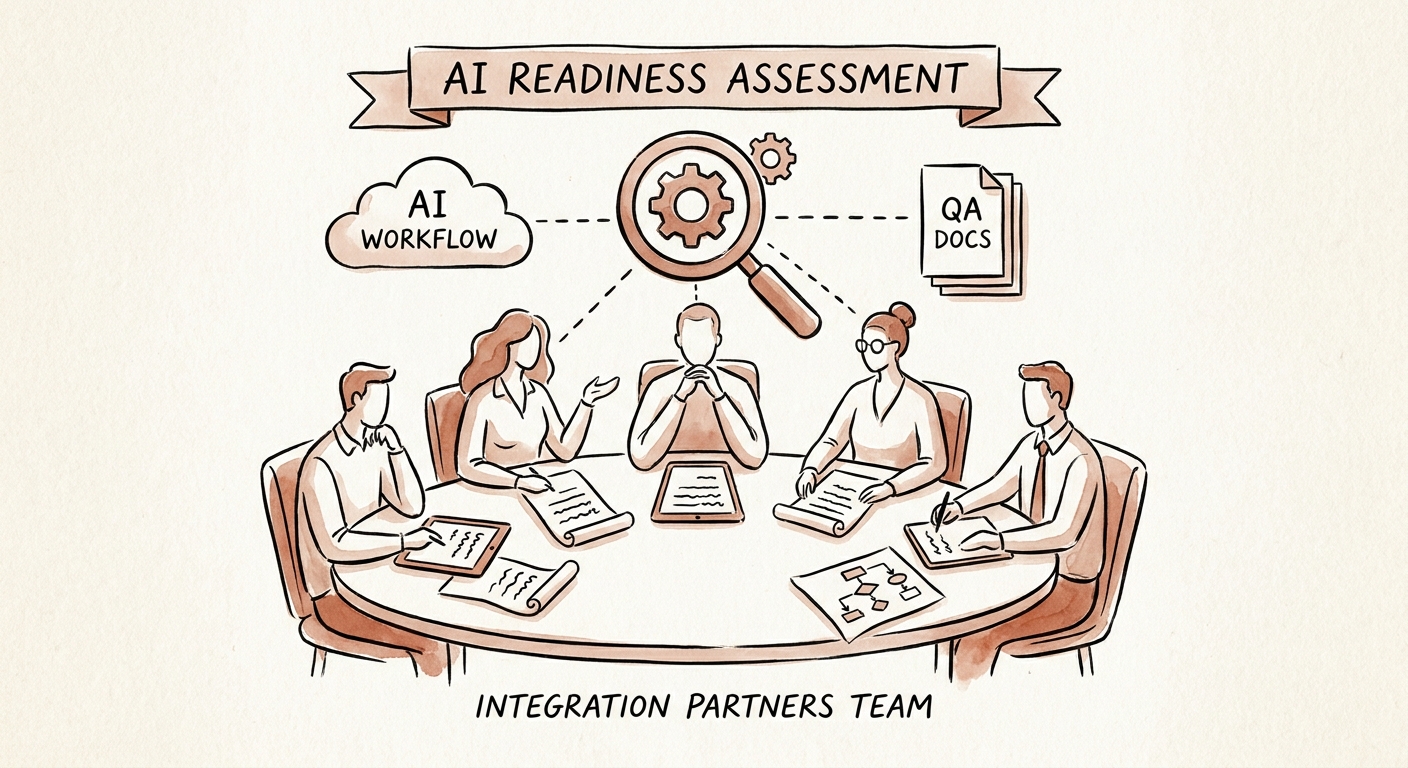
Furthermore, manual documentation is a massive, silent margin killer that plagues every software implementation partner. Writing technical specifications, system architecture documents, and end-user training manuals eats up weeks of project timelines and drains the morale of your best engineers. McKinsey's 2023 Developer Productivity with Generative AI Study proves that AI tools can help engineering teams complete complex technical documentation nearly 50% faster. For a 50-person SI, reducing documentation time by half immediately reallocates hundreds of hours of capacity back to billable work. You simply cannot afford to have your best technical minds acting as highly paid technical writers. You can read more about how to systemize this exact workflow in our guide on SOP Documentation: When Copilot Is Enough and When You Need a Custom AI Workflow. AI readiness means ensuring your operational data is clean enough, and your deployment processes are standardized enough, that a large language model can actually generate accurate, client-ready documentation directly from your codebase and configuration files without hallucinations.
Rebuilding Unit Economics with AI
At 50 employees, your gross margins dictate both your resilience during market downturns and how much you can reinvest back into the business. TSIA's 2024 Professional Services Gross Margin Benchmark reports that average professional services gross margins sit around 35% to 40% when projects are scoped and delivered correctly. But AI gives you the operational leverage to push that margin past 50%. How? By relentlessly automating Implementation QA and rework cycles. Instead of having a highly paid lead functional consultant manually check configuration environments against the design document to find missing custom fields or broken workflows, a custom AI validation workflow does the first pass in seconds. This prevents the embarrassing and costly client-discovery of bugs during User Acceptance Testing.
McKinsey's 2025 AI in Software Development Quality Analysis revealed that top-performing teams achieved 31% to 45% gains in software quality by embedding AI deeply into their QA and deployment processes. You do not need a massive R&D budget or a dedicated machine learning engineering team to deploy this capability today. You just need proper data governance, tightly standardized delivery methodologies, and a ruthless willingness to stop billing clients for low-level configuration checks that should be fully automated. We explored this dynamic deeply in our recent analysis, Implementation QA: The AI Solution to the Professional Services Margin Squeeze.
If you simply want to stop the bleeding on fixed-fee projects that constantly run over budget—or eventually position the firm for a sale—an AI readiness assessment exposes exactly which unbillable hours to target first. It systematically highlights your data silos, evaluates your team's current technology maturity, and maps out a precise 90-day sprint to deploy custom AI workflows that directly protect your margins. Stop letting your 50-person team operate like a disorganized boutique shop relying on hero culture. It is time to industrialize your software delivery with AI, extract your founders from the daily project weeds, and build a scalable machine that prints cash.