
The practical answer
- Short answer
- A diagnostic guide for 10-person software implementation teams to assess AI readiness, protect margins, and automate administrative overhead.
- Best fit
- Industry: Technology Services. Function: Operations & Delivery
- Operating path
- AI Transformation Strategy → AI Transformation
- Key metric
- 16-30% improvement in team productivity for top AI performers
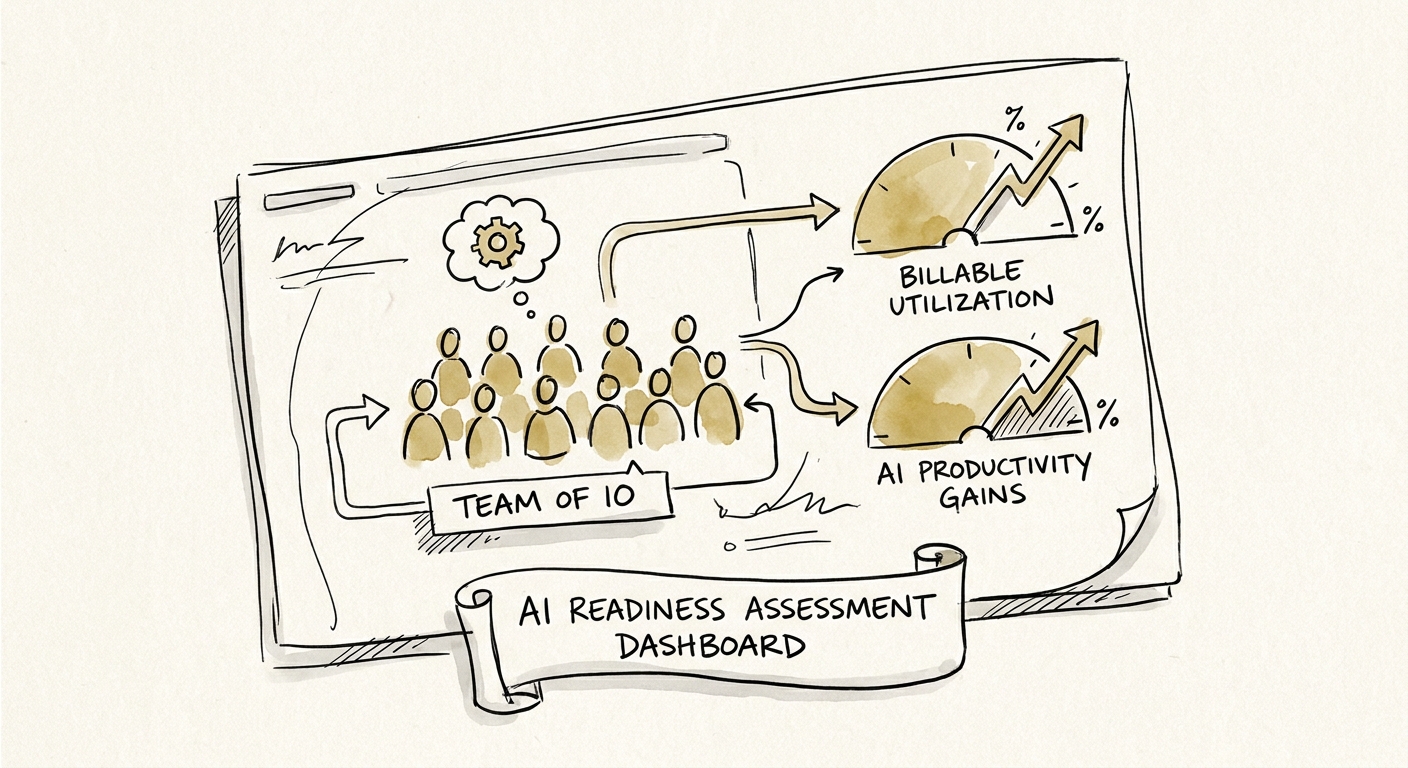
For a 10-person software implementation boutique, the biggest threat to your profitability isn't a lost deal—it is the brutal reality that SPI's 2025 Professional Services Maturity Benchmark reveals Level 5 firms achieve 36.4% more billable utilization than their lower-tier peers. When your headcount fits around a single conference table, every hour spent on manual scoping, administrative reporting, and repetitive documentation is a direct tax on your enterprise value. I have rebuilt this team three times across different implementation ecosystems, and the pattern is always the same: highly paid architects act as overqualified project managers, burning their capacity on tasks that artificial intelligence can now handle instantly.
We saw this exact pattern in our last engagement with a boutique SaaS implementation shop. The founder was acting as the primary hero architect, manually translating discovery notes into statements of work and configuration maps. They were effectively subsidizing their clients' disorganized data with their own premium engineering hours. The market is shifting too fast to maintain this manual drag. According to Gartner's 2026 IT spending forecast, global AI investment is surging toward $2.52 trillion, primarily driven by enterprises demanding faster, more predictable vendor execution. If your 10-person team is still doing manual data extraction and brute-force discovery mapping, you will rapidly become too slow and too expensive to compete.
AI readiness for a small services team does not mean hiring a data scientist or buying a massive enterprise platform. It means isolating the specific, repeatable workflows where your most expensive talent is trapped in low-value execution. You must fix the foundational data layer before applying intelligence, which is why we always tell clients to address their core CRM and project hygiene first. If you want to understand the true cost of delaying this, look at The True Cost of AI Consulting for a 10-Person Business.
AI readiness for a small services team does not mean hiring a data scientist. It means isolating the specific, repeatable workflows where your most expensive talent is trapped in low-value execution.
At the $2M to $3M revenue mark, your implementation firm is entirely dependent on workflow velocity and utilization rates. You do not have a bench of junior analysts to absorb the shock of poorly scoped projects. According to TSIA's professional services utilization framework, standardized tracking of billable versus non-billable time is the fundamental baseline before you can even measure automation impact. Readiness, therefore, is defined by your ability to standardize inputs. You cannot deploy an AI agent to draft technical design documents if every senior consultant on your team takes discovery notes in a different format. The prerequisite to AI transformation is unyielding process standardization.
The impact of getting this right is massive. McKinsey's 2025 analysis on the AI revolution in software development demonstrates that top-performing engineering teams achieve 16% to 30% improvements in productivity and up to 45% gains in software quality when AI is deployed effectively. For a 10-person team, unlocking a 20% productivity gain is the equivalent of adding two full-time senior architects to your roster at zero additional payroll cost. We force our clients to look at AI not as a shiny toy, but as a lever for gross margin expansion.
In practice, readiness requires a hard audit of your knowledge assets. Are your past statements of work, configuration playbooks, and training materials centralized in a structured database, or are they dying in isolated document folders? You must build a unified data repository before an AI co-pilot can surface relevant deployment context. The firms that skip this step end up feeding garbage data to a language model and complaining about hallucinations. If you are struggling with where to begin, I strongly recommend mapping your current unbillable leaks, starting with your project status workflows as outlined in What Operations Teams Should Automate First with AI: Project Status Reporting.
High-Impact AI Workflows for Small Implementation Teams
Once your data is clean and your processes are standardized, you must target the highest-friction bottlenecks. Do not attempt to automate the actual client-facing strategic advisory; automate the scaffolding that surrounds it. The first target is always proposal and SOW drafting. By piping structured discovery transcripts through a tuned AI model, you can instantly generate 80% of your initial scoping document, preserving your senior architects' time for strategic refinement rather than blank-page drafting. This alone reclaims dozens of hours per month for a boutique partner.
The second immediate target is employee training and onboarding documentation. We consistently see small implementation partners lose massive institutional knowledge when a single key employee leaves. According to Gartner's 2026 forecast on finance technology, leaders who strategically deploy AI and automation are projected to add 10 margin points of growth. Capturing tribal knowledge through automated meeting transcription and converting those insights into standard operating procedures is how you secure those margin points. It converts fragile human memory into a durable corporate asset.
Finally, you must automate your implementation QA and code review processes. By leveraging AI to scan configurations or custom code against your established best practices, you catch errors before they reach user acceptance testing. This dramatically reduces costly rework loops that erode your fixed-fee margins. To see how these tactical automation choices fit into a broader operational strategy, review AI Readiness Assessment for a 10-Person Professional Services Firm. Take our AI Opportunity Score diagnostic today to pinpoint exactly which workflows are silently destroying your firm's profitability, and begin building a scalable, AI-driven delivery engine.