Your account teams are already using AI. You just can't see it.
Walk the floor of a 250-person agency and you will find ChatGPT open on a strategist's second monitor, a copywriter pasting a brand voice guide into a tool you've never approved, and a media team auto-summarizing performance reports for a Friday client call. None of it is on a roadmap. None of it is measured. And some of it is happening inside accounts where the master services agreement says client data stays on systems you control.
That is the real reason to run a readiness assessment, and it is different from the version a software company would run. At your scale, the danger is not that nobody adopts AI. The RSM middle-market AI survey shows adoption is already moving fast across firms your size. The danger is that fifteen account teams adopt fifteen different ways, and you find out which client's confidential brief went into a public model only when their procurement team asks. The OECD report on AI adoption by small and medium-sized enterprises is blunt about why: real adoption rests on skills, data handling, governance, and process maturity — not on how many people have logins.
A readiness assessment is how you convert that scattered, invisible usage into something a CEO and a COO can actually steer. It is not a crackdown. It is a map of where you stand before you let any of it touch billable work.
Score eight dimensions — and weight the two that decide agency margin
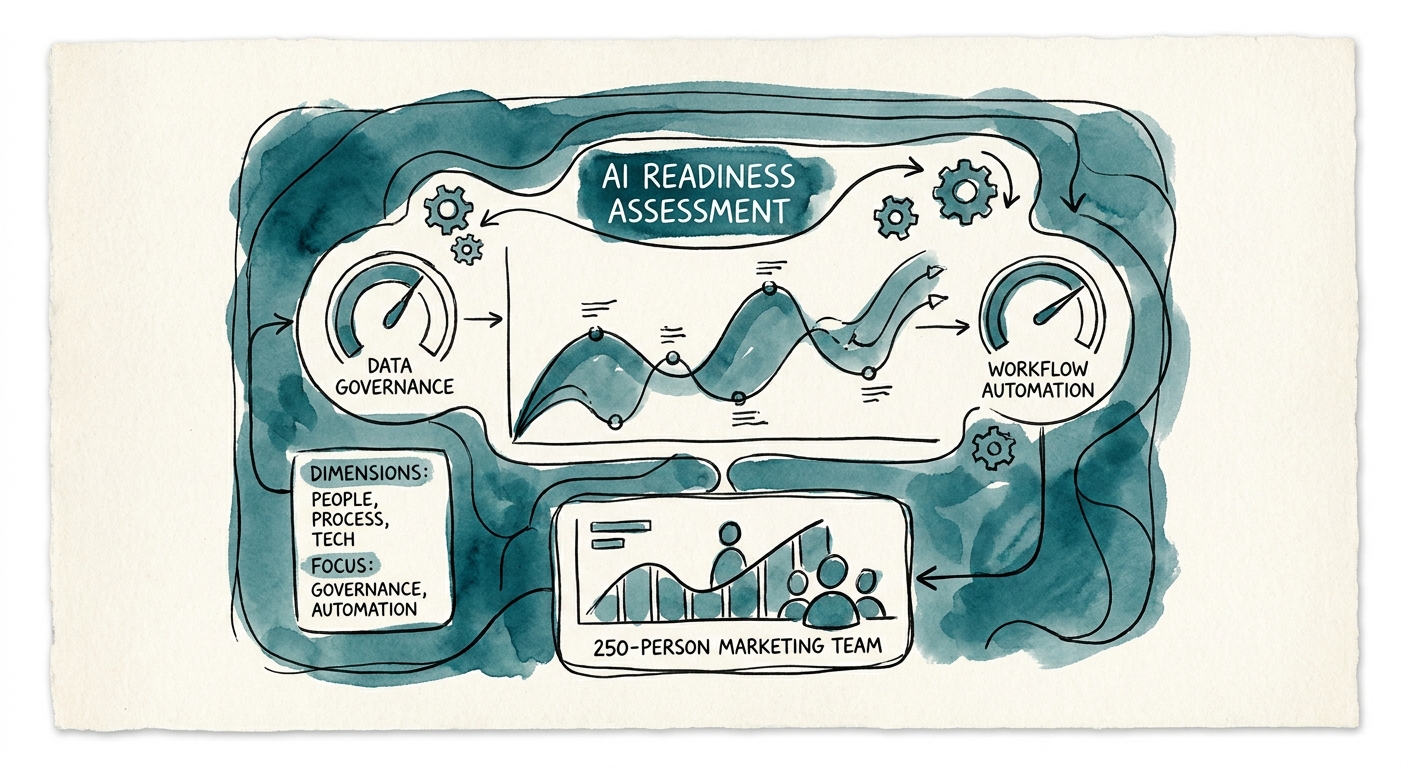
Score your readiness across eight areas, on a simple 1-to-5 scale, with the account leaders who actually run the work in the room: workflow value (is the task repeated and reviewable?), client-data boundaries (can you prove what data went where, per account?), source quality, QA standards (who catches a hallucinated stat before it reaches a client deck?), tool access, adoption friction, pricing impact, and measurement clarity. The exercise is borrowed from the SMB AI readiness assessment, but two dimensions carry far more weight for an agency than for almost any other business.
The first is client-data boundaries. You don't have one confidentiality obligation — you have one per account, and they conflict. A CPG client may permit AI-assisted research; a pharma or financial-services client in the next pod may forbid their material from ever touching a third-party model. A readiness score below 4 here means you cannot honestly answer a client's AI clause, and that is a contract risk, not a tooling preference. The NIST AI Risk Management Framework gives you the language to make this concrete: approved sources per client, named restrictions, mandatory human review, and retained workpapers so you can reconstruct any deliverable.
The second is pricing impact — the dimension agencies quietly dread. If you still bill hours, AI that makes a strategist 40% faster on a research brief doesn't grow margin; it shrinks the invoice while your salary cost stays flat. So pair the readiness score with honest AI ROI measurement from day one. Say a 250-person shop cuts deck-prep rework on a retainer account by a third — the win only shows up if you redeploy that recovered capacity into scope you can charge for, or move that client toward value-based pricing. Measure reclaimed hours, QA consistency, and faster handoffs. Do not measure "more output," because more low-margin output is exactly how an agency makes itself busier and poorer at the same time.
Pick one account, one workflow, and prove it before you scale
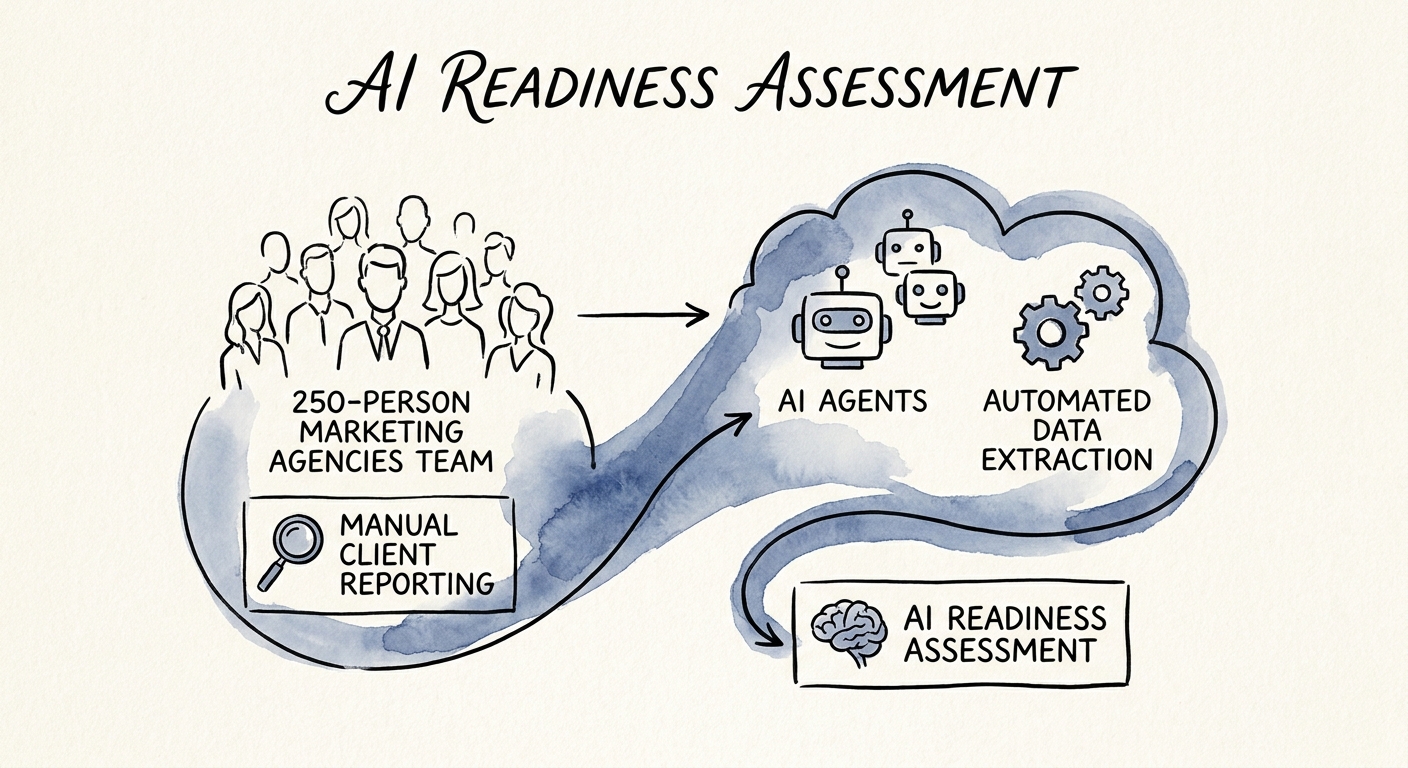
Resist the urge to roll a policy out to all fifteen pods at once. Take your highest-scoring workflow — research briefs and content repurposing usually clear the bar first, because they are repeated, reviewable, and rarely client-facing in their raw form — and run it inside one cooperative account team. The Deloitte State of AI report makes the case plainly: the firms that get returns change the process, not just the tool access. For an agency that means a named owner, a defined work type, written client-data rules, a QA checklist that lives inside the deliverable, a training plan for that one pod, and a weekly number you actually look at.
And hold the line on agents. It is tempting to wire AI straight into your project management stack, cross-client asset libraries, or automated publishing — that is where the apparent magic is. The Gartner agentic AI project forecast expects more than 40% of agentic projects to be scrapped by 2027, and an agency wiring autonomous AI across client accounts before its data boundaries score a 4 is volunteering to be in that 40%. Prove one governed human-in-the-loop workflow first.
Start by finding the workflow that's actually ready. Use workflow discovery for AI automation to identify your strongest candidate, then map the path from one governed pilot to a firm-wide standard.