
The practical answer
- Short answer
- Acquired ML engineers don't quit over money. They quit the week IT puts a two-week ticket between them and a GPU. Here's the post-close playbook that keeps them.
- Best fit
- Industry: B2B SaaS & Enterprise Tech. Function: M&A Integration / IT
- Operating path
- Migration & Integration → Turnaround & Restructuring → Transaction Advisory Services
- Key metric
- 35% Value saved by linking earnouts to model performance rather than standard tenure retention.
The resignation was written on a Tuesday, three weeks before it was sent
Picture the diligence room nine months earlier. The thesis was the team: four ML researchers whose model was the entire reason you paid an 18x revenue multiple for a generative-AI bolt-on. The data room was clean, the founders were aligned, the earnout looked airtight. Then the deal closed, and the integration PMO ran the same plan it runs on every acquisition — migrate infrastructure on Day 30, rationalize cloud spend by Day 60, consolidate identity on the corporate tenant. By Day 45, the lead researcher was on a recruiter's calendar. None of those PMO milestones knew they had just terminated the asset.
Here is the part that surprises operating partners: machine learning engineers do not break the way enterprise full-stack developers break. A full-stack dev can tolerate a ticketing queue, a VPN, a change-approval board — annoying, survivable, normal corporate friction. An ML researcher's entire workday is an experiment loop: pull a slice of training data, spin up a GPU instance, run it, look at the loss curve, adjust, repeat — sometimes forty times before lunch. The instant you put a two-week IT provisioning ticket between them and that loop, you haven't slowed them down. You've removed the reason they show up. That gap between "I had root on my own cloud yesterday" and "I now file a ticket and wait" is the moment the resignation gets written, even if it doesn't get sent for three more weeks.
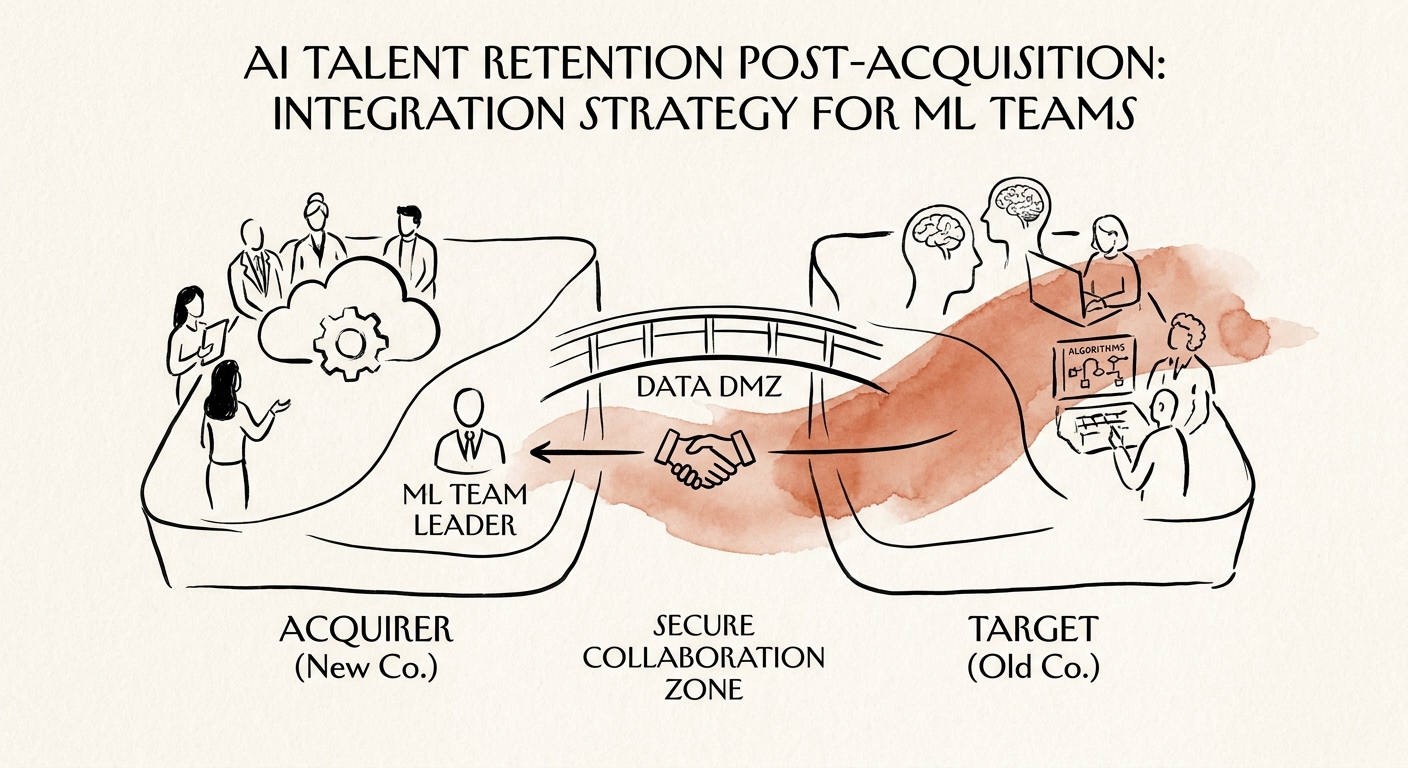
The market has priced this. PitchBook's 2026 Tech Talent M&A Benchmarks put fully-loaded ML talent replacement north of $1.4 million per head once you count recruiting, sign-on, and the months of lost model velocity — and that assumes you can re-hire at all, which you usually can't, because the model the new hire would need to understand left with the person who built it. You don't recover from this by spending more on retention bonuses. You recover by never triggering the loop-break in the first place. And that means the most important integration decision happens on Day 1, not Day 100: you ring-fence their environment. The acquired team keeps their existing AWS or GCP project, with root, untouched, for at least the first twelve months — and you treat that as a non-negotiable term of the deal, the same way you'd treat a working-capital peg.
An acquired ML researcher's resignation letter is usually written the first Tuesday they wait 72 hours for a GPU they used to spin up in five minutes. You didn't lose them on compensation. You lost them on latency.
Why the model degrades even when nobody touches the code
The second failure is quieter and arrives later, which is exactly why nobody connects it to the integration. Roughly six months after a clean-looking close, the production model starts drifting — predictions get worse, the dashboard the deal thesis was built on slides — and everyone assumes the team got lazy or the tech was overhyped. It's neither. McKinsey's State of AI 2025 Report found that a large share of acquired ML models degrade in production within six months post-close, and the cause is structural: the model wasn't a static artifact, it was the live end of a continuous ingestion pipeline. When your team merged the data environments to show the investment committee a synergy number, they didn't break the model — they cut the pipeline that kept retraining it. Code doesn't rot. Severed data feeds do.
So the rule for the first 100 days is counterintuitive for anyone with a security background: the acquired team's data infrastructure is a protected production asset, not a thing to harden on the standard schedule. Your CISO will push to consolidate IAM immediately, and on a normal SaaS acquisition that instinct is correct. Here it's a beheading. When a researcher pulling a $400K comp package waits 72 hours for permission to stand up a test environment, the wait isn't an inconvenience — it's a signal that this company doesn't understand the work, and that signal is what they repeat to the recruiter. This is the trap acquirers fall into: over-securing the perimeter on the legacy playbook while ignoring the post-merger identity and access realities that actually govern whether the team can do its job. Bain & Company's 2025 Tech Integration Benchmarks tie those compute-access delays directly to a steep productivity collapse in ML teams through the first quarter — and productivity collapse and attrition are the same curve with a two-month offset.
The fix that works is an isolation pattern: a protected data zone where the acquired team keeps running experiments and shipping model updates autonomously, with their original feeds intact, while the parent quietly mirrors those feeds into the central data lake in the background. The team never feels the migration. By the time you cut over — months later, on the team's clock, not the PMO's — the pipeline has been running in parallel long enough that the model never notices. You get your consolidation and your synergy number. You just sequence them behind the work instead of in front of it. The discipline here is the same one that prevents the broader velocity tax on acquired engineering teams: integrate the things that don't touch the daily loop first, and the things that do, last.
Re-architect the earnout around GPUs, not tenure
Now the part the lawyers got wrong in diligence, before you even owned the problem. The retention package was a stay bonus tied to twelve months of tenure — standard, defensible, useless. Gartner's 2026 AI Talent Integration Study found tenure-based retention agreements succeed with AI researchers far less often than agreements tied to dedicated GPU-budget guarantees. The reason is mechanical: a tenure bonus competes on money, and on money you will lose, because a hyperscaler can buy out a stay bonus with a single equity grant before lunch. What they can't easily replicate is a written promise that this specific person's compute budget is theirs to command — because at the hyperscaler, that researcher becomes one of ten thousand fighting for the same cluster. Guaranteed autonomy over their own loop is a retention lever the giant can't match. Tenure is one it crushes.
So restructure the earnout around what the work actually rewards: a compute budget guaranteed in writing at the LOI stage, model-performance thresholds the team controls, and uninterrupted deployment authority — not a calendar date. PwC's Post-Merger Integration data for 2026 shows acquirers who tie technical earnouts to algorithmic performance thresholds preserve a meaningful slice of deal value that otherwise leaks to attrition. And get the sequencing right at the table: if you let the integration team tell a technical founder their cloud spend gets cut 40% post-close in the name of EBITDA, the senior researchers will be gone before the definitive agreement is signed. The compute number is a retention term first and a cost line second.
Three things to do in the first two weeks, not the first hundred days. First, during technical diligence, identify the top few researchers whose departure would actually break the model — name them, because "the whole team" is not a retention plan. Second, grant those people day-one equity in the parent platform so their upside is tied to the integration succeeding, not to a recruiter's next call; treat post-merger equity refreshes for key engineers as a close-week action, not a quarter-two review item. Third, put the GPU guarantee in writing and let the team see it. Do all three before the PMO's standard playbook touches a single line of their infrastructure — because the resignation is written on the first Tuesday the loop breaks, and by Day 100 you're not retaining a team, you're reading exit interviews.