The practical answer
- Short answer
- A diligence team can find every rogue AI subscription in your consulting firm in an afternoon. Here's how tool sprawl becomes a valuation lever — and how to close it.
- Best fit
- Industry: Professional Services. Function: Information Technology / Operations
- Operating path
- Process Documentation → Operational Excellence → Transaction Execution Services
- Key metric
- 31.4% Higher consultant utilization realized by firms with strictly documented and standardized AI workflows.
The afternoon a diligence team priced your tool sprawl
Picture a mid-market implementation shop — say a 150-consultant Salesforce or NetSuite partner doing $40-50M in services revenue, headed toward a sale. The expense report pull lands on a buyer's operational diligence team, and within an afternoon they've tallied it: eleven different AI subscriptions across the staff. ChatGPT Plus on forty cards. A dozen Claude Pro seats. Jasper for the marketing team, three flavors of code assistant in delivery, two transcription tools nobody approved. None of it runs through your firewall. None of it has a data processing agreement. All of it has touched client schemas, statements of work, and in a few cases regulated data.
The buyer doesn't write "innovative." They write "unquantifiable IP leakage" and start sharpening a pencil. This is not a hypothetical fear — it is the base rate. Gartner's 2025 Shadow AI Enterprise Spending Benchmark puts 68% of enterprise AI usage entirely outside corporate data-loss controls. For a services firm, that ungoverned majority is exactly the part doing the billable work.
Here is the trap most founder-CEOs miss: the problem isn't the $20-a-month spend. It's what the spend reveals about how your delivery actually runs. If your throughput depends on consultants quietly pasting client data into consumer apps, that throughput can't be inspected, can't be transferred, and can't be promised to a buyer's model. Bain's 2025 Consulting Firm AI Impact Report measures the live cost of that fragmentation at a 9.4% margin drag — duplicated licenses, inconsistent output, rework cycles. You're already paying it monthly. The valuation haircut just makes you pay for it again at close. Understanding the hidden margin in your delivery model starts with admitting your tech stack was defined by whoever expensed fastest.
A buyer doesn't discount you for using AI. They discount you because your best work lives in 150 private chat histories that walk out the door at resignation. Govern the workflow, not just the tool.
Standardization is a documentation problem, not a firewall problem
The instinct is to block OpenAI at the network edge and send a stern memo. Do that and you'll lose your best billers, who will simply use their phones. Tool sprawl is a symptom; the disease is that nobody wrote down how AI is supposed to be used on an engagement. So the fix is provisioning plus paper: one approved enterprise tenant — an enterprise Copilot, a private Azure OpenAI instance, an enterprise Claude deployment — and a documented workflow that makes the sanctioned path faster than the rogue one.
Two documents do the heavy lifting for a consulting firm specifically. First, a data classification policy that maps client data tiers — public, internal, confidential, restricted — to which approved model may touch them. A consultant should never have to guess whether a client's customer list can go into a prompt; the SOW tier should answer it. Second, a peer-review step inside your delivery workflow, because a hallucinated integration spec shipped to a regulated client is the kind of incident that ends up in a deposition. Build human verification into the project tooling, not into someone's good intentions.
This discipline pays both ways. McKinsey's 2026 State of AI in Professional Services finds firms with documented, standardized AI workflows hit a 31.4% higher consultant utilization rate than peers on fragmented toolsets — the gain comes from reusable prompt libraries and standard output templates, not faster typing. And it closes the diligence lever. PwC's 2025 Global AI Governance Survey reports 83.2% of private equity acquirers will actively penalize a target's valuation when no enforced AI governance policy exists. Show up to the data room without it and you've handed the buyer a compliance debt they will price down to the dollar.
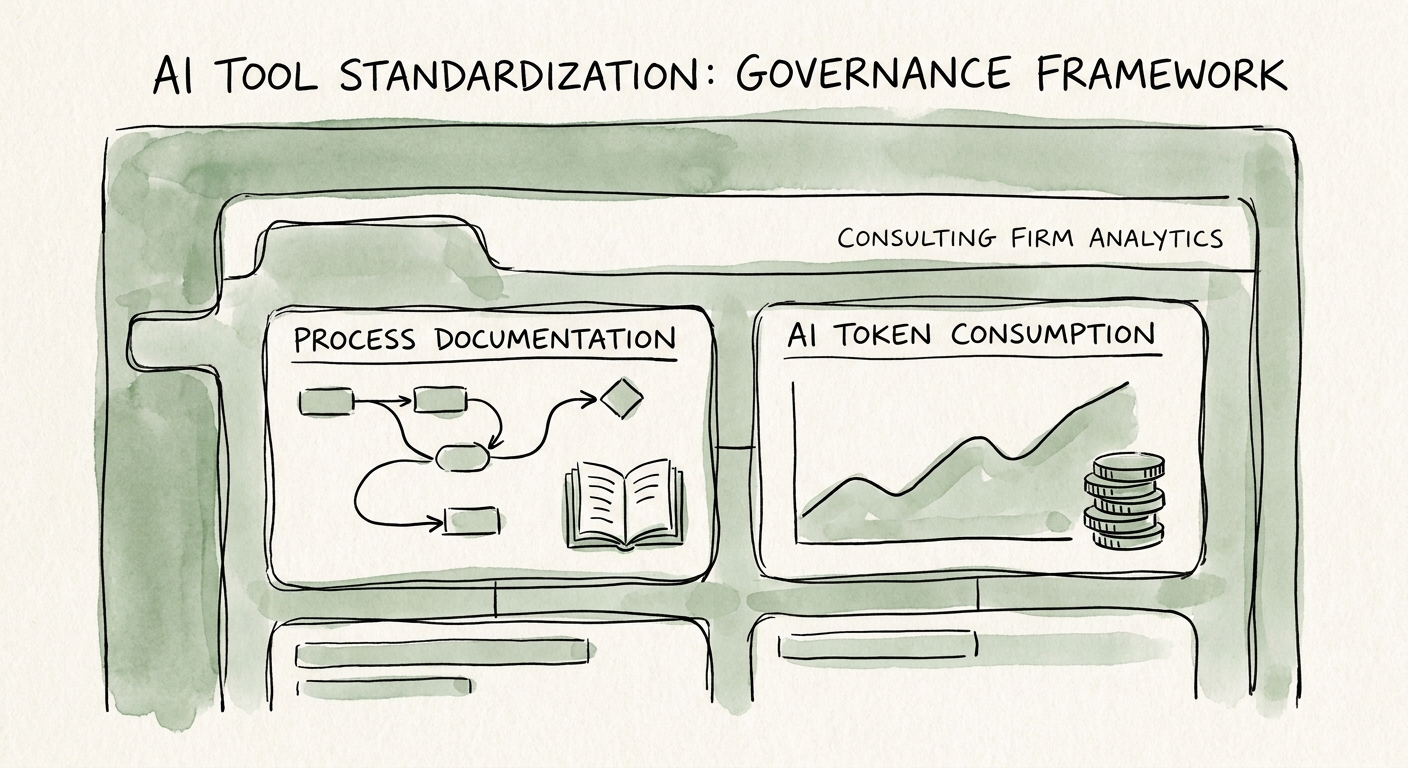
The 90-day migration, run like a tech migration
Treat consolidation the way you'd treat a PSA or ERP cutover, not a Slack announcement. Start with the expense reports you already have: every consumer AI line item is a node on your migration map. Cut reimbursement for the rogue apps and route that spend into a single enterprise tenant where your firm holds zero-retention terms and owns the interaction logs. That last part is the whole game. Right now your firm's accumulated AI know-how lives in 150 private chat histories that vanish the day someone resigns. A unified tenant turns those vanishing histories into a queryable institutional asset — and lets revenue operations tag token spend to a client engagement so AI moves from murky overhead to a billable, margin-tracked input.
Then build the thing the rogue tools never could: a curated prompt and template library for your actual deliverables — the integration runbook, the discovery questionnaire, the code-review checklist your senior architects run by instinct. That capture turns individual heroics into transferable IP, which is precisely what a buyer is paying a multiple for. Forrester's 2025 ROI of AI Tool Consolidation Analysis found firms consolidating to a single secure enterprise model cut severe IP-leakage incidents by 94.6% while trimming aggregate licensing costs 22% — you de-risk and save at the same time.
Monday's move is small: pull the AI line items off the last quarter of expense reports and count the distinct tools. That number is your sprawl, and it's the same number a diligence team will reach. Close the gap before they open it. The ROI of process documentation here isn't a softer audit — it's the difference between AI reading as risk on the diligence summary and reading as a transferable, governed delivery asset. One dilutes your enterprise value. The other expands the multiple.