
The practical answer
- Short answer
- Stop measuring generic CSAT. Learn the 3 operational metrics that actually predict AWS migration success and drive 12x exit multiples for consulting firms.
- Best fit
- Industry: Cloud Consulting. Function: Delivery Operations
- Operating path
- Process Documentation → Operational Excellence → Transaction Execution Services
- Key metric
- 83% Failure rate of data migration projects that lack standardized process governance (Source: Kaopiz Global).
The "Heroics" Trap: Why Your Best Engineers Are Killing Your Scalability
If your AWS migration practice relies on your lead architect pulling all-nighters to hit a go-live date, you don't have a business; you have a latent risk. I see this in 90% of the founder-led consulting firms we audit: a $20M revenue shop that delivers like a $5M shop because every complex decision still routes through the founder or a single "hero" engineer.
This isn't just an operational headache; it's a valuation killer. When private equity buyers look at your Quality of Earnings (QofE), they aren't just checking your EBITDA margins. They are looking for transferability. If your delivery success is tied to "Tribal Knowledge" rather than "Process Documentation," your multiple contracts from 10x to 4x instantly.
The industry data is brutal. According to recent studies, 83% of data migration projects fail or exceed their budgets. Why? It's rarely the technology. AWS provides the same tools to everyone. The failure point is almost always process governance. When you measure success by "did we hit the date?" (a lagging indicator) instead of "did we follow the standard operating procedure?" (a leading indicator), you are gambling with your client's infrastructure and your own equity value.
To break the "Hero Cycle," you must shift your Customer Success definition from "client happiness" (subjective) to "operational predictability" (objective). Scalable firms document the how, not just the what. You need to move from tribal knowledge to turnkey documentation before you can even think about an exit.
A high CSAT from a CIO means nothing if the VP of Engineering is quietly blocking your access. Divergence in stakeholder alignment is the single biggest predictor of project failure.
The 3 Metrics That Actually Predict Migration Success
Stop showing your board "Green/Yellow/Red" status slides based on vibes. If you want to scale your AWS practice, you need metrics that reveal the structural health of your delivery engine. Here are the three non-negotiable metrics we install in portfolio companies to predict project outcomes before they go off the rails.
1. Drift Velocity (Scope Creep per Sprint)
Most firms track Scope Creep as a change order dollar amount. That's too late. You need to measure Drift Velocity: the number of unplanned engineering hours consumed by "minor tweaks" each week. If your Drift Velocity exceeds 15% of total capacity, your project is already underwater, even if the timeline looks green. This metric forces your team to document scope boundaries rigidly. High drift is a leading indicator of margin erosion—a classic sign of cloud migration cost overruns waiting to happen.
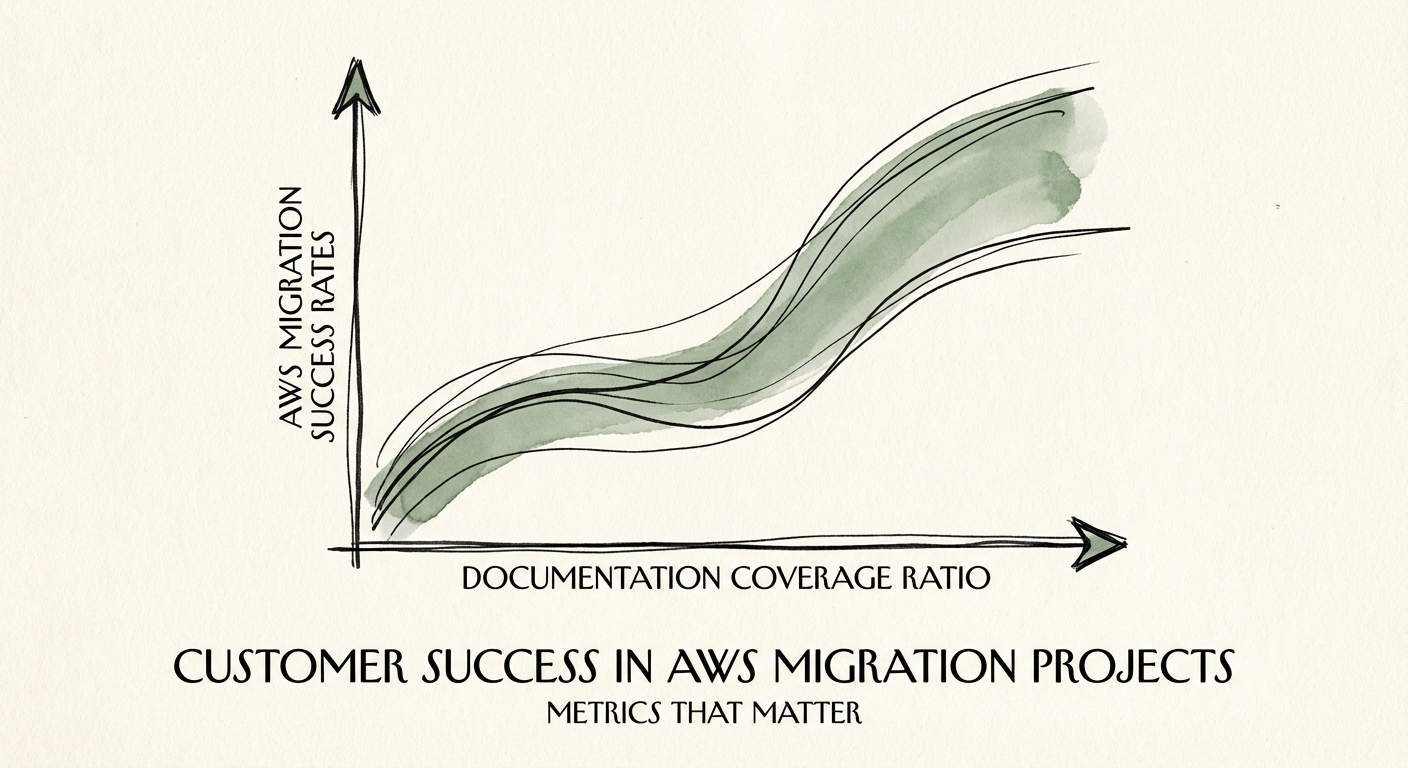
2. Documentation Coverage Ratio (DCR)
This is the percentage of migration steps that are executed against a written Standard Operating Procedure (SOP). In founder-led firms, this number is often <20%. In elite practices trading at 12x EBITDA, it's >90%. We require delivery teams to log which SOP was used for every major milestone (e.g., "Database Cutover SOP v4.2"). If a step is performed without an SOP, it's flagged as "Undocumented Risk." PE buyers love this metric because it proves your IP exists outside your CTO's brain.
3. Stakeholder Alignment Score (SAS)
Don't wait for the Net Promoter Score (NPS) survey at the end. The SAS is a bi-weekly pulse check where we ask the client's executive sponsor and technical lead three questions about alignment, not satisfaction. Divergence between the executive's score and the technical lead's score is the single biggest predictor of project stalling. A high CSAT from a CIO means nothing if the VP of Engineering is quietly blocking your access because you didn't document the compliance requirements correctly.
From Project to Platform: Securing the 12x Exit
The difference between a service provider and a strategic partner is the ability to guarantee outcomes. When you have the data to prove that your process reduces migration failure rates from the industry average of 70% down to <5%, you no longer compete on rate cards. You compete on risk mitigation.
Private equity firms pay premiums for "Productized Services." This means your migration service looks, feels, and performs like software: predictable, repeatable, and scalable. By rigorously tracking Drift, Documentation Coverage, and Alignment, you build a data room that tells a story of inevitability.
Your Customer Success function shouldn't just be taking the client to lunch. It should be the guardian of your process integrity. If you are the founder, your next hire isn't another rockstar architect. It's a Head of Delivery Operations who speaks fluent EBITDA and can enforce these metrics without blinking. That is how you turn a messy services shop into a high-margin platform ready for a strategic exit.