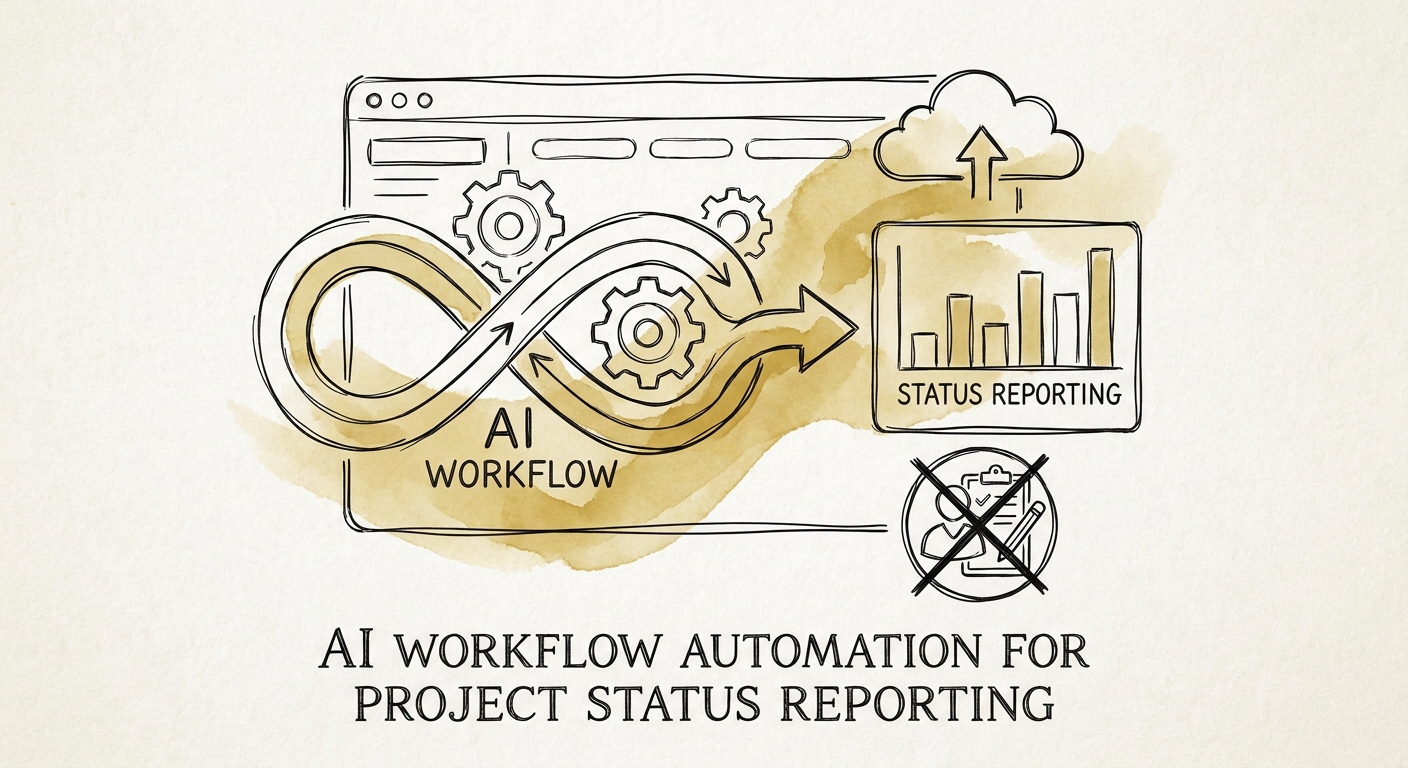
The Thursday-night deck is a plumbing problem, not a writing problem
Picture the standing ritual: it's 6 p.m. the night before the steering committee, and a delivery lead is alt-tabbing between Jira, a finance export, three Slack threads, and last week's deck — copy-pasting RAG statuses into slides and hoping the burn number is current. The output looks polished. It is also a snapshot of whatever the author happened to remember, formatted to look like fact.
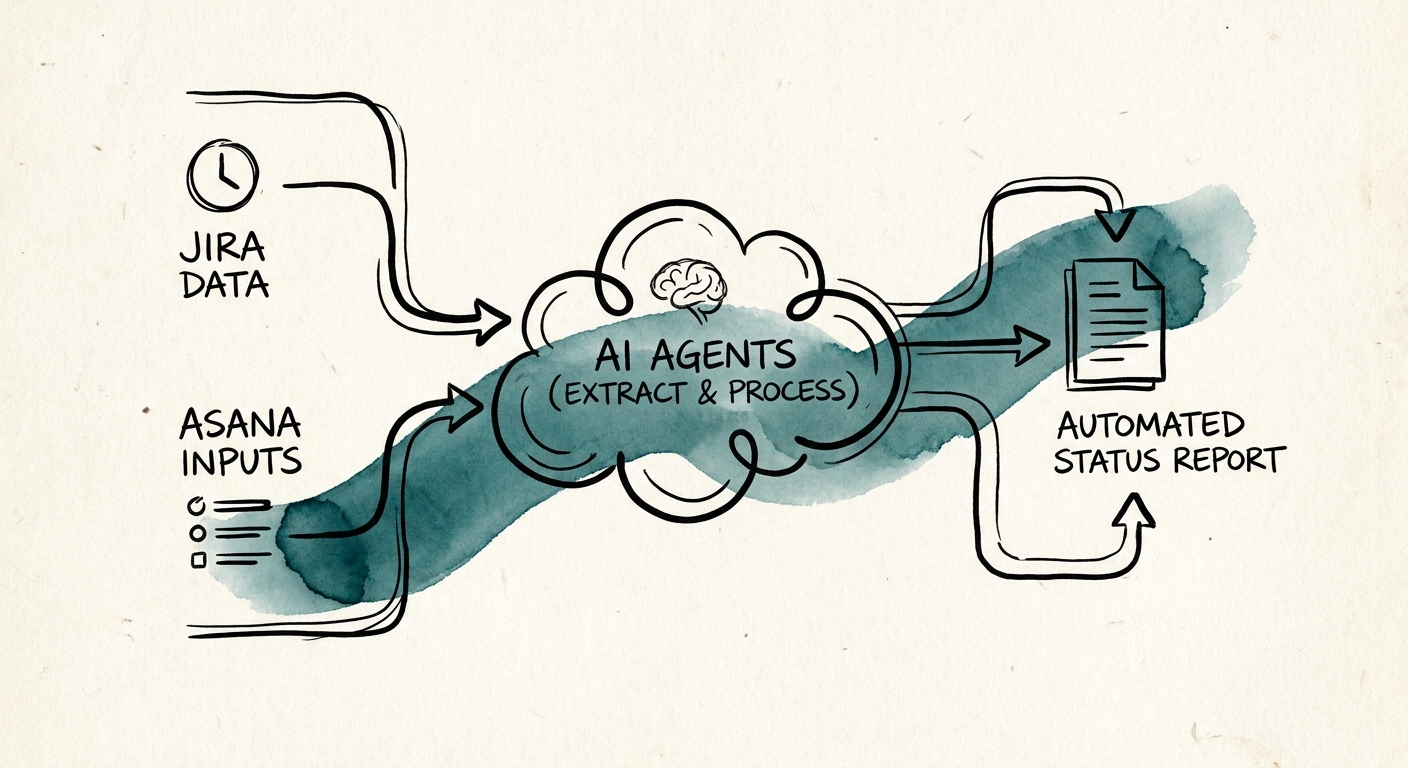
People assume the fix is a tool that writes better summaries. It isn't. The painful part was never the prose — it was reconciling six systems by hand under time pressure. McKinsey's State of AI 2025 makes the point that AI moves the needle when you redesign the workflow around it, not when you bolt it onto the old one. For status reporting that means the win isn't a prettier memo. It's an evidence-backed package where every red flag traces to a ticket, a burn line, or a missed update — assembled automatically while the owner sleeps.
Say a 25-person implementation team runs eight concurrent client projects. The drafting was never eight hours of typing; it was eight hours of hunting for what moved since last Thursday. Automate the hunting. Leave the judgment.
What you actually have to build before the AI touches anything
A status summarizer is only as honest as the pipes feeding it, and this is where most attempts quietly fail. IBM's Institute for Business Value research on AI capabilities frames the unglamorous prerequisites that decide whether you get ROI: clean source-system access, a consistent way to name things across projects, and logic for what counts as an exception. If two project managers tag "at risk" differently, or one team's "done" means deployed and another's means merged, the AI will dutifully average their inconsistency into a number nobody should trust.
So the order of operations is backwards from how teams usually approach it. First, decide which systems are authoritative — Jira owns task state, the finance system owns burn, and the AI is forbidden from inventing either. Second, write the exception rules in plain language: a milestone slips more than five business days, burn outpaces percent-complete by a defined margin, or a workstream goes quiet with zero updates for a week. The AI's job is to find those conditions and surface them, not to characterize whether they matter.
That last line is where governance earns its keep. The NIST AI Risk Management Framework gives you the control model: name your authoritative sources, define the point where a generated summary must get human eyes before it leaves the building, and decide how stale or wrong project evidence gets corrected and re-run. A status pack that quietly summarizes a two-week-old export is more dangerous than no pack at all — it launders staleness into the language of certainty.
Run it supervised, and measure the right loop
The temptation is to let an agent fully own the cadence — pull, summarize, send, no human in the loop. Resist it for the first quarter. Bain's agentic AI transformation report is useful for thinking about where autonomous workflows are headed, but reporting is exactly the place to start supervised: the owner reads the draft, confirms or overrides the exceptions, and adds the one thing the systems can't see — the client's mood on the last call, the dependency a vendor just slipped.
Then track whether it's actually working, not just whether it ran. Watch four things: prep time per status cycle (the hours you were trying to reclaim), missing-update rate the AI catches before the meeting instead of after, how many flagged exceptions turned out to be real, and the one that matters most — whether your steering committee leaves with clearer decisions. If the deck is faster to produce but the meeting still ends in "let's circle back," you automated the artifact and missed the point.
Pick your messiest recurring report and map its five inputs this week. Use AI Workflow Automation to scope that first reporting workflow, and run the AI ROI Calculator to weigh the reclaimed prep hours against what it costs to wire the systems together. Start there — one report, supervised, measured — before you ever let it run on its own.
