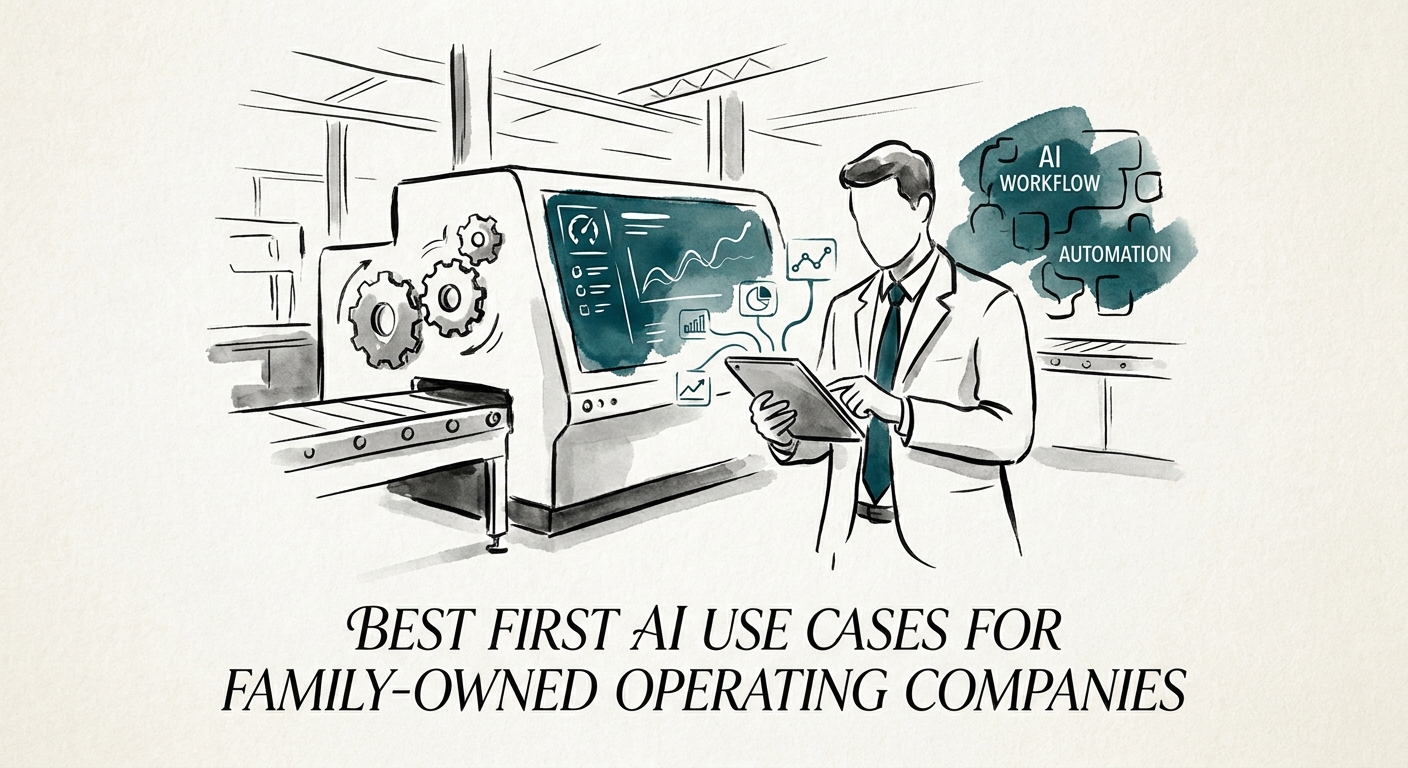
The work that lives in one person's head
In most family-owned companies I've seen, the real operating system isn't software. It's a person. It's the dad who still approves every invoice over a certain dollar amount because he "just knows" which vendors run late. It's the aunt who's done the month-end close the same way for nineteen years and has never written a single step down. It's the long-tenured plant manager who can look at a purchasing variance and tell you in four seconds whether it's a data error or a real problem.
That concentration of judgment is the strength of a family business and its single biggest fragility. And it's exactly why the first AI use case here looks different than it would at a venture-backed startup. The temptation is to chase the impressive demo — a chatbot, a marketing copilot, something you can show off at the next family meeting. Resist it. The right first workflow is almost always something boring and slightly uncomfortable: the routine decision that currently can't happen unless one specific person is in the building.
The data backs up why smaller companies struggle here specifically. The OECD report on AI adoption by small and medium-sized enterprises and the San Francisco Fed analysis of AI and small businesses both point to the same gaps: uneven internal skills, fragmented knowledge, and confidentiality worries that don't exist at the same intensity in a larger, more bureaucratic firm. The RSM middle-market AI survey shows mid-market firms are moving, but moving is not the same as choosing well. So before you pick anything, ask the honest question: which routine task stalls the whole company the moment one family member takes a vacation? That's your candidate. Run it through the SMB AI readiness assessment to confirm the source data is clean enough and someone other than the bottleneck-person will own the review.
You're not automating a process. You're touching a relationship.
Here's the part the technology vendors leave out. When you tell your father that you're going to have an AI system capture how he handles AP exceptions, he doesn't hear "efficiency gain." He hears "they're getting ready to do this without me." When you ask the nineteen-year close-process aunt to narrate her steps into a system, she may quietly conclude she's training her replacement. In a family business, those reactions are not paranoia — they're the accurate read of how power and identity work in a company where the org chart and the family tree overlap.
So the sequence matters as much as the use case. Start by naming the goal out loud, to the person whose knowledge you're capturing, before any tool gets involved: "We need this to keep running when you're not here, and we want it documented in your words." Capturing a tenured manager's standard operating procedure becomes a legacy project — preserving how they think — rather than a quiet act of redundancy. That framing is the difference between enthusiastic cooperation and slow-rolled sabotage.
Then put guardrails on the mechanics. The NIST AI Risk Management Framework translates cleanly into owner-level questions: what's the specific task, what kind of mistake would actually damage a customer or family relationship, and who signs off before anything goes out the door. The CISA AI Data Security Best Practices matter more here than at a faceless corporation, because the "data" is your vendors who've extended credit on a handshake, your employees' compensation, and family financial detail that has no business sitting in an unvetted tool. Approve the sources deliberately, lock access by role, keep the logs. Say a 60-person third-generation distributor wants to capture purchasing-variance review from a retiring manager — the system should draft the explanation and flag the anomaly, while a named human still makes the call. The 90-day AI implementation plan gives you a way to stage the conversation, the capture, the source cleanup, and a narrow pilot in an order that protects trust instead of spending it.
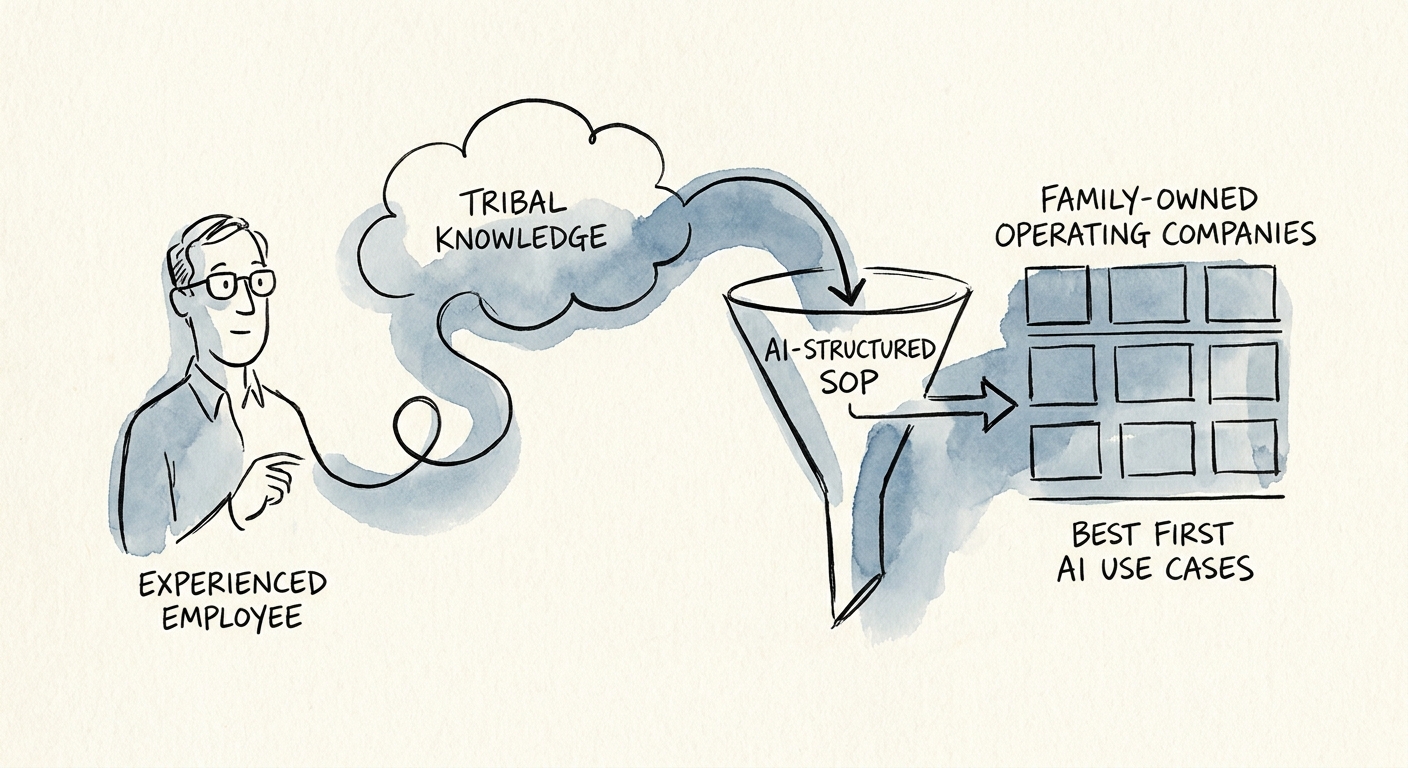
Prove it in the meeting you already have
You almost certainly already run some version of a weekly or monthly leadership huddle where the family and key managers look at cash, problem customers, and what broke. That meeting is your test environment. The Deloitte State of AI in the Enterprise 2026 lands on a finding worth tattooing on the conference room wall: value comes from governed workflows woven into how people already work, not from isolated experiments that live in a separate tab nobody opens. A pilot that requires a new ritual will quietly die. A pilot that makes Tuesday's standing meeting shorter and sharper survives.
So measure the things that meeting actually feels. Did the owner's approval queue shrink — can decisions clear when Dad's at his grandkid's game? Did the exception backlog go down or just move? Are handoffs getting missed less often? And the softest but most telling signal in a family company: did the meeting get calmer? When the variance review shows up pre-explained and the cash summary is already drafted, the discussion shifts from "what happened" to "what we do about it." If instead the AI output spawns three new arguments and reduces nothing, it isn't ready, no matter how clever it looks.
Do not bolt on a second trust-sensitive workflow until the first one has earned a few weeks of "this actually helped" in that room. Run the result through the AI ROI model without fake savings so you're counting real recovered hours and real reduced risk, not a vendor's hypothetical. Get one workflow right — clean data, a named human accountable, a result your leadership team can see every week — and you'll have something far more valuable in a family business than a flashy tool: proof that you can modernize without anyone feeling pushed out.
