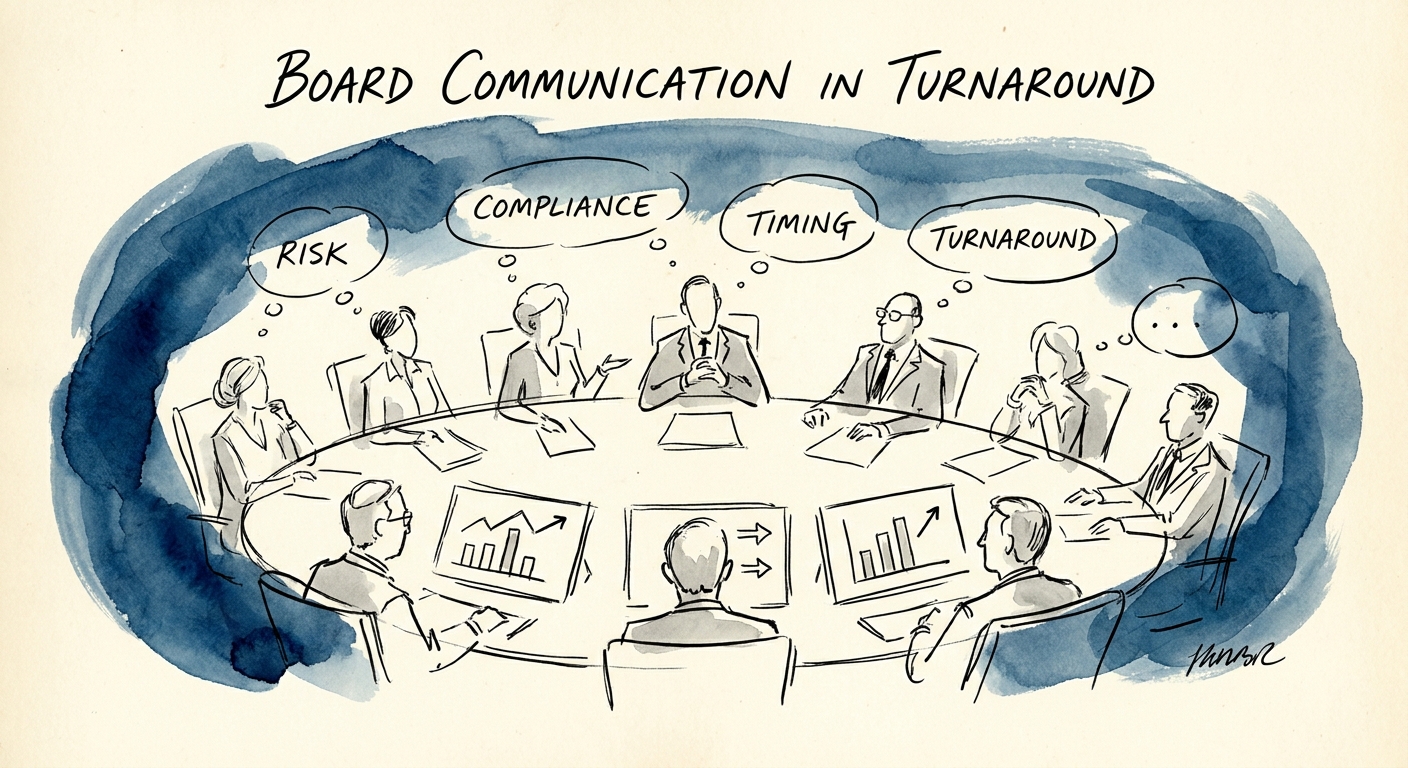
The week-six RIF is when the company is most exposed and least watched
Picture the board deck for a distressed software company six weeks into a turnaround. Slide one: the 13-week cash flow, color-coded, every line interrogated. Slide two: headcount, with a second RIF wave proposed for the IT and security functions because "we haven't had an incident, so it's clearly overstaffed." Nobody on the call asks who is processing offboarding for the forty people who left last month, or whether their VPN tokens and admin credentials have actually been revoked. That queue — not the burn rate — is where the next disaster is sitting.
This is the structural flaw in how turnaround boards run their agendas. Liquidity, working capital, and headcount get an hour; the security posture gets dropped to make time, right when organizational anxiety peaks, internal controls slip, and angry former employees still hold keys. The math is unforgiving: IBM's 2025 Cost of a Data Breach Report puts the average U.S. incident at $10.22 million. A turnaround team can grind for two quarters to claw back a few million in EBITDA, and a single breach erases all of it in an afternoon — plus the legal tail, plus the hit to whatever exit you were building toward.
And the failure mode is rarely a sophisticated attacker. Gartner's Cloud Security Posture Management Forecast attributes roughly 82 percent of cloud security failures to human error and misconfiguration — a forgotten storage bucket left public, a permission that was never scoped down, an offboarding ticket nobody closed. Those mistakes don't stay flat under pressure; they multiply when you've cut the team that catches them in half and told the survivors to do more with less. The board needs to hear about that the same week it hears about the cash, not in the post-mortem.
Stop asking "are we secure?" and start pricing the cut
"Are we secure?" is an unanswerable question, so it produces a useless answer — a green slide about firewall patching that tells the board nothing and lets everyone move on. The better question is specific to the asset keeping the company alive: if survival depends on a proprietary customer dataset or a regulated billing system, the board should hear exactly how that one data flow is being protected through the restructuring, and what changes the moment you cut the people guarding it. McKinsey's Board-Level Cyber Resilience Analysis makes the same point: treat cyber as an enterprise capability protecting specific value, not as an operational checklist to be skimmed.
The translation that actually changes behavior is to price every proposed cut in dollars and days. Say you're evaluating eliminating a compliance analyst to save roughly $120K a year. The honest board entry isn't "headcount reduction: $120K." It's: removing this role leaves GDPR and CCPA obligations unowned, the exposure on a regulatory finding runs well into seven figures, and that finding lands on the sponsor's desk — it doesn't politely wait behind the preference stack. Suddenly $120K of savings is a bad trade, and the board can see why without a security briefing. PwC's Cybersecurity Governance Framework frames this as embedding cyber risk directly into strategy and monitoring resilience — including whether disaster recovery still works after you've thinned the team that runs it.
You cannot cost-cut your way out of a regulatory mandate. The obligation survives the layoff; only the person who was meeting it disappears. A board that prices its cuts this way will reject the ones that look free on the cash flow but carry an unfunded liability you'll inherit at exit.
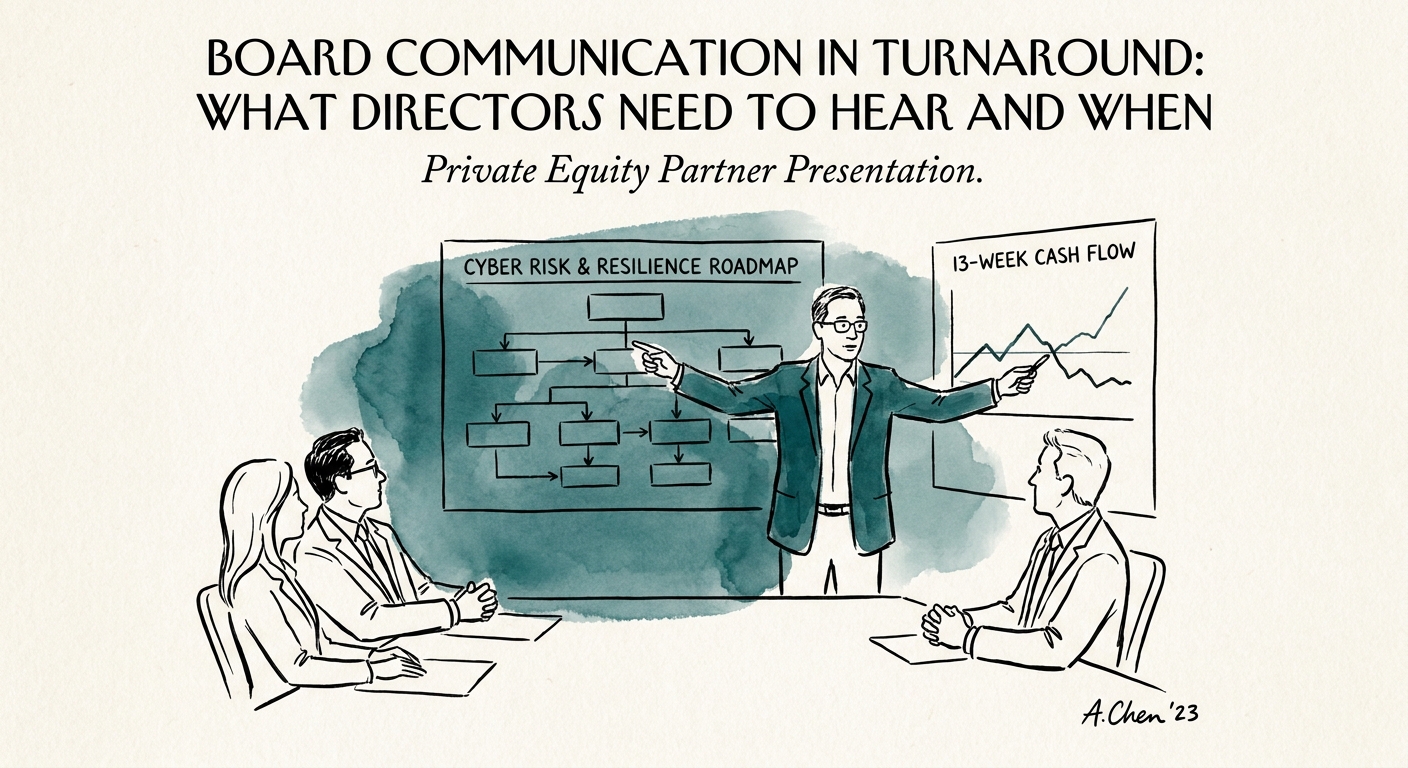
Map a 30-60-90 compliance roadmap against the cash flow — and watch the vendors
The single most useful artifact you can add to turnaround board reporting is a 30-60-90 day compliance roadmap laid directly over the 13-week cash flow. When a milestone — closing a control gap, completing a SOC 2 remediation, finishing access reviews — depends on a function you're about to cut, the conflict becomes visible before someone authorizes it by accident. Pair it with a single dashboard that puts security telemetry next to the financial KPIs: open offboarding tickets, accounts with standing admin access, days since the last access review, status of critical vendor contracts. If that view exists, you are never blindsided by an IT failure dressed up as a cost-saving win.
Watch the vendor edge especially hard, because turnaround chaos is where it frays. As you slash vendor spend, renegotiate contracts under duress, and consolidate suppliers to buy runway, the attack surface widens precisely when nobody's auditing it. BCG's Private Equity Regulatory Climate Report warns that regulators increasingly hold sponsors responsible for legacy compliance failures at the companies they operate. A financial turnaround buys no regulatory holiday, and it does not shield the GP. Here is the concrete failure that should haunt every operating partner: a team eliminates its internal audit and identity-and-access-management functions to hit a savings target, controls go unowned, and the gap surfaces as a finding that kills a pending asset sale days before close — the cost cut destroyed the exit it was meant to enable. If your board's technology risk oversight is doing its job, that conflict shows up on the roadmap weeks earlier, in dollars, where the board can veto it. Run a deep operational due diligence pass on the proposed cuts and flag which ones carry an unacceptable security or regulatory tradeoff before the RIF list is signed. Board communication in a turnaround has to be brutal, numeric, and tied to enterprise value — because the things that quietly destroy that value never show up on the cash flow until it's too late to stop them.