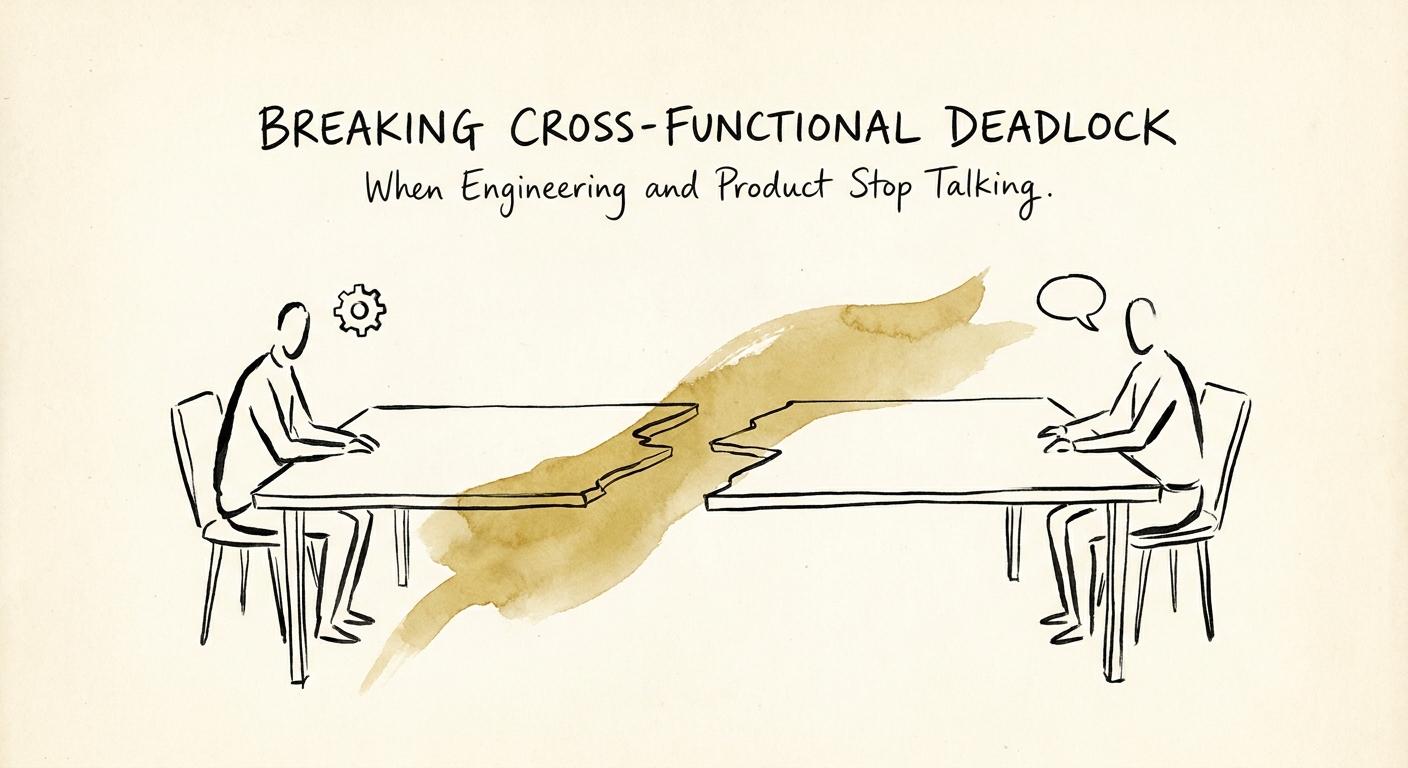
The standoff nobody calls a standoff
Walk into a $50M ARR SaaS company where product and engineering have quietly stopped talking and you won't hear an argument. You'll hear politeness. The VP of Product presents a clean quarterly roadmap. The VP of Engineering nods. Sprint planning runs on time. And deployment frequency has been sliding for three quarters while everyone agrees, in separate Slack channels, that the other side is the problem. That's not a culture issue you fix with an offsite. At this scale it's a capital problem — by the time a Series B or C founder feels it, roughly $4.2 million a year in engineering payroll is going to context-switching, half-built features, and architecture that exists mostly to protect engineers from product's next request.
I've been pulled into this exact dynamic more than once, and the tell is always the same: when I ask a product manager and an engineering lead to describe the same upcoming feature, I get two unrelated stories. Picture a 180-person MarTech company where leadership had spent a full quarter litigating why releases had slowed. I sat through one sprint planning session. The product team was dropping wireframes into tickets with no sense of what they cost to build; engineering was answering with "needs a platform refactor first" on nearly everything. Neither side was lying. They'd just stopped having the one conversation — feasibility versus value, out loud, in the same room — that the whole company depended on.
This isn't a boutique founder problem. Gartner's 2025 Software Engineering Friction Study attributes 63% of delayed software releases directly to misalignment between product and engineering leadership rather than to technical complexity. And the cost isn't only schedule. Harvard Business Review's 2024 analysis of cross-functional dysfunction found that organizations with deeply siloed product and engineering units lose senior developers at a 40% higher rate. Your strongest engineers don't leave because the work is hard. They leave because they've decided the roadmap is fiction, and they'd rather build something real somewhere else. If you're already wondering whether this has crossed from friction into something that needs outside hands, that's a fair question to sit with — there's a point where leaving it alone stops being patience and starts being negligence.
Three tells, all of them quiet
Open hostility is the easy case — people who are shouting are at least still talking. The deadlock I get called for is the polite kind, and it shows up as three operational patterns that look like diligence until you read them right.
The first is the architecture veto. Engineering starts answering product requests with "the platform can't support that yet," and the list of things requiring a foundational rebuild keeps growing. Sometimes that's real. Often it's a shield against requirements that were never specified well enough to estimate. McKinsey's 2025 Product Operating Model Benchmark found that teams in deep product-engineering deadlock burn 55% of their development cycles on unplanned refactoring to absorb shifting requirements. That's not deliberate debt paydown — it's reactive churn dressed up as engineering rigor. Before you accept "we need to rebuild," check the number against what a healthy debt ratio looks like at your stage. If a $50M-ARR team is running far past that line, the rebuild is often a political instrument, not a technical necessity.
The second is roadmap theater. Product writes an ambitious multi-quarter plan it privately knows engineering will deliver maybe a third of — because the board wants to see ambition, and because when the misses come, the blame can flow downstream. Engineers see through it on day one and mentally check out of the commercial reasoning entirely. Bain & Company's Developer Productivity Report ties precisely this disconnect to a 30% drop in real coding time, as engineers get pulled into alignment meetings that are really negotiations over whose ticket gets blamed. The third tell is the slowest poison: communication moves entirely into writing. Product ships a ten-page spec with no technical grounding; engineering counters with a constraints document of equal length; the two leads now "collaborate" exclusively through ticket comments. Once the conversation lives in async documents that exist to assign fault later, you've lost. Nobody is solving the problem anymore — they're building the paper trail for the postmortem.
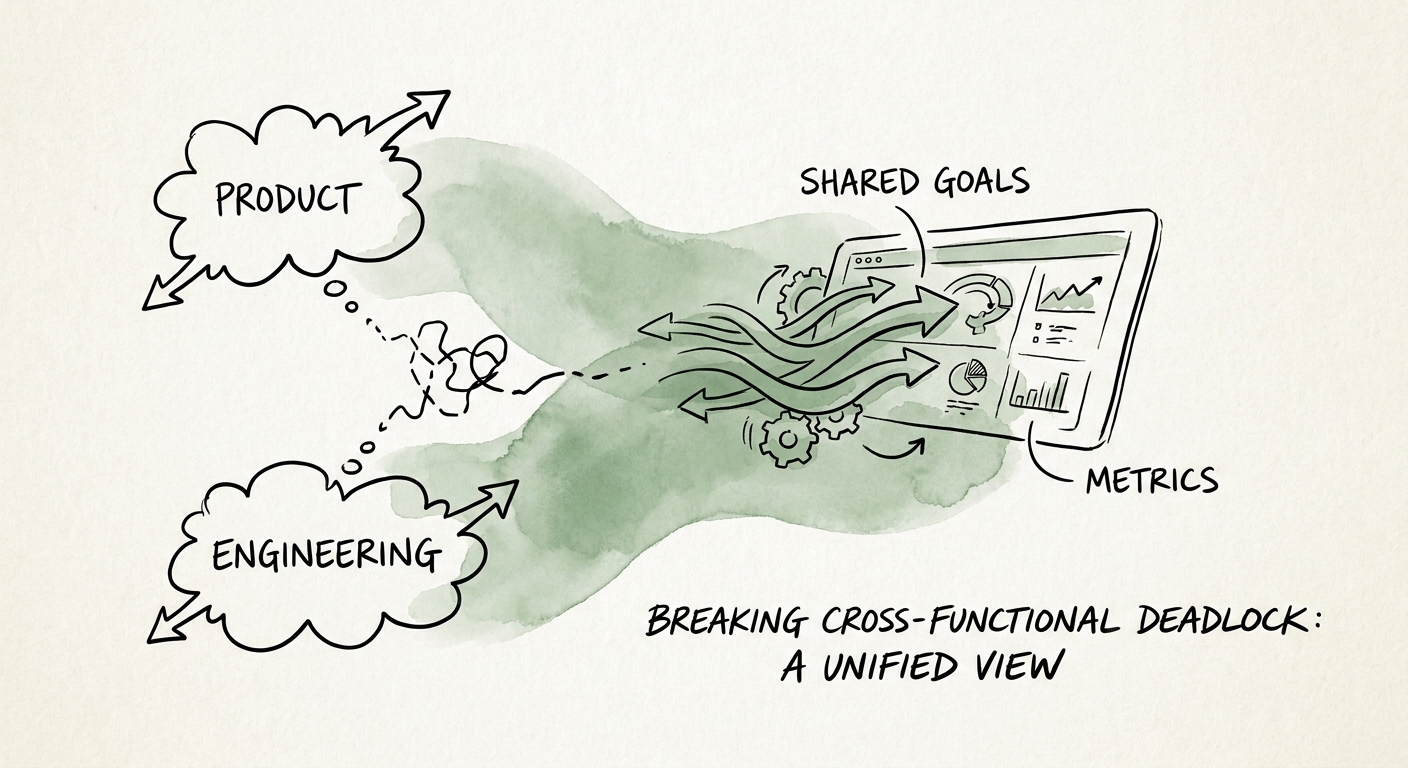
How to force the reconnect
You cannot delegate this fix to the two leaders who are deadlocked — they are the deadlock. It takes the founder or an operating partner stepping directly in, and there are three moves that actually shift it.
Start with the incentives, because right now you are paying these teams to disagree. Product is comped on shipped features and adoption; engineering is measured on uptime and defect rates. Those goals pull in opposite directions by design, so of course the people chasing them collide. Put both the VP of Product and the VP of Engineering on the same number — time-to-value for the customer — and watch how fast the posturing drops. Forrester's 2025 Agile Delivery Metrics Assessment found that teams running unified product-engineering KPIs hit time-to-market on new enterprise features 45% faster. When both leaders win or lose on the same line, the feasibility conversation stops being a turf fight and becomes a shared survival instinct.
Then change who owns the work. Every major initiative gets co-owned from day one by a product manager, an engineering lead, and a designer — one triad, no handoffs, no spec thrown over a wall. If a feature misses, all three own the miss together. That single structural change forces the hard "can we actually build this, and is it worth building" debate into week one instead of week thirteen, when the release is already on fire. The third move is the simplest and the most revealing: make your VP of Product and your CTO co-present the roadmap to the board, together. If they can't finish each other's sentences on both the why and the how, they aren't aligned yet — and you've just learned that before the board did. If the workflow itself is where things break down, our take on scaling engineering without snapping delivery velocity goes deeper on the mechanics. But the diagnosis holds: if your product and technical leaders won't sit on the same side of the table and own the commercial outcome jointly, you don't have an agile problem. You have a leadership problem — and at $50M ARR, the market will read it straight into your next valuation. Fix it before your next raise, not after.
