
Contact Us
Project RecoveryFor founder-CEO4 min

Bridge Financing Negotiation: Getting Runway Without Giving Away the Company

Discover how scaling founders can negotiate bridge financing without surrendering their cap table. Learn the 2026 benchmarks for tranches, discounts, and terms.

Executive reviewing bridge financing term sheet with project recovery milestones
Figure 01 Executive reviewing bridge financing term sheet with project recovery milestones
By
Justin Leader
Industry
B2B Tech
Function
Finance & Operations
Filed
Answer summary

The practical answer

Short answer
Discover how scaling founders can negotiate bridge financing without surrendering their cap table. Learn the 2026 benchmarks for tranches, discounts, and terms.
Best fit
Audience: founder-CEO. Industry: B2B Tech. Function: Finance & Operations
Operating path
Project Recovery -> Turnaround & Restructuring -> Transaction Execution Services -> Interim Management
Key metric
68% Failure rate of unstructured bridge rounds without operational milestones.

A "standard" 12-month bridge round in 2026 strips founders of 42% of their equity upon conversion, transforming a temporary cash shortfall into a permanent transfer of control according to PitchBook's Q1 2026 Venture Debt and Bridge Financing Report. I see founders treat bridge financing as a simple mathematical exercise in calculating months of runway, completely ignoring the structural landmines buried deep in the term sheet. You are not just buying time; you are repurchasing your own company at a massive premium. The market has fundamentally shifted from the founder-friendly extensions of the early 2020s. Today, capital providers are weaponizing the bridge note to seize governance, block future financing, and force premature liquidation events.

We saw this exact pattern in our last engagement with a Series B SaaS firm. The CEO had secured a $3M bridge to cover a stalled ERP overhaul that had temporarily frozen their invoicing. They celebrated the immediate cash injection. Three months later, they realized the bridge included a multiple liquidation preference and full-ratchet anti-dilution protection. The bridge didn't save the company; it essentially put it into receivership. When you hit The Series B Danger Zone, desperation blinds executive teams to the brutal reality of the cost of capital. You stop negotiating and start accepting. That is a fatal operational error.

The specific terms dictated in the first 48 hours of a cash crisis dictate who owns the upside when you finally fix the underlying operational failures. The empirical data is brutal on this front. According to CB Insights' 2026 Down Round Risk Matrix, 68% of companies that take unstructured bridge notes without explicitly defined operational recovery milestones fail to raise a subsequent priced round. The bridge becomes a pier. You run to the end of it and drown. You must tie the capital directly to a measurable project recovery plan.

Deconstructing the Bridge Term Sheet

Stop looking at the interest rate. The interest rate is a complete distraction. The true cost of your bridge financing lives entirely in the discount rate, the warrant coverage, and the negative covenants. Investors use bridge rounds to re-price their past mistakes. I have rebuilt this executive team consensus three times this year: you must aggressively refuse standard discount rates if the bridge is strictly tied to a discrete project recovery. When you review Cooley's 2026 Convertible Debt Benchmark Study, it shows that the median discount rate on a distressed bridge has spiked to 25%, with warrant coverage frequently reaching 30%. That compound math is simply unrecoverable if your current project delay pushes your next equity raise out by another six months.

You must fiercely negotiate the valuation cap, not just the conversion discount. An uncapped note in a distressed operating situation is literally a blank check for your investors. If your valuation takes a hit in the broader market—which it will, because you are actively missing targets—the uncapped bridge will convert at the bottom and swallow your cap table entirely. You are effectively handing over the keys because you couldn't get a vital product launch out the door on time. Before you sign that term sheet, you need to ruthlessly evaluate your burn multiple. If your underlying unit economics are intrinsically broken, a bridge round is just funding the incinerator.

Furthermore, negative covenants are the silent killers of your operational autonomy. We routinely see bridge investors insert aggressive blocking rights on M&A, executive hiring, and even future standard debt facilities. They lock you in a room and throw away the key. You cannot agree to terms that structurally prevent you from executing the very turnaround the bridge is supposed to fund. You must strictly carve out exceptions for vital operational spending and explicitly define the recovery metrics that trigger the release of those covenants.
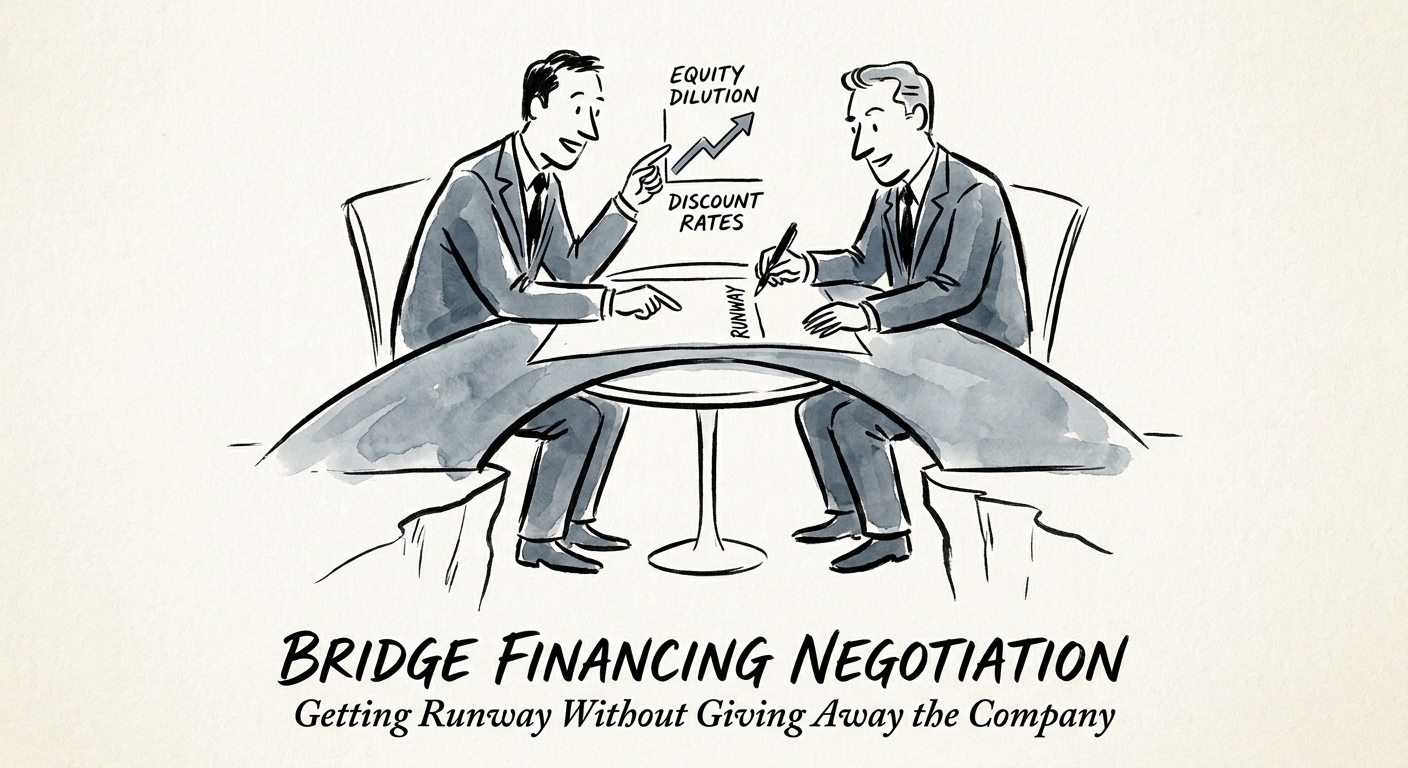
Chart showing equity dilution impact of bridge financing discount rates and warrants

Structuring the Tranches for Project Recovery

I never let founders take the full bridge amount upfront. I know it sounds counterintuitive to a cash-starved CEO, but I have watched the lump-sum trigger maximum interest accumulation and immediate warrant issuance on the entire facility. I structure every bridge I negotiate in intelligent tranches tied directly to specific project recovery milestones. When a critical deployment is actively failing, throwing $5M into the general operating account ensures that money will be immediately absorbed by legacy burn, not the turnaround effort itself. According to Fenwick & West's 2026 Tech Valuation Survey, tranched bridge rounds have a 40% higher probability of converting into a successful up-round strictly because they force immediate operational discipline.

In my practice, I mandate a gated funding structure. Tranche one funds the immediate project triage and secures external turnaround resources—knowing exactly when to bring in external help for a failing project is the critical difference between recovery and bankruptcy. Tranche two is released only when specific technical debt is successfully retired or a stalled implementation finally goes live in production. This perfectly aligns the investor's capital deployment with objective risk reduction. You are clearly telling the board, 'We are not just buying time; we are funding a specific, highly measurable intervention.'

Finally, your bridge note must include a viable exit valve. If the project turnaround is exceptionally successful, you need a defined mechanism to convert the debt on favorable terms or prepay it entirely without crippling financial penalties. You must build in a conversion premium that actually rewards the company for early operational recovery. Bain & Company's 2026 Private Equity Turnaround Analysis demonstrates that firms utilizing milestone-based debt conversions achieve enterprise value recoveries 2.4x faster than those burdened with rigid, time-based notes. I negotiate from the reality of the operational turnaround plan, not the sheer desperation of the bank balance. If I cannot draw a straight, defensible line from the bridge capital to the project recovery, I tell my clients to walk away from the note.

Continue the operating path
Topic hub Project Recovery Stalled programs unblocked. We've rescued $13M and $3M Fortune 500 initiatives in under 30 days. Pillar Turnaround & Restructuring Project recovery rarely fails on the technical merits — it fails on governance, ownership, or stakeholder alignment. We bring an operator authority to unblock what's been stuck for 6+ months. Service Transaction Execution Services Integration management, carve-outs, system consolidation, and post-close execution for technology acquisitions that must turn thesis into EBITDA. Service Interim Management Operator-led interim management for technology companies in transition, crisis, integration, or founder extraction. Service Turnaround & Restructuring Services Crisis intervention, runway extension, project recovery, technical rescue, and restructuring support for technology middle-market firms.
Related intelligence
Sources
  1. PitchBook's Q1 2026 Venture Debt and Bridge Financing Report
  2. CB Insights' 2026 Down Round Risk Matrix
  3. Cooley's 2026 Convertible Debt Benchmark Study
  4. Fenwick & West's 2026 Tech Valuation Survey
  5. Bain & Company's 2026 Private Equity Turnaround Analysis
Move on this

A 14-day operator-led diagnostic, before the gap is priced into your multiple.

No retainer until we agree on the work.

Request a Turnaround Assessment →