It's 9:40. The Window Was 10 AM. Now What?
A technician texts in sick at 9:40. There's a confirmed 10 AM to noon appointment forty minutes away, a part on the van that nobody else is carrying, and a customer who already took the morning off work. The dispatcher has roughly twenty minutes to either find a swap or make the call that the window breaks. That is a dispatch exception, and it is nothing like the use cases AI usually gets sold for. Nobody needs help "drafting" here. They need to know which of the other six techs is close enough, qualified for the job, and not already committed to something that breaks if you pull them.
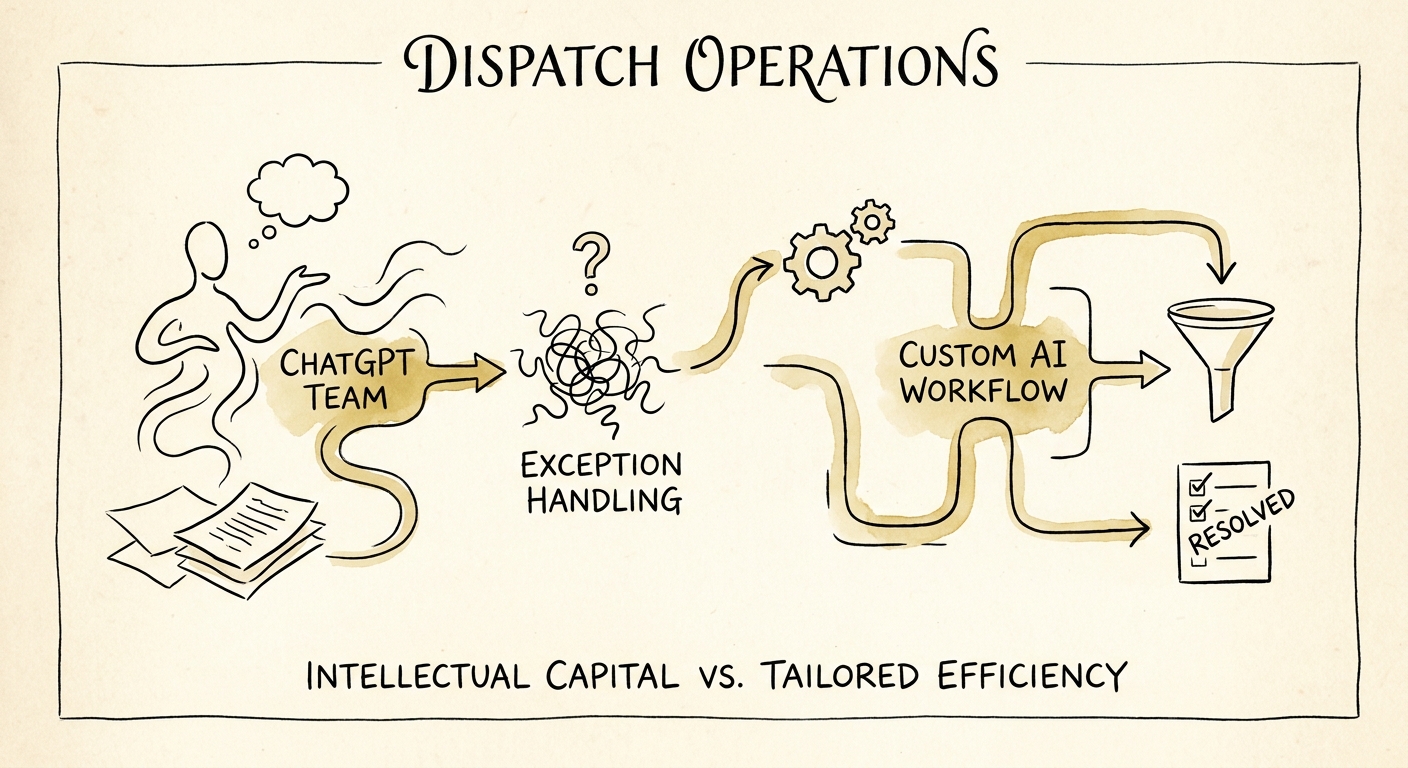
This is exactly where the line between ChatGPT Business and a custom workflow gets drawn, and most teams draw it in the wrong place. ChatGPT Business is genuinely good at the language layer: the apology text to the customer, the recap a service manager writes after a bad day, the "here's how to explain a missed window without sounding defensive" coaching. What it cannot do — because it has no live read on your schedule board, your van inventory, or your SLA clocks — is decide where the job goes next.
Why this distinction is worth getting right for a 50-300 person service company specifically: at that size you have enough volume that exceptions happen daily, but not enough margin to staff a dispatch desk three deep. RSM's middle-market AI survey, the San Francisco Fed's work on AI and small businesses, and the OECD's review of SME adoption all circle the same finding: the AI that fails in this segment is the AI that adds a step without removing one. A chat tool that produces a lovely customer message but leaves the dispatcher re-routing by memory has added a step.
The Tell: Is the Reroute Decision in Someone's Head, or in a System?
Here's the diagnostic that settles the build-vs-buy question faster than any vendor demo. Walk the dispatch floor and ask one thing: when a window is about to break, where does the dispatcher look to find the swap? If the answer is "she just knows the crew — who's fast, who's nearby, who's already behind, who's certified on that equipment" then your reroute logic lives in one person's head. A chat assistant will not fix that; it will only narrate around it. And the day that dispatcher is out sick, your exception handling is out sick too.
A custom workflow earns its keep precisely when the reroute decision has to consult five things at once that no human holds reliably under a twenty-minute clock: open ticket status, the live schedule, what part is on which van, the customer's entitlement (a platinum-contract account is not the window you let slip), and the escalation rule. The model can still write the customer note. But the reassign-escalate-or-hold decision should run on deterministic rules — "if no qualified tech is within X minutes and the account is tier-1, page the service manager" — not on a language model's vibe. OpenAI's own description of ChatGPT Business frames it as a shared workspace for team analysis and drafting, and its enterprise privacy guidance covers the data-handling side — useful for the note, not a stand-in for routing logic.
Two risk lenses keep this honest. Map service-quality and accountability risk against the NIST AI Risk Management Framework — every automated reroute should show the source data and name the human who approved or overrode it, so a bad swap is traceable to a decision, not a black box. And because dispatch records carry customer site details, service credentials, and access notes, run the data-handling question through CISA's AI data-security guidance before any of that context flows into a chat tool. The simple rule: customer-facing prose can live in ChatGPT Business; gate codes and account entitlements stay in the dispatch system.
Score It on Saved Windows, Not Prettier Apologies
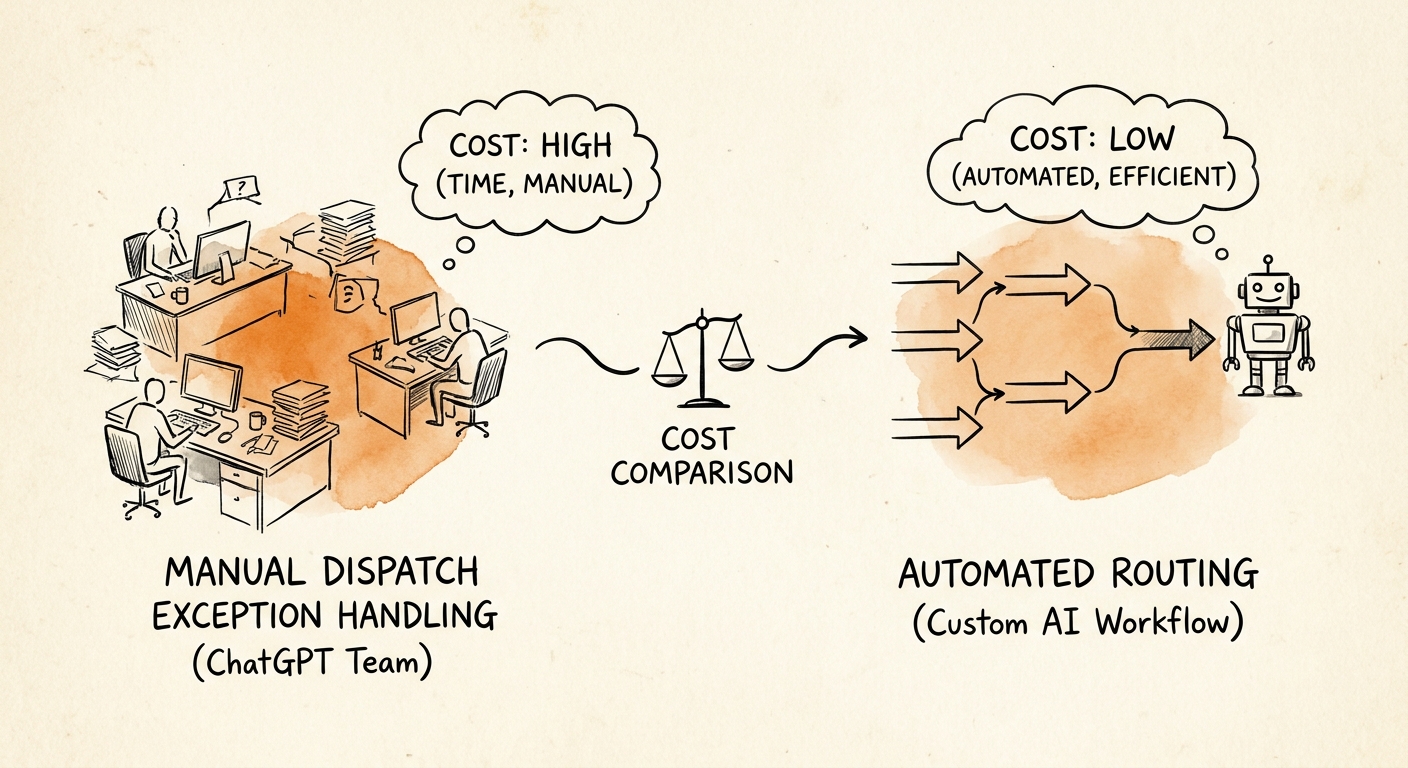
The trap is measuring this on writing quality. A polished customer text feels like progress and recovers nothing. The number that matters is whether the window held — or, when it couldn't, whether the customer got rebooked before they'd already wasted the morning. Deloitte's 2026 State of AI work keeps pushing teams from pilots toward production operating systems, and in dispatch "production" has a concrete meaning: fewer broken windows, faster swaps, the service manager pulled in before the SLA pops, not after the angry call.
So track the operational metrics, not the cosmetic one: exception aging (how long from the 9:40 text to a resolved reroute), SLA recovery rate, dispatcher touches per exception, time-to-reassign, and how often the manager has to override the system. If ChatGPT Business only moves the message-quality needle, that's a real win — keep it doing that and stop there. If the same exceptions keep recurring and the swap decision is still manual every time, that's your signal to build the connected workflow.
Start narrow. Don't try to automate "dispatch" — automate one exception family. Pick the most frequent: missed arrival, missing part, or priority conflict, and instrument that one end to end before touching the others. Use the manual-work guide to size how much dispatcher time that single family is actually eating, and pressure-test the spend against what AI implementation really costs before you scale past the first family. Then write down the decision and the evidence behind it — kept in ChatGPT Business, built custom, or paused because the schedule and inventory data isn't clean enough to trust yet. Expand only when the owner can point to a real drop in exception aging and say which windows got saved that would have broken last quarter.