The Monday-morning exception queue is the real test
Picture a 90-person distributor. Monday, 7:40 a.m., a planner opens the day to roughly 140 flagged lines: SKUs below reorder point, three POs that slipped their promised dock date, a customer order for 600 units against 410 on hand, and a dozen "negative available-to-promise" rows that are probably a receiving error from Friday. None of those 140 lines are equal. Maybe 15 will actually cause a stockout or a blown customer commitment this week. The job is not to read all 140 — it's to find the 15 and act before lunch.
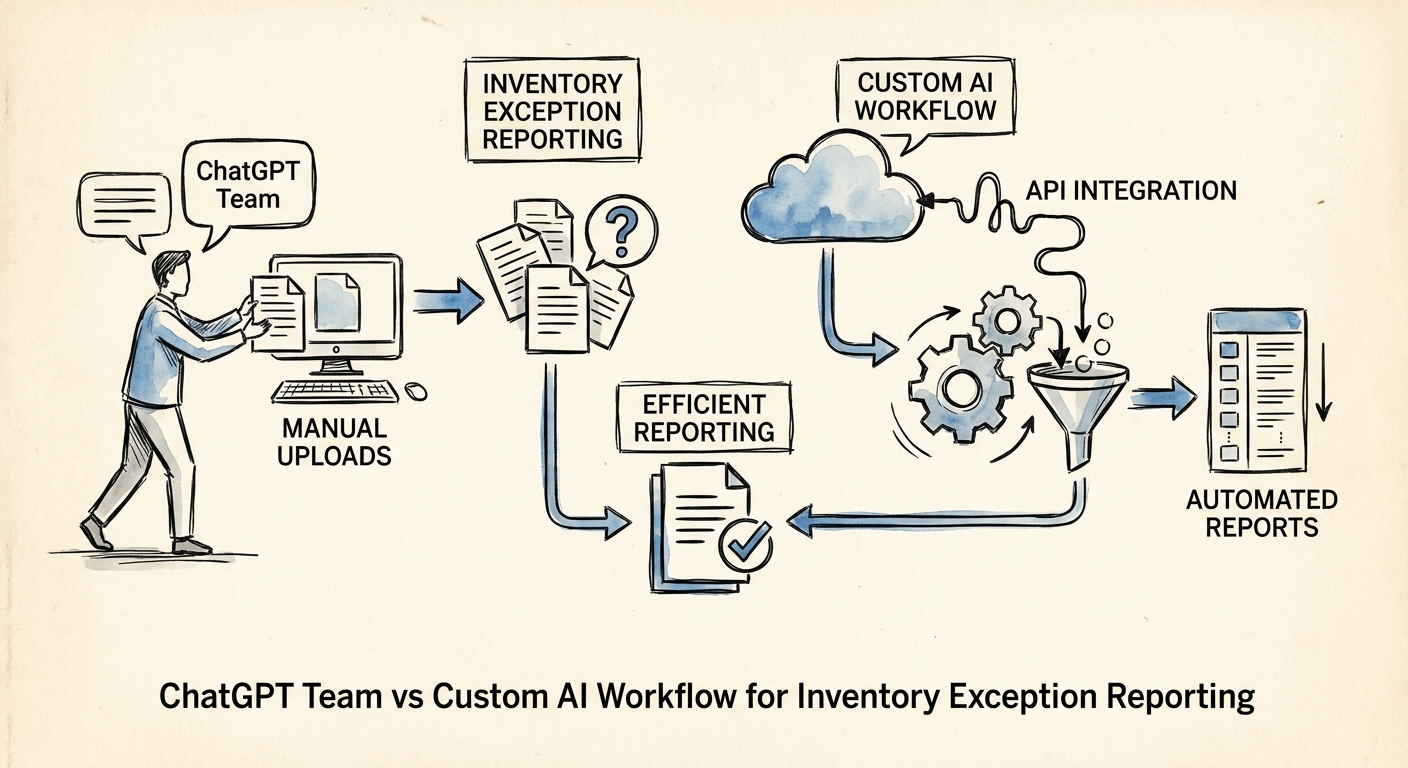
That distinction is exactly where the build-vs-buy question lives. ChatGPT Business is genuinely good at the parts that are language. Paste in an exported exception list and it will summarize it, group it, and draft a clear "your PO is three days late, here's the impact" email to a vendor. What it does not do is know that the 600-unit order is for your second-largest account, that the substitute SKU is sitting in the other warehouse, or that finance already flagged that vendor for chronic late shipments. It explains the export. It does not own the planner's next move.
The pressure to even ask this question is real for mid-market operators. RSM's middle-market survey and the San Francisco Fed's research on AI and small businesses both describe firms trying to wring more out of thin planning teams, and the OECD's work on AI adoption by SMEs shows the same appetite at the smaller end. The mistake is treating "we adopted AI" as the goal instead of "fewer of those 15 lines turn into a stockout."
Here is the cleaner way to draw the line. If a human is going to read the AI's output, think for a second, and then go do something in another system anyway, ChatGPT Business is fine — it's a smart analyst for reviewed exports and vendor drafts. The moment you want the SKU's on-hand, the open PO status, the demand signal, the customer's priority, and the escalation rule pulled together into a ranked queue that a planner clears every morning, you've outgrown chat. That's a workflow, and it has to live where the data lives.
The exception means nothing until it writes back to the ERP
The trap is judging these tools on how well they explain a variance. A beautifully worded paragraph about why SKU 40119 is short does not move a single unit. What moves units is a task assigned to a buyer, a PO date renegotiated, a substitution approved, or an expedite authorized — and every one of those is an action inside ERP, the WMS, or your procurement system. The ChatGPT Business documentation describes shared analysis and team workspaces, and the OpenAI enterprise privacy material belongs in your data review — but neither one is a system of record for inventory, and shouldn't be mistaken for one.
A custom inventory exception workflow does a specific chain that chat can't: it classifies the exception (low-stock risk vs. PO delay vs. data error vs. demand spike), shows the source record so a planner isn't trusting a summary, compares the supply signal to the demand signal, routes the right follow-up — buyer task, vendor email, planner review — and only then, after a human approves, creates a task or writes a note back into the ERP. The model can absolutely draft the vendor email inside that chain. It just can't be the thing that decides the line is actionable and closes the loop.
Two things make this concrete for inventory specifically. First, classification has to be honest about the data-error rows. A meaningful share of any exception list is garbage — negative on-hand from a receiving lag, a unit-of-measure mismatch, a phantom backorder. Routing those to a buyer wastes the scarcest resource you have. The workflow should bucket them for a data fix, not a purchasing action. Second, the supplier, customer, and order data flowing through this thing is sensitive. CISA's AI data-security guidance applies the moment vendor terms and customer commitments move into a model's context, and the NIST AI Risk Management Framework gives you a way to assign owners and measurable controls before you let any of it touch a writeback.
So the review question isn't "did it explain the exception well." It's: can the source owner challenge the AI's classification, is the next system action logged so a manager can inspect it three weeks later, and does approval sit with the planner who owns the consequence? If the answer to any of those is no, you have a confident summary and an unowned action — the worst combination in inventory, because it looks like control and isn't.
Score it on units, not eloquence
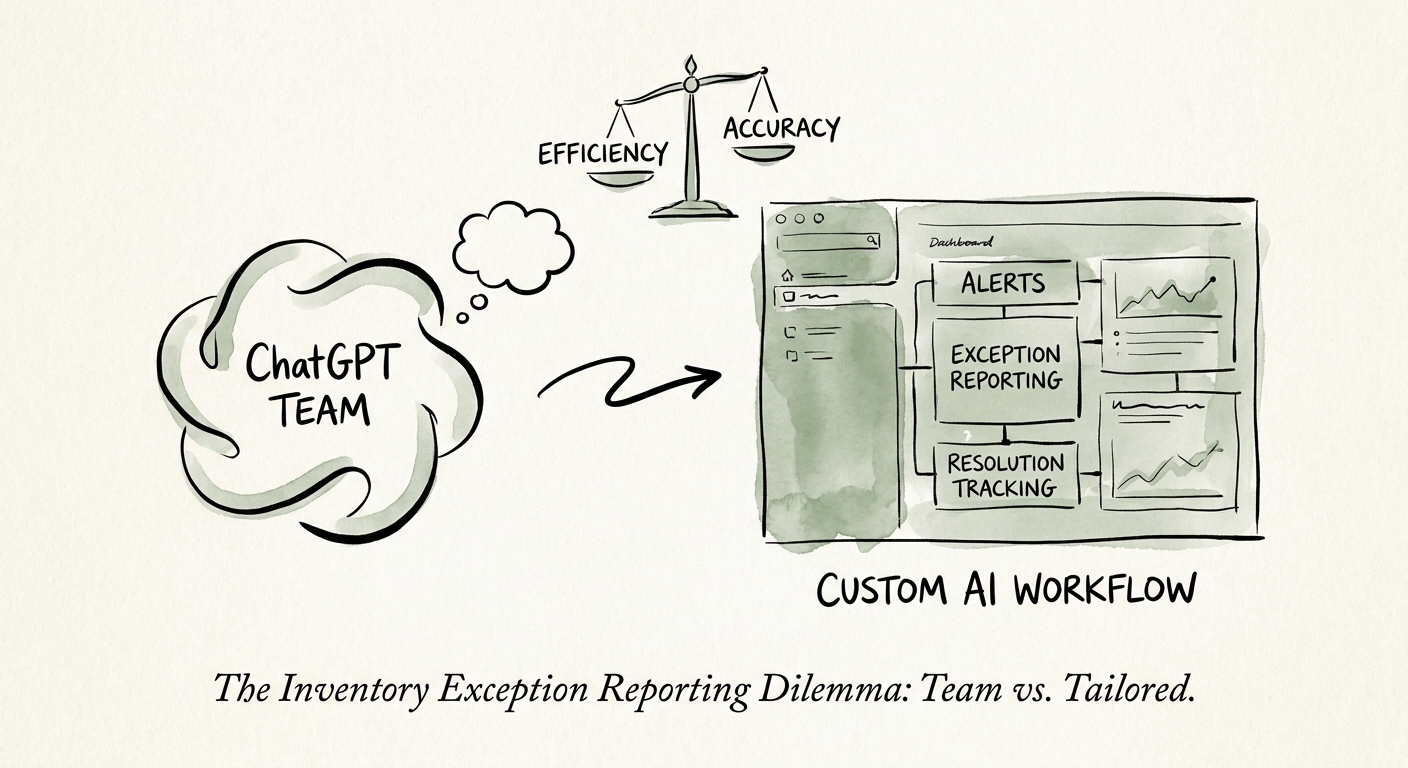
Deloitte's 2026 state-of-AI work pushes teams to chase production value rather than pilot theater, and in inventory the value is almost insultingly measurable. Did exception aging come down — are lines getting cleared the day they appear instead of sitting four days? Did avoidable expedite freight drop? Did you prevent the stockout on your top accounts? Did overstock on the slow movers stop creeping up? If the AI work isn't moving those, it doesn't matter how clean the writing is.
Don't boil the ocean. Pick one exception category and instrument it. Low-stock-risk lines and PO-delay lines are the two best starting points because both have a clean before/after: planner touches per exception, vendor response time, and the expedite cost or stockout you avoided. Run it for a few cycles, then look at the numbers. If a reviewed export plus a vendor-email draft got you there, keep it in ChatGPT Business and pocket the simplicity. If the win only showed up once routing and ERP writeback were automated, you've justified the custom build — and you have the evidence to expand it.
To pressure-test which category to start with, use the operations automation lens on where exceptions actually pile up, and run the candidate through the AI ROI Calculator to put real numbers on cycle time, working capital, and service risk before you commit a quarter to it. Write down the decision — kept in chat, built custom, or paused because the source data is too dirty to trust — and the three metrics that drove it. Expand only when the owner can say, in one sentence, what got faster, what got cheaper, and which exceptions stopped reaching the customer. That sentence is the difference between an inventory program and an AI hobby.