The ticket that breaks both approaches
Picture a Friday afternoon queue: 140 open tickets, two of them from your largest account, one of which says "we're evaluating alternatives" in the third paragraph. A first-line rep skims, mislabels it as a routine how-to, and it sits in the general queue over the weekend. Monday you're explaining to that customer why their churn signal got the same treatment as a password reset. That single misroute is the entire build-vs-buy decision in miniature — not "can AI read tickets" (it can), but "what happens when AI is confidently wrong about which ticket matters most."
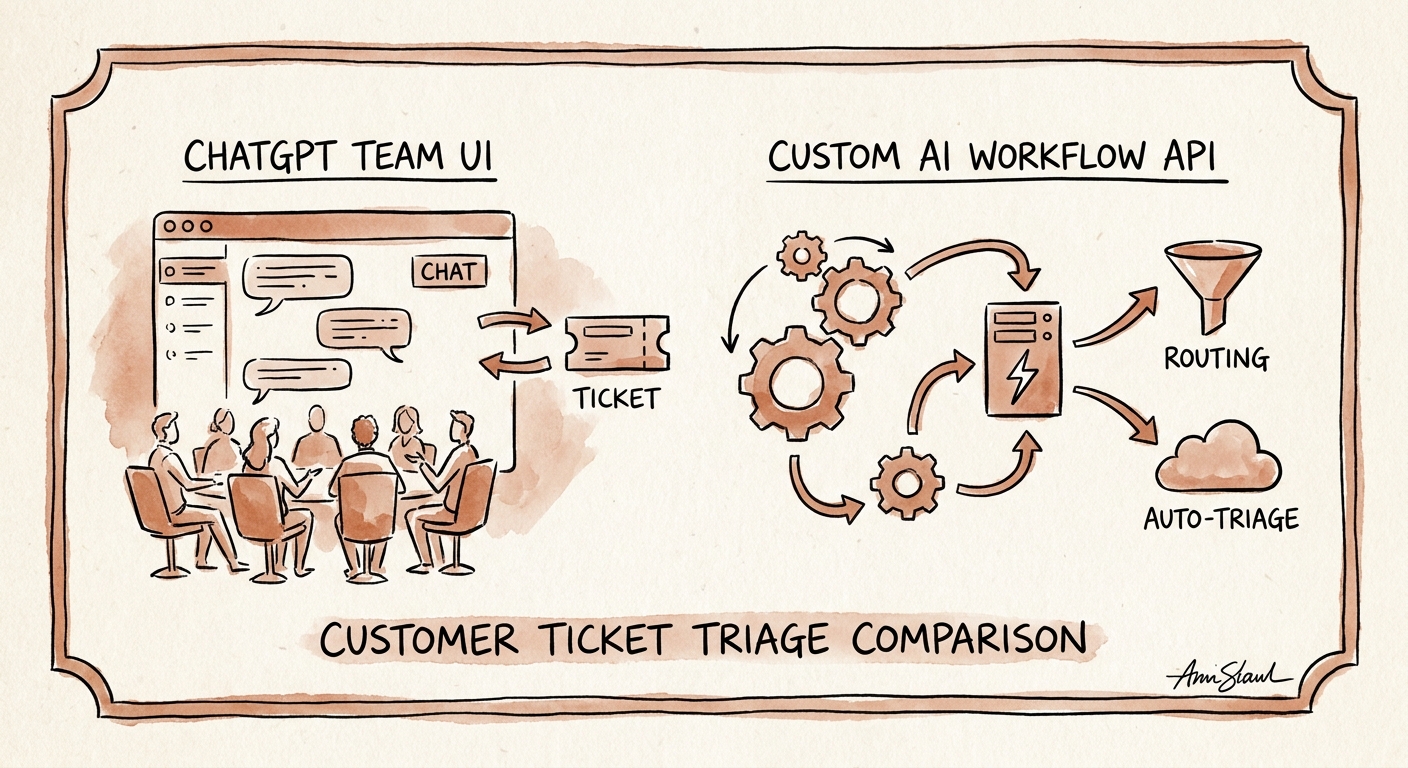
ChatGPT Business is genuinely good at the reading part. Paste a ticket, and it will summarize the issue, guess the product area, and draft a reply that's better than what a tired rep writes at 4:55pm. OpenAI's own ChatGPT Business overview and its enterprise privacy commitments mean you can do this on real customer text without that text training a public model — a real precondition, not a footnote. (And yes, the product was renamed; OpenAI's rename FAQ covers the Team-to-Business shift if your procurement docs still say "Team.")
But notice what ChatGPT Business does not do: it doesn't know that this account is on a 2-hour SLA, that they escalated twice last quarter, or that "evaluating alternatives" plus "enterprise tier" means a human manager should see this in minutes. It triages the text in front of it. Triage that actually protects the queue weighs account tier, SLA clock, escalation history, and product area together — and those live in your helpdesk, not in a chat window.
Where the copy-paste assistant quietly fails
Here's the failure mode that build-vs-buy guides skip. With ChatGPT Business, a rep is the integration layer. They decide which ticket to paste, they remember to check the account tier, they apply the model's suggestion or override it. That works at 30 tickets a day with disciplined people. At 300 tickets across rotating shifts, the discipline frays exactly where it costs most: the high-tier, high-anger ticket that looks routine on the surface is the one a rushed rep doesn't bother pasting at all.
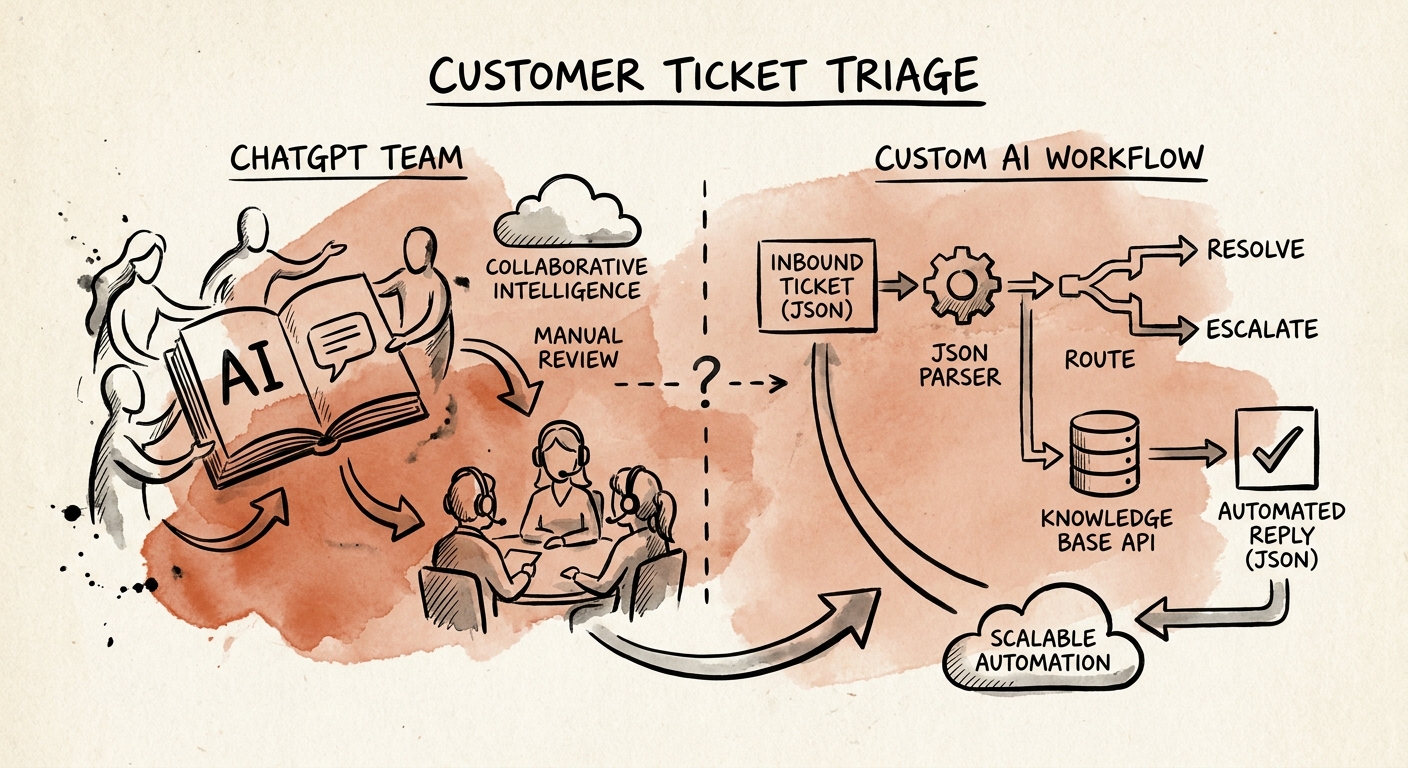
A custom workflow earns its cost the moment routing depends on data the rep can't hold in their head. Instead of a chat transcript, the unit of work becomes a review packet: the ticket text, the proposed queue and priority, the SLA clock already running, the account tier pulled from your CRM, the escalation count, and a one-line reason ("flagged urgent: enterprise tier + churn language + open SLA under 2h"). The reviewer sees the recommendation and the evidence behind it, and accepts, rejects, or corrects in one screen. That's the difference between "the AI suggested this" and "here's why, against your actual records."
This is also where the governance stops being theoretical. The NIST AI Risk Management Framework is useful here precisely because triage risk is contextual: routing a billing dispute to general support is a minor annoyance; routing a security-incident ticket there is a reportable problem. And because the workflow now touches account records and ticket history, CISA's AI data-security guidance should set the retention and access rules for that exact data — who can see the source trail, how long routing logs live, what the system is never allowed to auto-resolve (cancellations, security flags, billing disputes) without a human in the loop.
The number that decides it: wrong-queue rate
Don't decide build-vs-buy on a feature list. Decide it on one measurement you take by hand for two weeks first: your wrong-queue rate. Sample 100 closed tickets and ask how many were initially routed to the wrong queue or priority, and how many of those were high-tier or SLA-sensitive. If your misroutes are rare and mostly low-stakes, ChatGPT Business as a drafting aid for replies is plenty — buy the seats, train the team on a paste-and-review habit, and stop there. Deloitte's State of AI in the Enterprise 2026 is blunt about this: the value shows up only when there's a process you can measure and improve, not when you've bought a smarter chatbot.
If your misroutes cluster on exactly the tickets that matter — enterprise accounts, open SLAs, repeat escalations — that's your signal to build the workflow, because those are the cases ChatGPT Business can't fix without the data it can't see. Run it as a real pilot: 30 days mapping one queue from trigger to reviewed route and stripping out any source field a manager won't stand behind, 30 days comparing each AI route to what a seasoned rep would have done, and a day-90 call to scale, narrow, or pause. The tell of a good rollout is boring: fewer SLA-breach surprises, fewer reviewer rewrites, and high-tier tickets surfacing on their own. The tell of a bad one is a polished dashboard while managers still hand-check the enterprise queue every morning.
If triage is competing with three other AI ideas for first place, run it through the AI Opportunity Score to see whether it's actually your highest-leverage starting point. Once the review path has produced real evidence — hours saved, breaches avoided — pressure-test the spend with the AI ROI Calculator. When you're ready to sequence this into the next workflow without losing control of your source data, the AI Transformation Blueprint maps the path.
