The P1 that sat in the queue for forty minutes
Picture a Tuesday at a 90-person managed services provider. A retail client's point-of-sale network goes dark mid-afternoon. The ticket lands in the general queue. The L1 tech on shift, three weeks into the job, reads "POS slow" and tags it routine. The client's contract says POS outages are a one-hour P1 with a dedicated escalation path to the network lead. Nobody on shift knew that account had that clause. The SLA clock burned forty minutes before a senior tech happened to glance at the board.
Now ask the build-vs-buy question with that scene in mind. ChatGPT Business would have helped the L1 tech write a clearer ticket summary and a calmer client update. It would not have known the contract terms, would not have read the SLA clock, and would not have rerouted the ticket to the network lead. Drafting is a real problem worth solving. But the forty-minute miss was an enforcement failure, and enforcement is a different layer of software.
That is the distinction most service desk leaders blur. Deloitte's 2026 AI research tracks the industry-wide push from AI demos toward production value, and on a service desk "production value" splits cleanly: help a human read and write faster, or make the routing decision itself. The first you can buy off the shelf this afternoon. The second touches your PSA, your contract records, and your on-call schedule.
What each layer can and can't reach
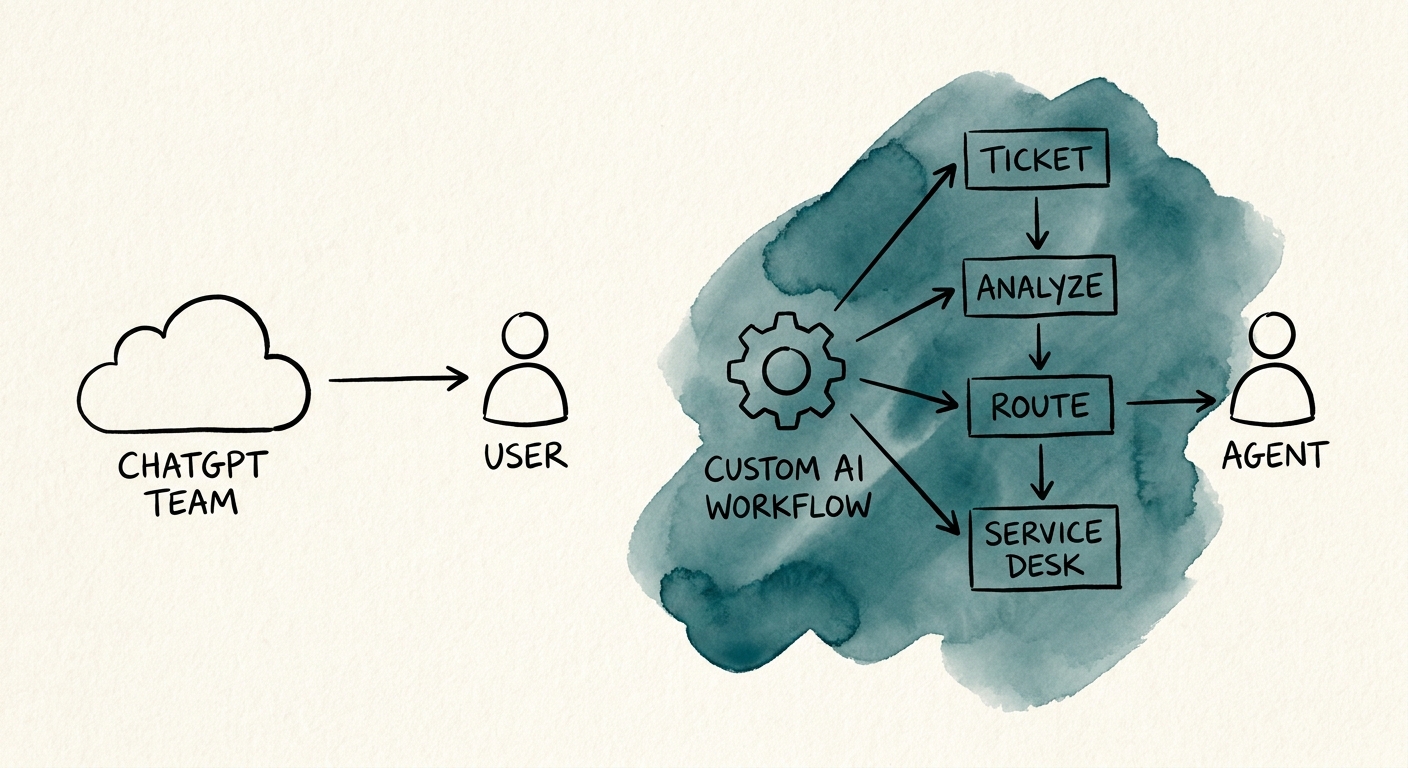
Run the same retail-POS ticket through four levels of capability and the boundary becomes obvious.
The packaged assistant (ChatGPT Business). It rewrites the L1 tech's three-word note into a structured summary, drafts the client-facing update, and suggests likely causes from the symptom description. It never sees the contract, the SLA timer, or who is on call. It is a typing aid for the human who is still making every routing call.
Workflow automation. Rules in your PSA — Autotask, ConnectWise, Halo — can auto-tag "POS outage" as P1 and route to a queue. This works when your triage categories are stable and your priority logic fits a rules table. It breaks the moment priority depends on which account, which contract tier, and which clause, because that lives in fields the rule engine wasn't told to read.
Custom retrieval. Now you connect ticket history, the client's signed entitlements, prior incidents on that POS network, and the relevant KB runbook. The AI can say: this account, this clause, this is a one-hour P1, here is the last time the POS dropped and what fixed it. It informs the human, fast and in context.
Full enforcement. The system reads the contract entitlement, checks the live SLA clock, confirms the network lead's availability, reassigns the ticket, and logs that a service manager (or the rule they pre-approved) accepted the action. This is the only layer that would have caught the forty-minute miss without a human noticing.
Each step up adds reach and adds risk. NIST's AI Risk Management Framework is the right lens here precisely because a wrong escalation hurts both service quality and client trust — and an MSP's whole value proposition is trust. Before any ticket context flows into an AI workflow, CISA's data-security guidance forces the unglamorous questions: which clients' data can this model see, where are the source boundaries between accounts, and is every AI-touched routing decision logged where a manager can audit it later. On a multi-tenant service desk, cross-account data bleed is not a hypothetical — it is the thing that ends contracts.
A decision you can run this week
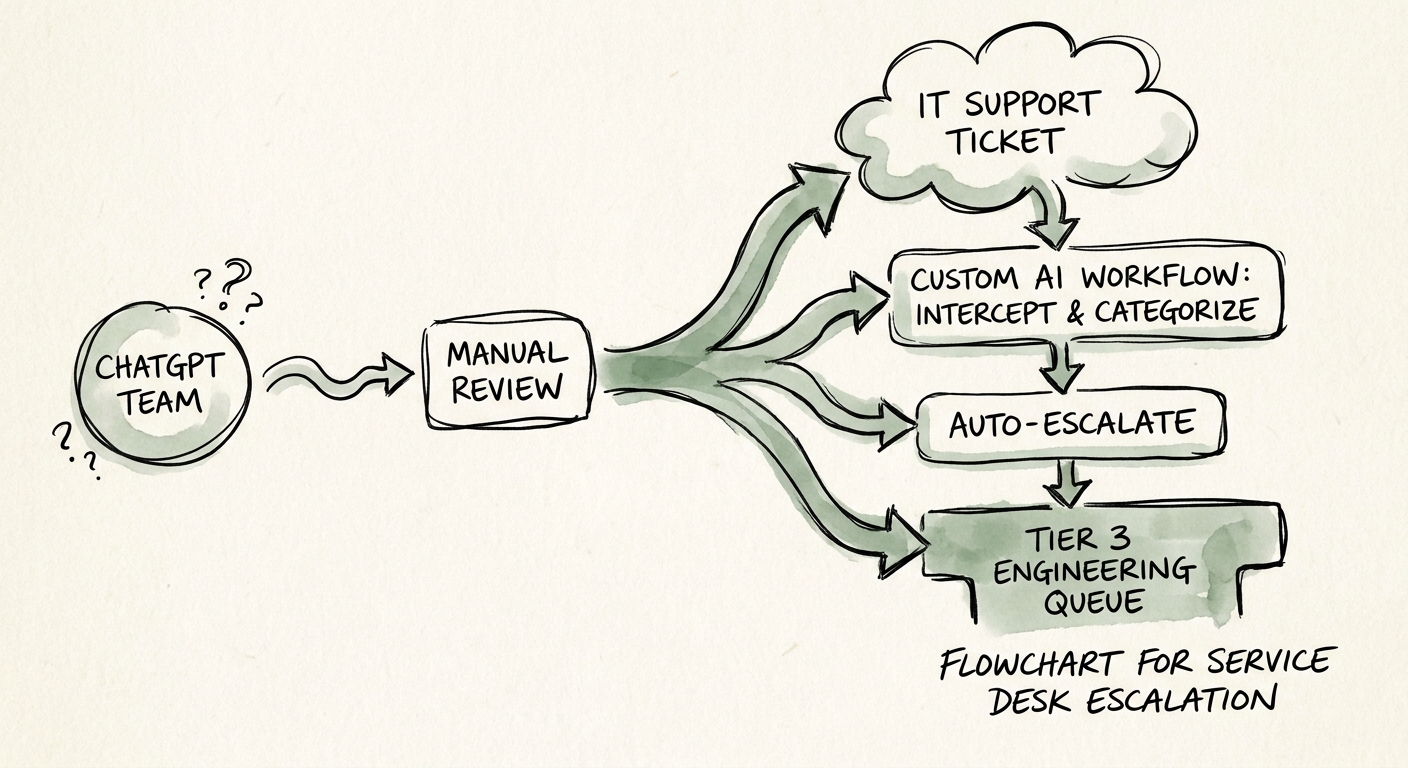
Pull twenty escalations from the last month — your actual bounced tickets, your SLA breaches, your "why did this sit so long" cases. For each one, write a single letter next to it: J if a human's judgment was the gap, R if a stable rule would have caught it, E if it needed the system to read a contract or clock and act.
If most are J, buy. ChatGPT Business will lift your L1 drafting and client comms today, and you keep routing in human hands. If most are R, configure your PSA's existing automation before you write a line of custom code. If a meaningful cluster are E — contract-tier priority, SLA enforcement, on-call-aware reassignment — that is your case for a custom workflow, and the twenty-ticket tally is the evidence to justify the spend. At Human Renaissance we start exactly here: a manual-work triage on real tickets, then a scoped sprint, sized against a clear-eyed AI implementation cost view.
Three conditions mean wait, regardless of the tally. Wait if your escalation rules live in senior techs' heads instead of your PSA — automate the tribal knowledge into documented rules first, or you'll automate the chaos. Wait if client entitlements are inconsistent or out of date across accounts, because an enforcement engine reading bad contract data routes confidently and wrongly. And wait if your team can't commit to reviewing AI suggestions during the pilot; an escalation system nobody is checking is worse than the forty-minute miss, because now it fails silently across every account at once.
Measure the pilot on what the POS incident exposed: escalation-cycle time, correct owner on first assignment, bounced-ticket rate, and SLA-breach count by contract tier. If all you get is cleaner ticket wording, that is a genuine win — just don't let anyone call it escalation automation in the QBR. The build decision starts the day the workflow has to enforce the rules, not merely describe them.