Open eleven tabs, paste, pray
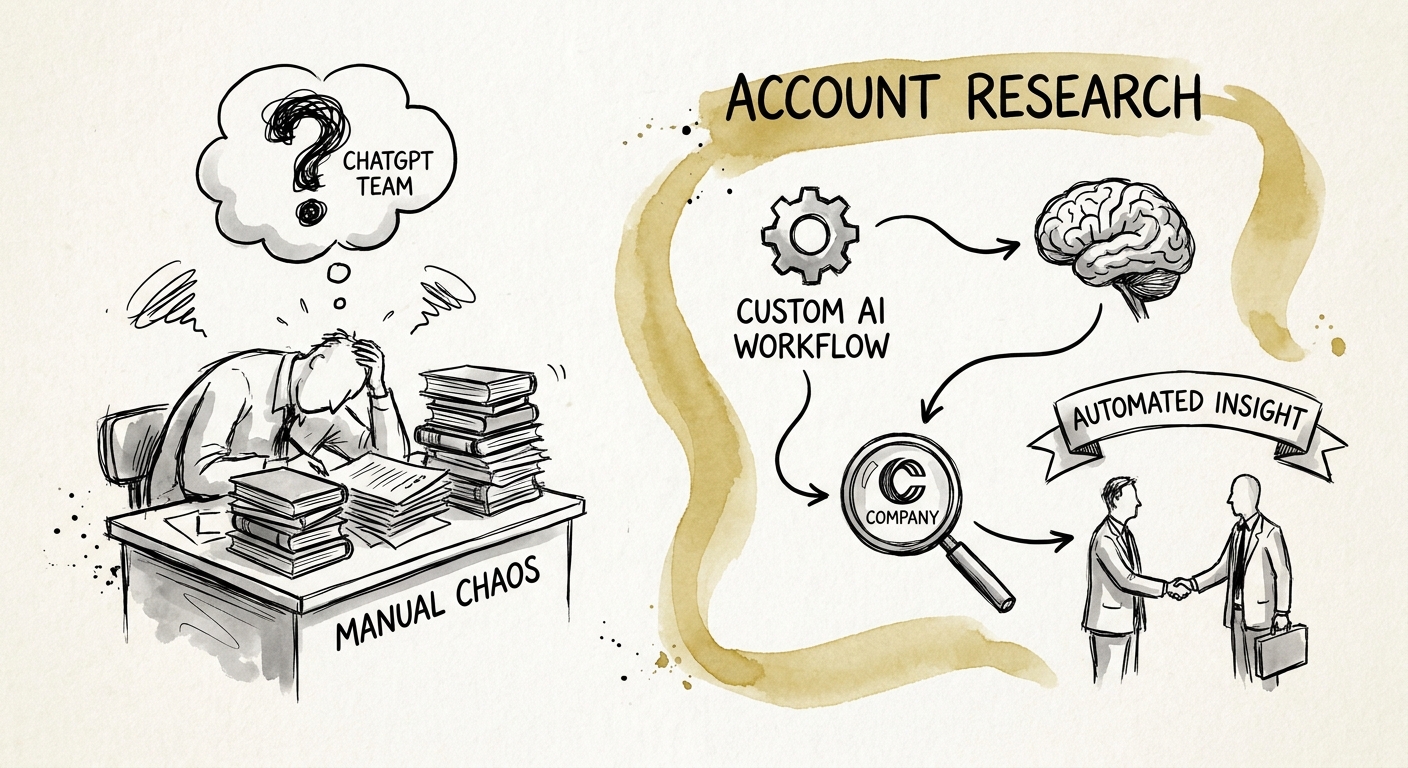
Picture a SaaS account executive prepping for a renewal call with a mid-market customer. To build a useful brief, she opens the CRM opportunity record, the account's usage dashboard, last quarter's support tickets, the QBR deck, the company's funding news, the champion's recent LinkedIn move, and the notes from the SDR who first booked the logo eighteen months ago. Then she pastes a hand-picked subset of all that into ChatGPT Team, writes a prompt from memory, reads the output, and drops two sentences into the CRM notes field where they will never be seen again.
ChatGPT Team did real work in that flow. It summarized the support history, spotted that usage dipped in March, and drafted three discovery questions. None of that is wrong. But notice what the tool didn't do: it didn't gather the eleven tabs, didn't decide which of them she was allowed to paste, and didn't put the brief anywhere the next rep or her manager could find it. The seller is still the integration layer. She is the API between your systems and the model.
That distinction — chat assists the person, a workflow changes the process — is the whole decision. McKinsey's work on AI in B2B sales keeps landing on the same point: the value shows up when AI is wired into the selling motion, not when it lives in a side window a rep visits when they remember to. A custom workflow pulls from approved systems, structures the account the same way every time, and writes the brief into the opportunity record the rep already lives in. The rep still reviews and edits. What disappears is the eleven tabs.
The case for staying on ChatGPT Team
Plenty of SaaS revenue teams should not build anything yet, and saying so out loud is the honest move. ChatGPT Team is the right answer when account research is occasional, individually owned, and low-stakes: an AE drafting call-prep questions, an SDR turning a discovery call recording into a follow-up, a CSM summarizing a customer-shared roadmap doc before a check-in. A sanctioned seat beats the alternative, which is reps quietly pasting customer data into whatever free tool they found, and it pulls that shadow usage into something you can set rules around. Salesforce's State of Sales data shows reps already adopting AI faster than their orgs can govern it — a license is how you catch up to your own people.
But name the ceiling clearly. A chat seat scales access, not leverage. If forty AEs each spend twenty minutes assembling the same usage-plus-tickets-plus-renewal-date picture before every call, you haven't fixed account research — you've licensed forty people to do it by hand a little faster. The work just moved into more tabs.
And "we gave everyone ChatGPT Team" is not a governance answer. Decide, on paper, which fields a rep may paste — does the model get to see contract value, discount history, or a customer's confidential roadmap? — who checks the output before it touches a buyer, and where generated language needs a manager's eyes. A chat tool with no usage rules is shadow AI wearing a corporate badge.
One more honest prerequisite: if your CRM is a swamp — half-empty stage fields, three records for the same account, renewal dates nobody trusts — neither path works, because both feed on that data. Fix the foundation first; the guidance in CRM cleanup before automating sales applies no matter which tool you land on.
When the build earns its keep — and the smallest version that proves it
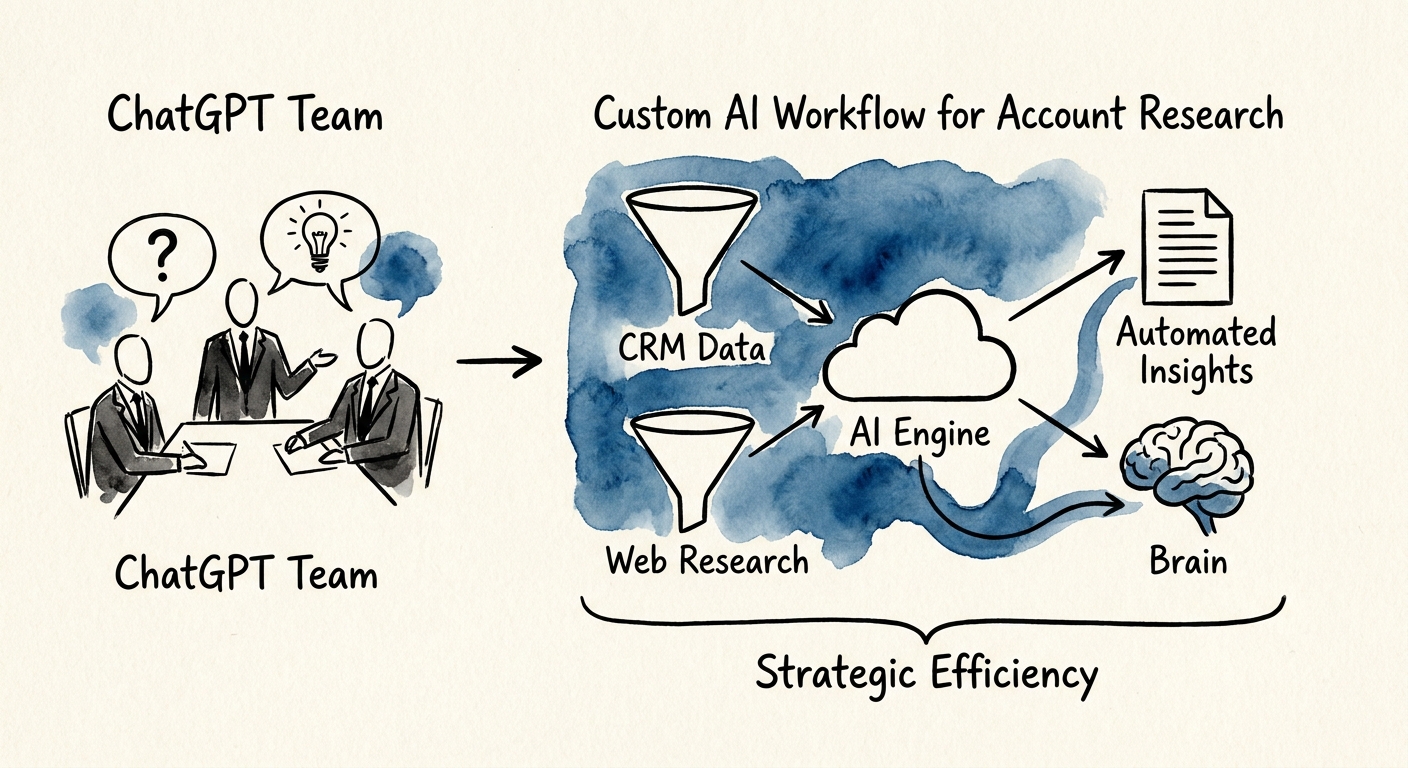
A custom account-research workflow earns its cost when three things are true at once: the research is frequent, the dollars per account are high, and the output has to be reviewable. In SaaS that usually means renewal-risk review, expansion planning on strategic logos, and onboarding the just-closed enterprise deal — places where the same inputs recur on a schedule and a missed signal costs real ARR. Bain's AI research and Forrester's revenue-operations work both push toward this: standardize the repeatable, high-stakes motions, and leave the one-off thinking to a chat window.
Build it around four checkpoints, not features. One: name the approved source systems — say CRM, the product usage warehouse, the support desk, and a public-firmographic feed — and nothing else. Two: fix the brief structure so every account is rendered the same way: health signal, usage trend, open tickets, stakeholder map, renewal date, recommended angle. Consistency is what lets a manager compare twenty accounts in an afternoon instead of reading twenty freeform paragraphs. Three: keep a human review gate before the brief reaches a buyer. Four: instrument it — did briefing time drop, did CRM hygiene improve, did renewal forecasts get more honest?
The version-one mistake is building for the whole revenue org. Don't. Pick one motion — renewal briefs for accounts inside ninety days — one team, one brief format. Ship that. If the CSMs trust it enough to stop opening the eleven tabs, and a manager can audit a brief without asking how it was made, you've earned the right to expand. If they don't, you have a source-data or review problem that more automation would only have hidden.
Run the numbers before you commit: the AI ROI Calculator pressure-tests whether the build has enough operating value, and the AI use-case scoring model helps you rank account research against the other workflows competing for the same budget.