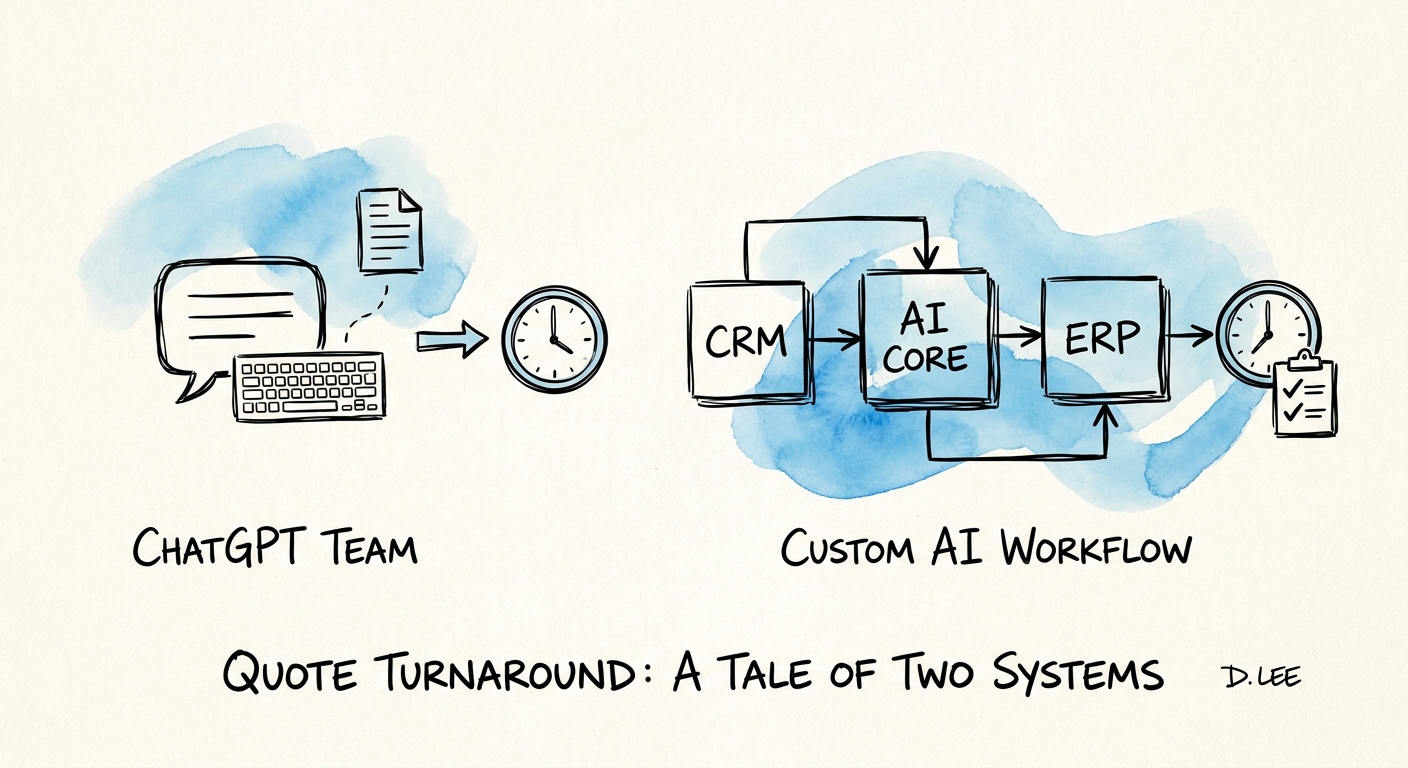
The slow quote isn't the expensive one. The wrong one is.
Picture a 60-person IT services firm. A rep gets an RFP on Tuesday afternoon, and the quote needs to go out before a Thursday vendor-selection call. So she does what reps do: pulls last quarter's quote for a similar client, eyeballs the hours, applies what she thinks is the current blended rate, and writes a confident cover note. It goes out in two hours. Everyone's thrilled with the speed. Three weeks later, after the deal closes, delivery realizes the rate card changed in March, the discount she applied required VP sign-off she never got, and the scope quietly omitted the data-migration line that eats forty hours. The quote was fast. It was also wrong, and now it's a contract.
That is the actual stakes of "quote turnaround" in a services business, and it's why the build-vs-buy question lands differently here than it does for, say, drafting a follow-up email. The hard part of a quote is never the prose. It's the four or five inputs that determine price, scope, margin, and who's allowed to approve a discount — and those inputs live in a rate-card spreadsheet, the CRM, a signed MSA, and someone's head. A general assistant has no view into any of them.
So be precise about what each tool is for. ChatGPT Team can take an approved scope and turn it into clean customer-facing language, summarize discovery notes into a statement of work, or tighten an executive summary. That's real time saved, and the OpenAI enterprise privacy commitments and Microsoft 365 Copilot privacy and data controls mean you can do it without your draft scopes training someone else's model. But none of that touches the part that actually costs you money: deciding the number.
Draw the line where the price gets calculated
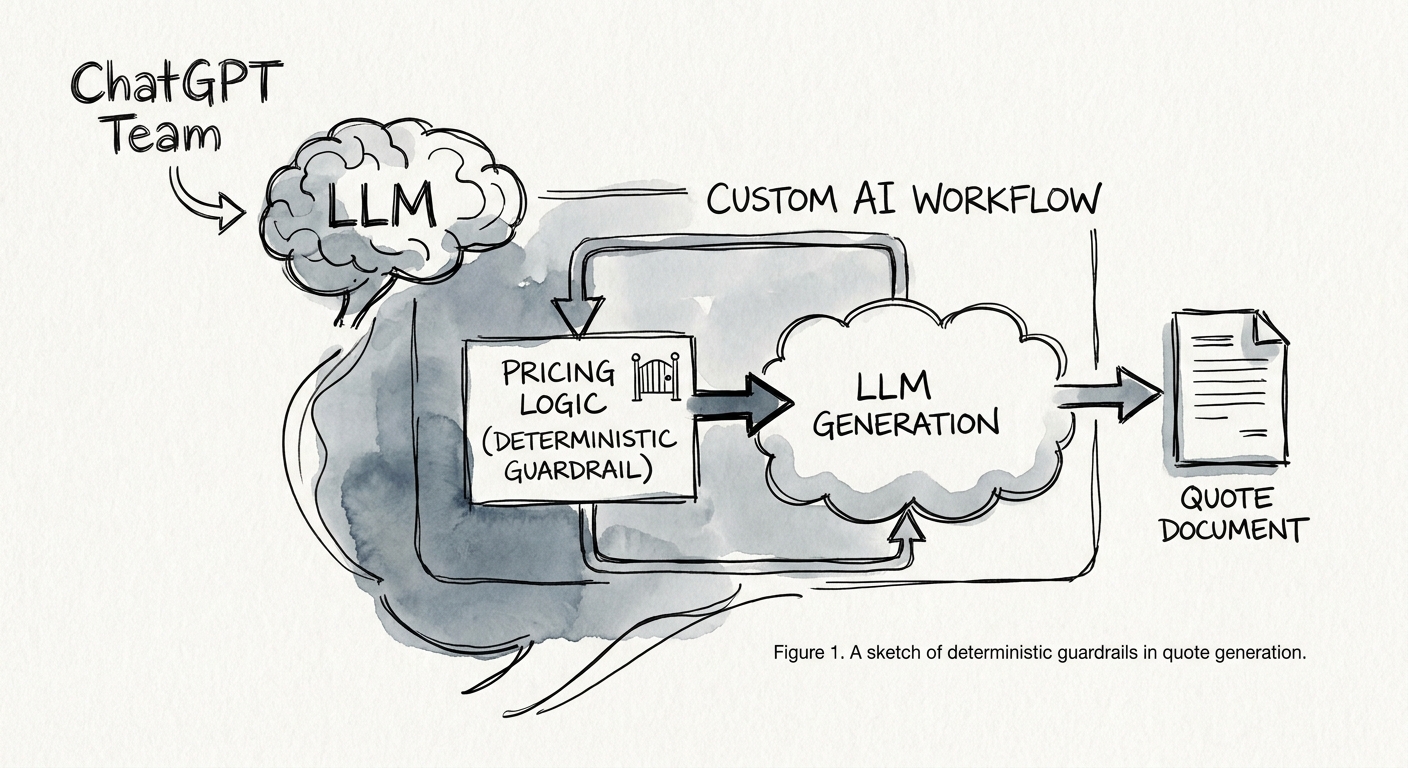
Here is the rule that settles most of these debates: if the quote depends on anything that can be wrong — a current rate, a margin floor, a client's contracted discount, available capacity — the price has to be calculated by deterministic logic, not generated by a model. The AI's job starts after the number is set.
Walk a real quote through it. The workflow pulls the SKU or service line and its current rate from the rate-card system of record. It reads the account from the CRM and applies any contracted discount. It checks the margin against your floor and flags the deal for review if it's under. Only then does the language model assemble the package: a readable scope, a clean pricing table built from the retrieved numbers, an executive summary, and a flag for any input it couldn't find. If it can't name the source for a rate, it stops and asks — it does not guess a plausible-looking number, which is exactly the failure mode that makes free-text quoting dangerous. Salesforce State of Sales research makes the case that reps need fast, usable guidance inside the selling motion; the point is to give them speed on the writing while taking the math out of their hands entirely.
That split is also what makes a custom workflow worth building rather than living in a chat window. When pricing logic is deterministic, every quote leaves a record: which rate version was used, which discount was applied, who approved the exception. You can audit a deal that went sideways instead of reconstructing what the rep was thinking. And you can measure the thing honestly — quote cycle time, rework rate, margin exceptions caught before they ship, approval latency — instead of pretending every saved minute became revenue.
Ship one quote type, then earn the next
You don't need a quoting platform to start. You need one quote family that's high-volume and rule-bound — fixed-scope managed-services renewals, say, or a standard project tier — where the pricing logic is clear enough to encode. Build the workflow for that one path: one rate source, one reviewer, one exception queue for the deals that fall outside the rules. Run it for 90 days. If cycle time drops and rework stays flat or falls, you've proven the pattern and you expand to the next quote family. If rework goes up, the problem is almost never the model — it's that your rate card has three versions floating around, or nobody actually owns the margin floor. Fix that first; AI can't out-run a source-of-truth problem.
The governance scaffolding here isn't optional, and it doesn't have to be heavy. The NIST AI Risk Management Framework gives you the operating loop — govern, map, measure, manage — and the CISA AI Data Security Best Practices tell you to know what client and pricing data moves through the workflow, who can see it, and how long outputs are retained. For a quote workflow that touches contract terms and margin, both matter before you give anyone a shortcut around pricing review.
Monday-morning version: list your quote types, circle the one that's most repeatable and most rule-driven, and find the single authoritative source for its rates. That's the first thing to wire up — and whether it ends up in ChatGPT Team or a custom build follows almost automatically from how much of that quote is calculation versus prose. When you're ready to map the full sequence, the quote turnaround ROI guide shows how to tell whether the workflow is actually adding sales capacity, and the AI roadmap turns one proven quote path into a plan for the rest.
