One webinar, fourteen assets, and the moment the wheels come off
Here's the job nobody scopes correctly. You run a 45-minute webinar. Now marketing wants a recap blog, five LinkedIn posts, a customer email, three sales one-pagers, a carousel, two short clips with captions, and a snippet for the newsletter. Same core ideas, fourteen different shapes, each with its own length, tone, and rules about what you're allowed to claim. That's content repurposing, and it's the single most automatable thing a small marketing team does — which is exactly why everyone reaches for AI to do it.
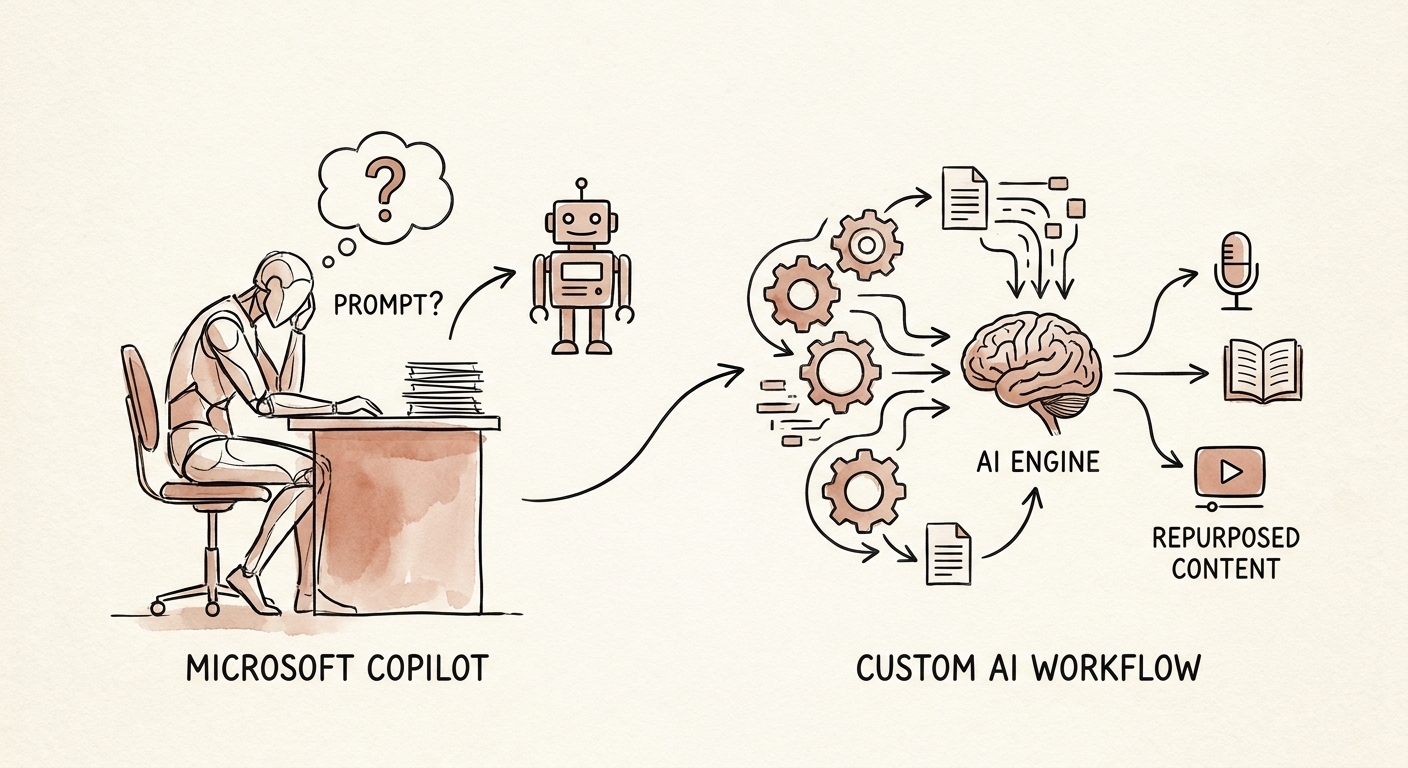
The mistake is treating "should we use AI for this" as the question. The real question is which AI setup, and the dividing line is embarrassingly simple: who reads the output, and what happens if a number is wrong. Microsoft Copilot works inside your tenant's existing data and permissions, per Microsoft 365 Copilot's privacy and data controls. That makes it genuinely good at the low-stakes half of repurposing: turning your own webinar transcript into a draft recap, reshaping an approved deck into talking points, spinning internal notes into a first-pass post a human will obviously edit before it goes anywhere.
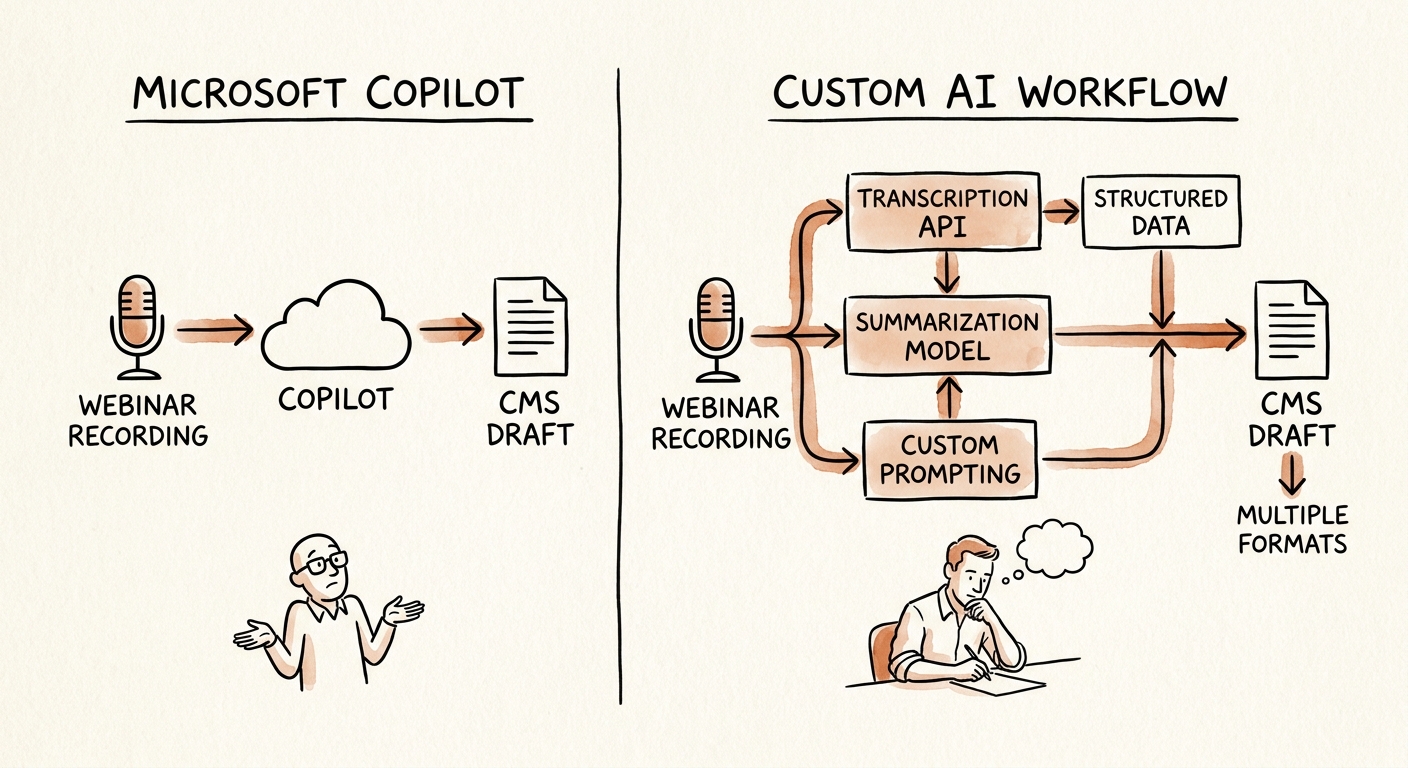
The other half is where Copilot quietly becomes a liability — not because the writing is bad, but because there's no system around it. When a repurposed asset carries a regulated claim, has to cite a source, needs the right disclaimer attached, must match brand voice guidelines, and has to route through an approver before it publishes, the model is no longer the workflow. It's one step inside a workflow you have to build.
The 14-asset stress test (run it on a real piece this week)
Don't theorize the build-vs-buy call. Take one actual asset you repurposed last month and walk its fourteen children through three questions. First: did the output reference a specific number, a customer name, a product capability, or a compliance-sensitive claim? Second: did it go out under your brand to someone outside the company? Third: if it was wrong, who would catch it — and when? Sort each piece into "internal and low-stakes" or "external and consequential." The pile that lands in the second bucket is your workflow scope. Everything in the first can stay in Copilot today.
What the second pile needs is not better prose. It's plumbing. An approved source library — your messaging, live proof points, current product language, the disclaimers, and an explicit list of things the business will not say — so the model draws from one defensible truth instead of whatever it scraped from an old deck. Then version control, an approval state on every asset, reviewer notes that persist, and a publication history you can actually audit. The RSM middle-market AI survey shows mid-market firms are pouring money into AI, but the ones getting return have the operating discipline underneath it. Repurposing is the cleanest example: feed AI a thin or stale source library and it doesn't fix your inconsistency, it mass-produces it — fourteen confidently-worded variations of a message you can no longer defend.
This is the trap with Copilot at scale. It's so good at producing plausible variations that a 40-person agency can generate a quarter's worth of content in an afternoon and not notice that the "92% retention" stat in the carousel doesn't match the "high-90s retention" in the email, and neither matches what the case study actually said. The fix isn't a smarter model. It's deciding, before a single draft, which facts are canonical and where they live.
Measure review burden, not output volume
The vanity metric here is assets-per-week, and it lies. A team that ships 50 repurposed pieces while the marketing lead rewrites 40 of them by hand has automated nothing — they've moved the bottleneck downstream and made it invisible. Track the honest numbers instead: cycle time from source to published, the percentage of AI drafts a reviewer changes (and how heavily), reuse rate per source asset, channel performance, and — the one that actually matters — corrections issued after something publishes. A workflow earns its build cost when it cuts the repetitive formatting work and the reviewer-change rate at the same time. If reviewers are still rewriting everything, your source library is the problem, not the tooling.
For anything touching customer data, regulated claims, or confidential context, set the auto-draft rule in writing before you automate: what AI can draft and publish, what it can draft but a human must approve, and what may not be repurposed at all. The NIST AI Risk Management Framework and CISA AI Data Security Best Practices give you the guardrail language to make those tiers defensible rather than arbitrary.
So here's Monday's move. Pick your most-repurposed source from last quarter, run its fourteen outputs through the three-question stress test, and circle every external, consequential piece. If that pile is small, Copilot is your answer and you're done. If it's most of them, you have a content factory running without quality control — and that's a workflow to build, not a license to buy. Score the use case honestly with the AI use-case scoring model, and if the build is real, build the AI roadmap so it ships with the source library and approval gates from day one.