The brief was wrong, and nobody could say why
Picture the moment a research brief goes sideways. A 60-person professional services firm is weighing whether to enter an adjacent market. An analyst feeds three reports, a folder of past deal memos, and a competitor teardown into an AI tool and gets back a tight two-page summary. Leadership reads it, nods, and greenlights a hire. Six weeks later someone asks where the "market is growing 18% annually" line came from. Nobody knows. It might have been the analyst's draft, a vendor's marketing PDF, or the model stitching two unrelated numbers together. The brief read like authority. It was untraceable.
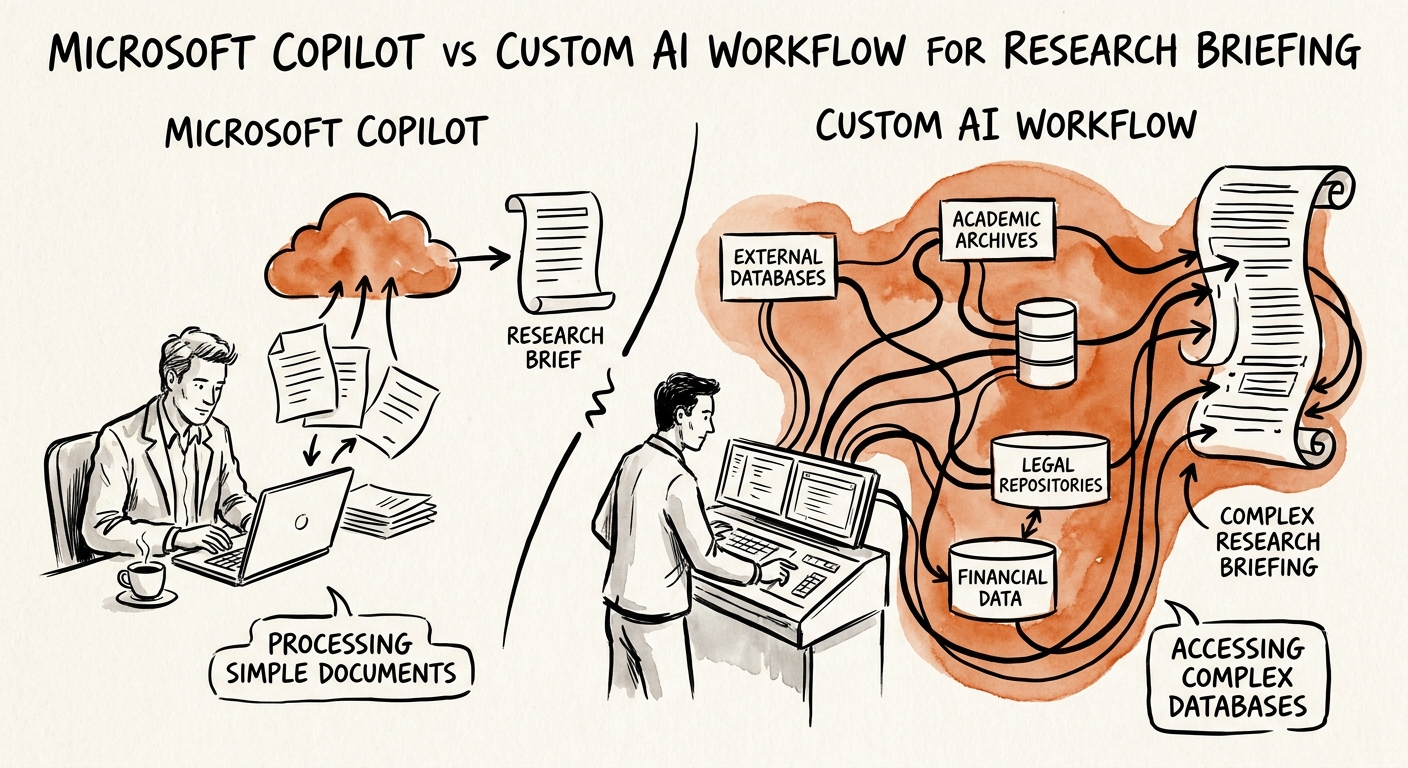
That is the real question behind Copilot versus a custom workflow for research briefing — not which one writes faster, but which one can defend what it wrote. Microsoft's documentation on Microsoft 365 Copilot privacy and data controls describes how Copilot stays inside your tenant's permissions and pulls from the SharePoint, Teams, and email your analyst can already see. If your evidence lives there — internal memos, meeting notes, an approved reports folder — Copilot is genuinely useful out of the box. The RSM middle-market AI survey shows leaders adopting tools like this at speed, which is exactly why the citation problem spreads quietly: the output looks finished long before anyone checks whether it can be sourced.
Before you pick a tool, do an unglamorous inventory first. Where does the evidence for a typical brief actually live? If 80% of it is in your tenant, the Copilot path is short. If half of it is in external databases, paywalled analyst reports, a CRM, or one person's head, you have a sourcing problem no tool solves on its own — and that's the signal to keep reading. The AI use-case scoring model walks through scoring source access, evidence risk, and system fit before you commit.
Where Copilot stops earning its keep
Use Copilot for the part of briefing that is summarization, not judgment. Drop it on an approved folder and let it compress 40 pages of meeting notes and internal reports into a first draft an analyst then verifies and rewrites. That is a real afternoon saved, and it is the highest-confidence use. The OECD report on AI adoption by small and medium-sized enterprises makes the point that smaller firms get value when a human owns the process, not when the tool is left to run alone — and a research brief is a document where the human owner is the whole game.
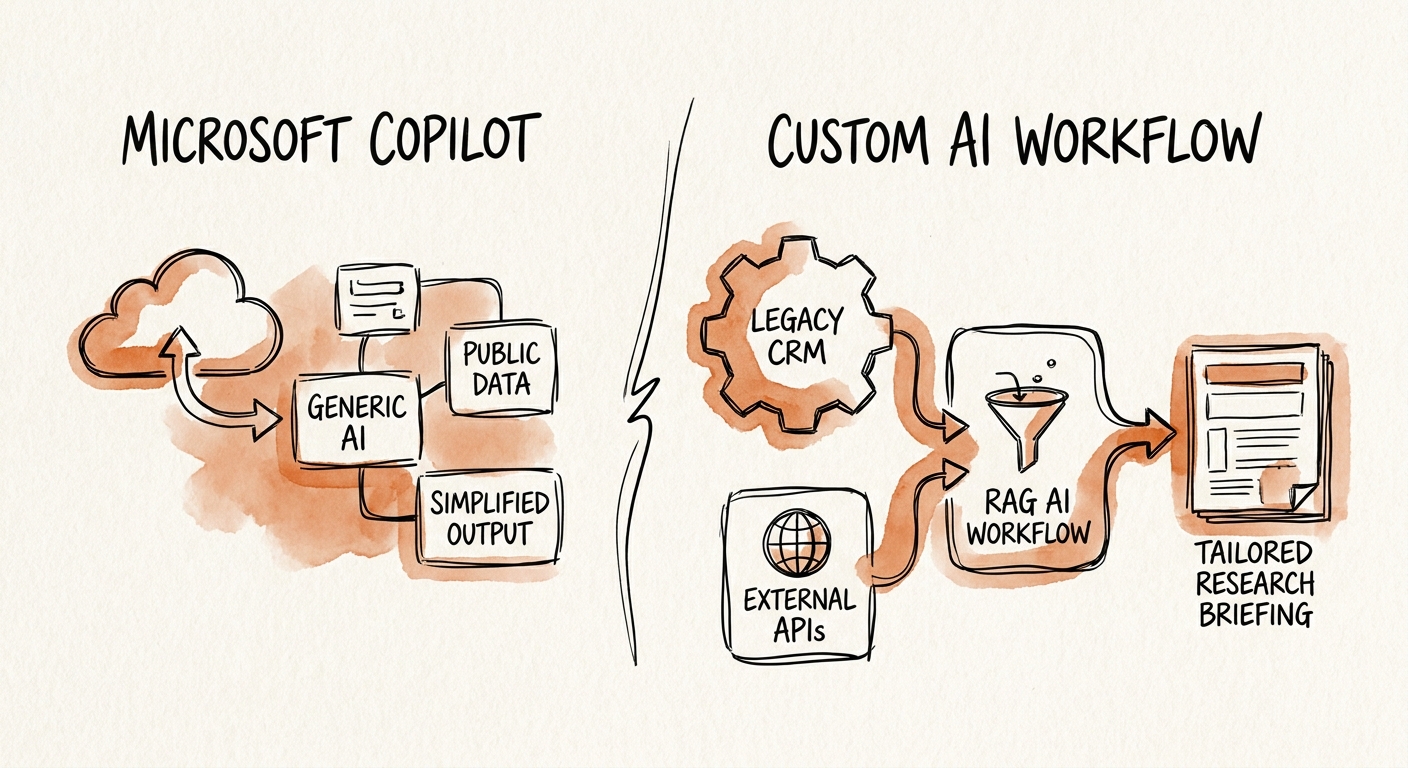
Here's where Copilot quietly fails the brief, and it has nothing to do with quality of prose. A research brief carries obligations a meeting summary doesn't: every material claim should trace to a named source, conflicting evidence should be surfaced rather than averaged away, and uncertainty ("two sources, they disagree, here's the range") should survive into the final document instead of being smoothed into one confident sentence. Copilot will happily blend a 2023 figure with a 2025 figure and hand you a clean number with no footnote. It has no native concept of "this claim is contested" or "log which source produced this line." For a Tuesday standup recap, fine. For a brief a six-figure decision rests on, that gap is the failure point.
That gap is precisely what a custom workflow is built to close: named source libraries it's allowed to draw from, mandatory per-claim citation, a conflicting-evidence step that forces disagreements into the open, and a source-and-output log you can pull up when someone asks "where did 18% come from" three months later. The NIST AI Risk Management Framework maps cleanly onto this — context mapping, risk measurement, control design, accountability — because a brief is exactly the kind of artifact where an untraceable claim becomes a real liability. Compare the two paths honestly with an AI ROI model that avoids fake savings: Copilot's payoff is faster drafts; the custom workflow's payoff shows up as fewer reversed decisions and less "we can't reconstruct why we believed that."
The decision, and the Monday version of it
Don't build a custom workflow because it sounds rigorous. Build it only when the briefs you produce carry consequences that demand traceability — when a wrong, unsourced line costs you a hire, a market entry, or a board's trust. The Deloitte State of AI report keeps landing on the same lesson: AI creates value when it changes how questions get scoped, sources get checked, and findings move into decisions — not when it just produces output faster. And the Gartner agentic AI project forecast is the counterweight: most custom builds get scrapped when nobody can name the value, the cost, or who owns the controls. So make the case narrow and explicit before you write a line of it.
Here is the test that settles it. Take your last three real briefs and ask: could you, today, trace every material claim back to a named source? If yes, Copilot plus a disciplined analyst is probably enough — your sourcing is already tight and the tool just speeds it up. If no — if even one consequential number is an orphan — that orphaned claim is your business case for a workflow that enforces citations and logs evidence by default. The decision isn't Copilot versus custom; it's "how much does an untraceable claim cost me," and your own back catalog answers it.
What to do Monday: name a single research owner, write down the approved source list for a typical brief, and add one rule — no claim lands in a brief without a source attached. That costs nothing and immediately tells you which tool you need. If the rule is easy to follow with Copilot, you're done. If it's constantly violated and impossible to enforce by hand, you've just sized the workflow. The AI pilot versus production workflow guide helps you decide whether the answer is Copilot, a light automation, or a governed custom build.