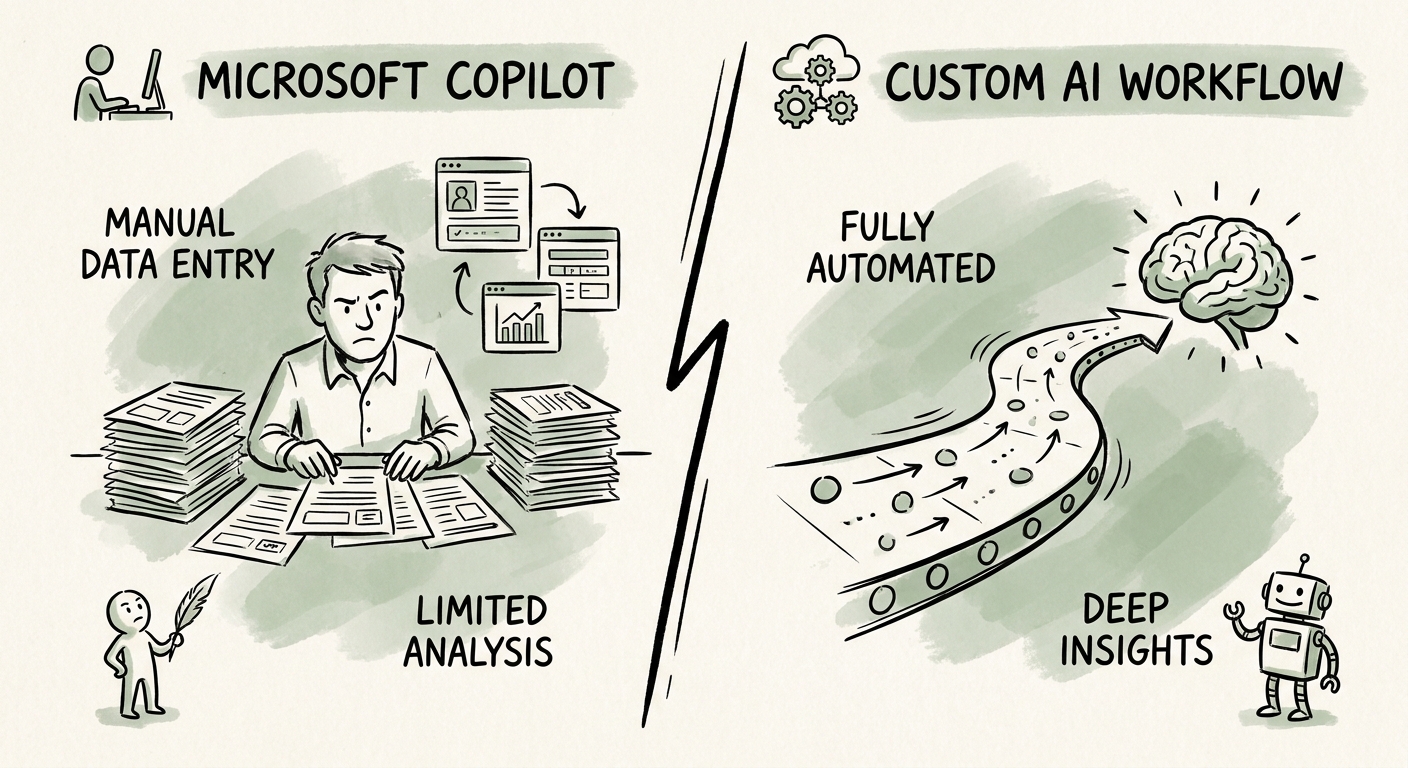
The summary was beautiful. Nobody could act on it.
Picture a 120-person SaaS company the morning after a quarterly business review. The VP of Customer Experience pasted three weeks of support transcripts, a churn-notes doc, and a pile of app-store reviews into Copilot and got back a clean six-theme summary: "onboarding friction," "billing confusion," "performance complaints," and so on. It read well. Then the head of product asked one question — "Which customers, and how many of them are on the plans we actually care about?" — and the room went quiet. The summary couldn't answer it. The themes had no segment, no count, no link back to a single ticket anyone could open.
That gap is the whole decision. Customer feedback doesn't arrive as a report; it arrives as fragments — a one-line NPS verbatim, a frustrated support thread, a renewal call note, a feature request buried in a Slack-forwarded email. The question is never "can AI summarize this." Of course it can. The question is whether a leader can take a theme, trace it to the specific customers behind it, and decide whether it earns a roadmap slot, a retention play, or nothing. OECD research on SME AI adoption keeps returning to organizational readiness over raw capability — and feedback programs are where that distinction bites, because a summary that changes no behavior is just a tidier version of the inbox you already ignored.
Copilot is the analyst's scratchpad. The workflow is the system of record.
Here is the honest split, and it's not about which tool is "better." Copilot is excellent the moment a CX lead or PM is in exploration mode: read this one ugly transcript and tell me what the customer is actually upset about, compare these five renewal emails, draft a first-pass theme list before the standup. Because it runs inside the user's existing Microsoft 365 permissions, that ad hoc work stays governed by access the person already has — Microsoft's own Copilot privacy and data protection documentation describes that boundary, and the Copilot architecture reinforces that it's grounding on content the user can already reach. For one analyst, one batch, one afternoon, that's exactly right.
The custom workflow earns its keep the moment feedback analysis stops being an event and becomes a cadence. That's when you need things Copilot was never built to hold steady: every verbatim tagged to a customer segment and account tier, severity scored on a rule everyone agreed to, each theme linked back to the source ticket or CRM record so a PM can click through to the actual evidence, escalations auto-routed to the right owner, and the same definitions applied next week and the week after so trend lines mean something. NIST's AI Risk Management Framework gives you the review-and-monitoring scaffolding for recurring scoring, and CISA's data-security guidance matters more here than in most build-vs-buy calls, because feedback data is laced with customer identifiers, contract context, and unredacted complaints moving between systems. The line is simple: if the output dies in a chat window, Copilot. If it has to land in a roadmap meeting next month with the same rules, build it.
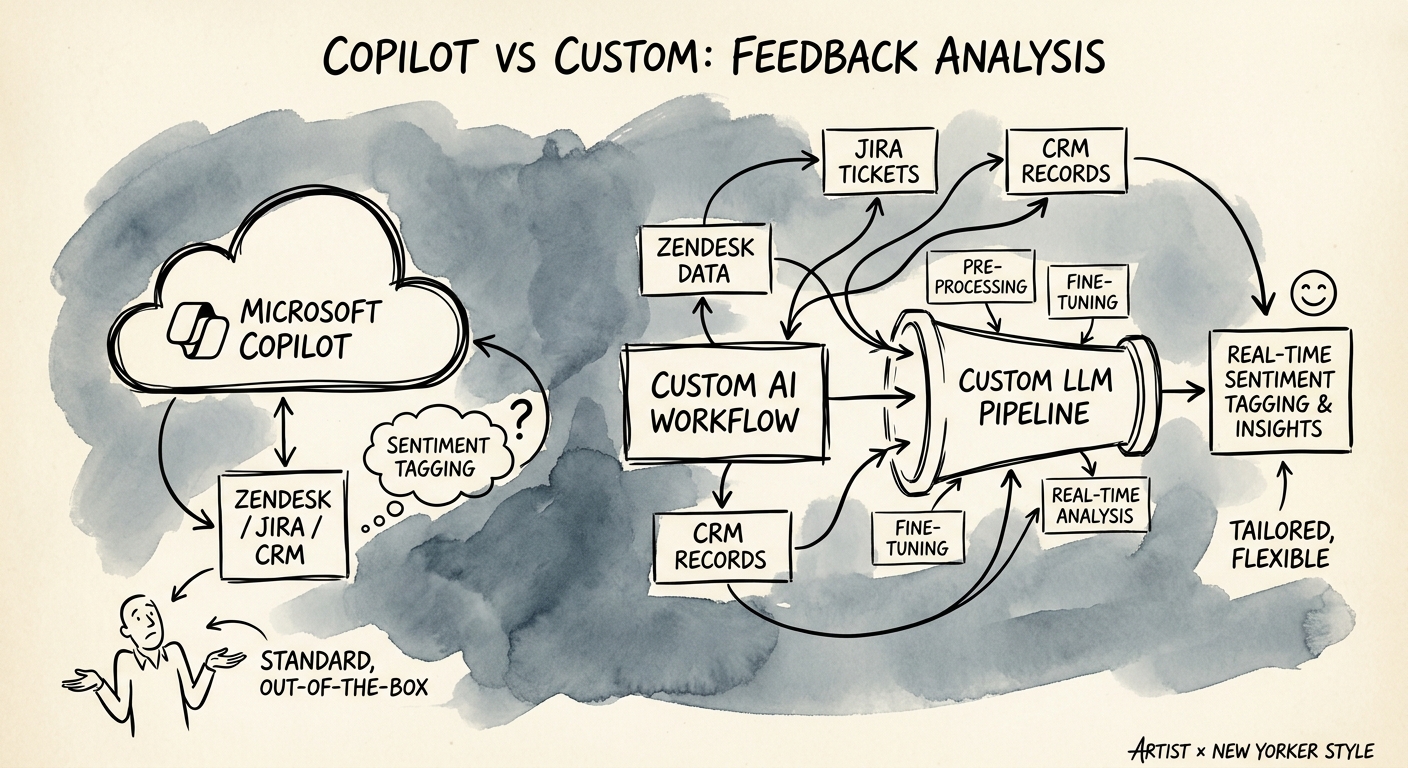
Run a two-source pilot and watch what survives the roadmap meeting
Don't pilot on everything. Pick the two feedback sources that already cause arguments — say support tickets plus churn/renewal notes — and ignore the rest for now. Run six to eight weeks. The only success criterion that matters: did at least one theme produced by the workflow change a real decision, with the PM able to click from the theme to the underlying customers and defend the call out loud? Deloitte's State of AI work keeps flagging production activation as the place these efforts stall — pilots that demo well and then never enter the operating rhythm — so judge yours by adoption in the cadence, not by how good the first summary looked.
Instrument it honestly. Track time-to-surface the top three issues, the share of themes that carry working source links (anything below near-total and trust collapses), escalation routing accuracy, how often a "churn-risk" flag was actually useful versus noise, and how much human cleanup the false positives demanded. If those numbers hold across multiple weeks with the same definitions, you have a system; if they wobble, you have a clever demo. Keep Copilot for the one-analyst exploratory pass — that's a genuinely good use of it. Commit to the governed workflow when the company needs evidence packets a PM can defend, routing that fires the same way every time, and a real read on which customer issues are moving renewals. If you want help drawing that line for your own feedback sources before you spend on the build, map it into an AI roadmap first.