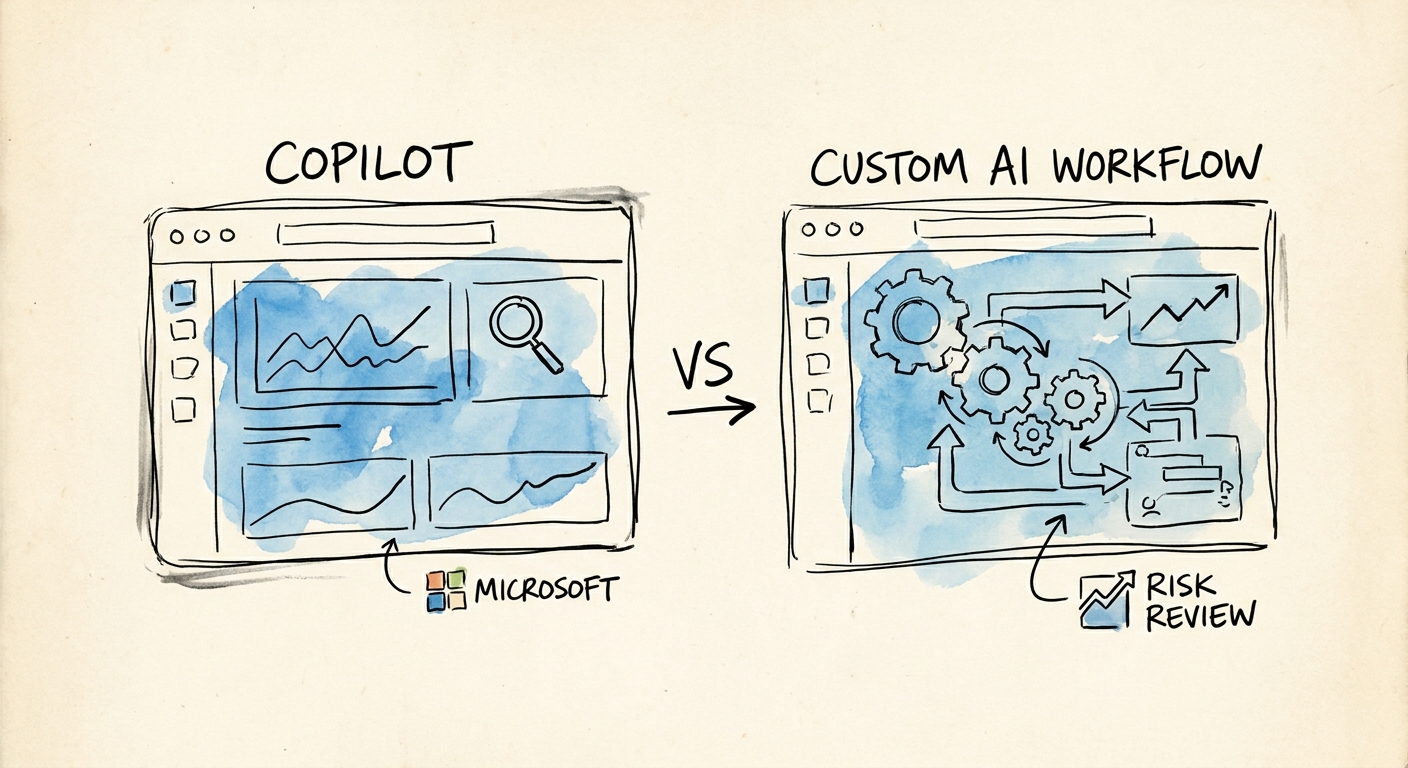
The renewal you lose is the one nobody flagged in March
Here is the pattern that costs mid-market software and services companies their net retention number. An account is fine in January. In February the champion who signed the deal leaves for a competitor. In March the new VP opens four support tickets that drag. In April logins drop 40% in the product's busiest workflow. In May the CSM runs the QBR, hears "we're evaluating options," and scrambles to build a save plan with six weeks left on a twelve-month contract. The renewal was readable in March. Nobody connected the dots until the QBR, because the dots lived in five different systems.
That is the actual job of renewal risk review at a 50-300 person company: not summarizing the QBR after the fact, but catching the sponsor change, the ticket pile-up, the usage cliff, and the quiet contract clause early enough that a save plan can still bend the outcome. The hard part isn't analysis. It's that login telemetry sits in the product database, tickets sit in the help desk, the org change sits in a LinkedIn alert nobody read, and the renewal date sits in CRM. RSM's middle-market AI survey shows companies your size are leaning into AI for exactly this kind of synthesis work. The operating question underneath the hype is narrower: do you want AI to help one account owner prepare faster, or do you want it scoring every account in the book and routing the at-risk ones to a queue before anyone has to remember to look?
Copilot reads the room. A custom workflow watches the whole portfolio.
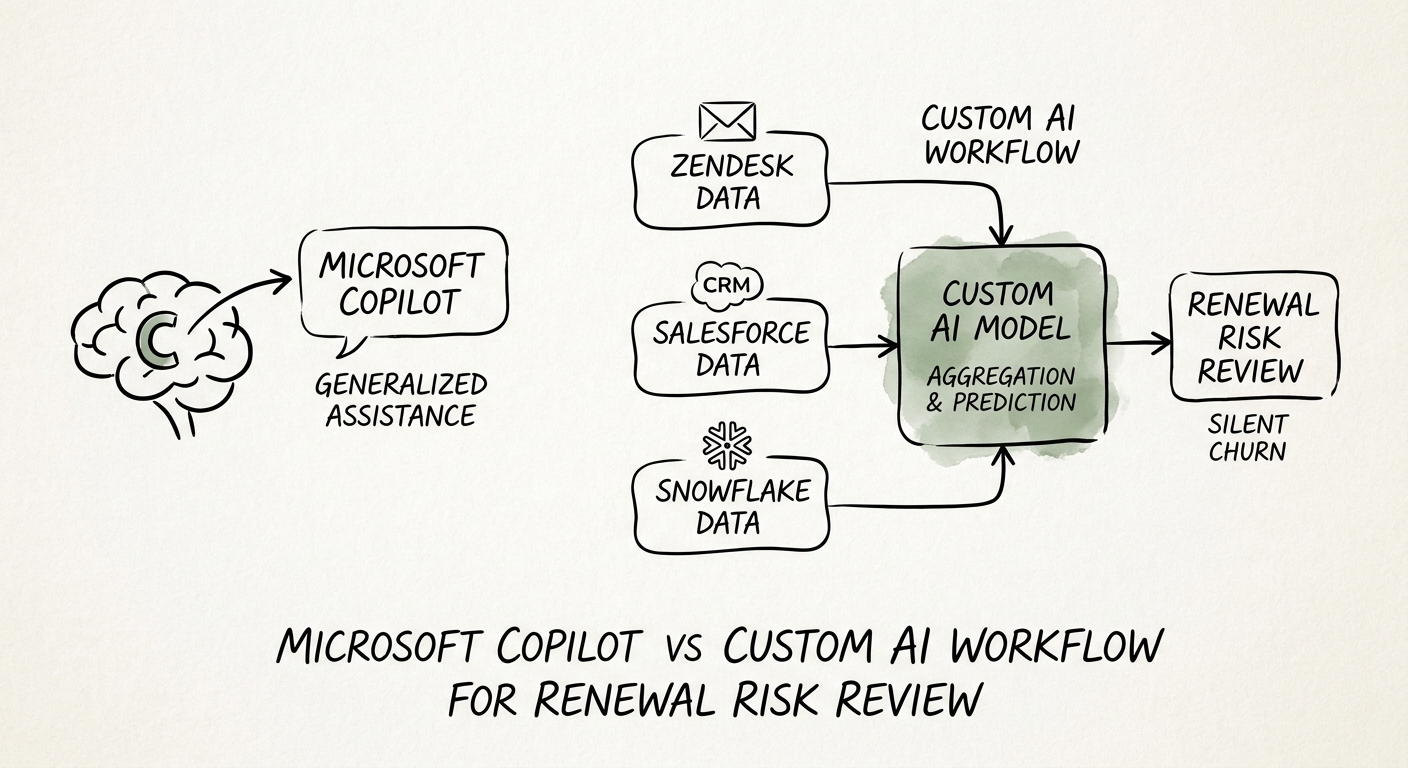
Draw the line at a simple test: does the work depend on one human already deciding which account to look at? If yes, that is Copilot territory. A CSM pulling together a renewal narrative gets real leverage from Copilot summarizing the last three QBR decks, the email thread where the budget got cut, the Teams call where the new VP went cold, and the account plan that's six months stale. Microsoft's privacy and data protection model and its architecture make this safe to turn on, because Copilot only reaches what that CSM can already see in Microsoft 365. The catch is that it only sees Microsoft 365. Product usage, ticket SLAs, and CRM renewal dates aren't in that boundary, so Copilot can make the human faster but it can't tell you which 30 accounts to worry about this week.
Custom AI earns its cost the moment "remember to look" stops scaling. Once you're past roughly a couple hundred renewing accounts a year and one or two CSMs covering them, you need a workflow that joins login decay against last quarter, parses ticket history for unresolved-and-escalating patterns, detects sponsor changes, scores each account, and fires a review trigger on the renewal calendar at 120 and 90 days out, then writes the flag and a save-play suggestion back into CRM. That is a build, not a prompt. And because it now touches commercial terms, support records, and customer telemetry in one place, you govern it like infrastructure: the NIST AI Risk Management Framework for how risk scores get reviewed and overridden, and CISA's data security practices for the customer data the model now reads across systems.
Test it on accounts actually renewing, not on a slide
The trap with renewal AI is demoing it on accounts that already churned or already renewed, where the answer is known and the model looks brilliant. Deloitte's 2026 AI research names activation, not capability, as where value actually leaks out. So run the only test that matters: pull every account renewing in the next 90 to 180 days, let the workflow score them cold, and check whether it surfaced risk earlier than your current cadence would have. If a CSM was already going to catch it in next month's review, the AI added nothing. If it flagged the sponsor change or usage cliff weeks before the human would have, that's the lead time a save plan needs.
Track six numbers, not a vibe: renewal-risk lead time (days between flag and renewal date), forecast accuracy versus your old gut-feel call, save-plan creation rate on flagged accounts, escalations the team would otherwise have missed, CSM override rate on the AI's scores (too high means it's noise, too low means nobody's checking), and the net retention delta over two renewal quarters. If the answer is "our coverage is thin and accounts slip through cadence," that's a build. If your CSMs already catch what matters and just want to prep faster, keep it in Copilot and spend the budget elsewhere. When you do decide to build, scope it as a governed workflow from day one rather than retrofitting controls onto a tool that's already reading every customer's commercial data — that sequencing is the difference between a 90-day win and a 9-month cleanup.