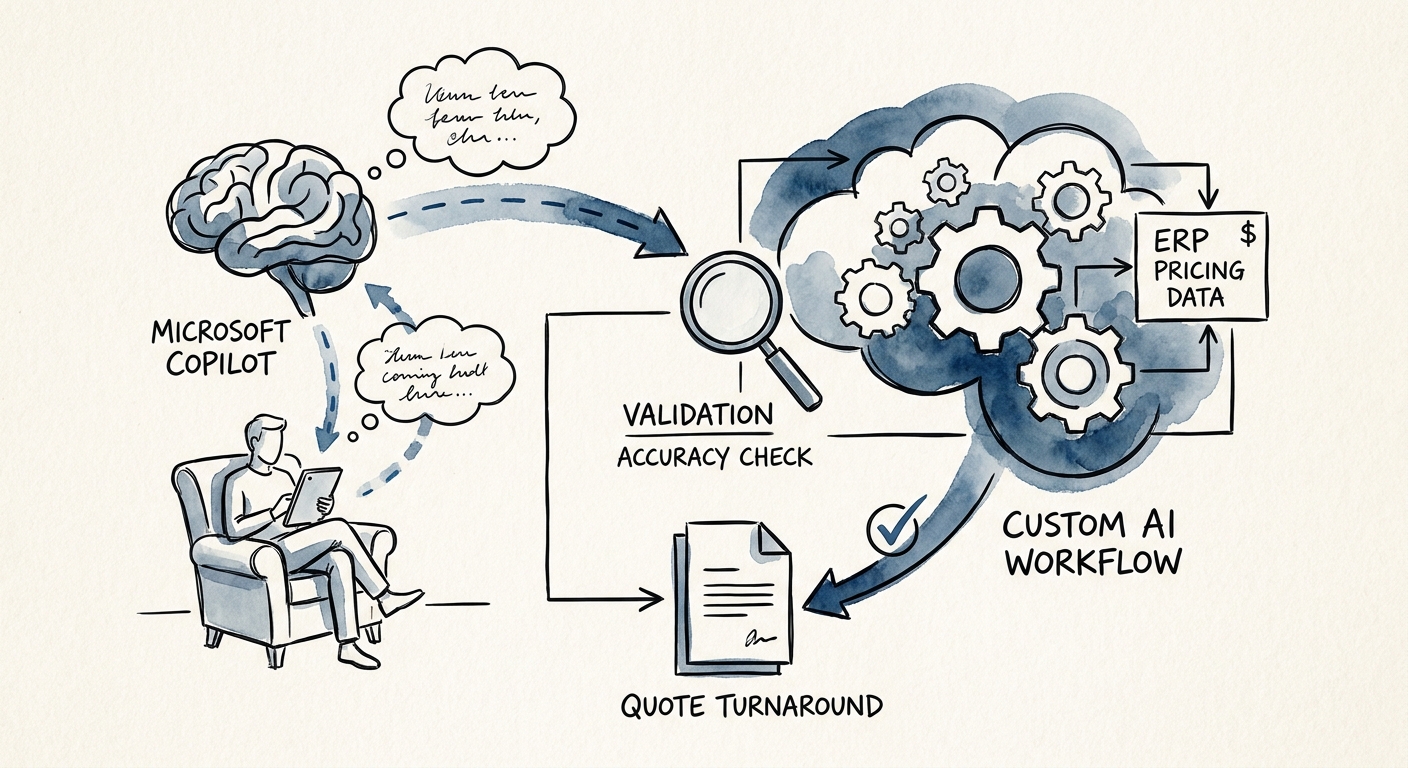
The quote isn't slow because someone is typing
Picture a 60-person B2B technology reseller. A rep gets a request for a 200-seat renewal with a hardware bundle and a non-standard payment term. The quote takes four days to go out. When you actually trace those four days, almost none of it is writing. It's waiting: waiting for the rep to dig last year's pricing out of a closed opportunity, waiting for the price book to confirm the bundle discount is still valid, waiting for finance to bless a margin that dipped below floor, waiting for someone to update the CRM stage so the forecast stops lying. The cursor blinking in an empty quote is the cheapest part of the whole sequence.
This is the trap in most "Copilot will speed up quoting" pitches. They assume the bottleneck is drafting, so they buy a drafting tool. Microsoft 365 Copilot's data protection architecture is genuinely strong at the layer where the delay isn't: it rides Microsoft Graph and honors tenant permissions, so it can surface that buried prior proposal, summarize the account history sitting in Outlook and Teams, and draft the cover note — all without exposing a document the rep wasn't allowed to see. If your quote turnaround is mostly "find the last one and adapt it," Copilot can take real days off the calendar tomorrow.
But notice the boundary. Copilot reads and assembles. It does not enforce that the bundle discount is current, hold a quote that breaches floor margin, or write the stage back to the CRM. The moment a quote stops being a document and starts being a commitment — a price, a term, an approval — you've crossed into territory the assistant was never designed to govern. And quotes are commitments by definition.
Where the line actually falls: read vs. commit
Run the test on every step of your quote process. Is the AI reading something, or is it committing something? Reading is Copilot's home turf — pulling history, summarizing context, generating first-draft language. Committing is not: applying a price-book rule, calculating margin against a floor, routing an exception to finance, advancing the deal stage, syncing a line item back to ERP. IBM's Institute for Business Value research frames this as a capability question rather than a tool-shopping question, and that's the right lens. Once your quoting touches pricing logic and approvals, you don't have a writing problem anymore. You have a controlled operating workflow.
Here's the failure mode that should worry a sales-ops leader more than a slow quote: a fast wrong one. The NIST AI Risk Management Framework exists to make you map exactly this before you let any assistant near the process. A general-purpose assistant prompted to "build the quote" can confidently produce a number that's internally plausible and four points under your margin floor — because it has no concept of the floor. It doesn't know the volume tier reset last quarter, or that this customer's contract caps the annual uplift. Those rules don't live in the documents Copilot reads. They live in your price book and your approval matrix, which is precisely why a custom workflow earns its cost: it can encode the deterministic rules, refuse to advance a quote that violates one, and produce an audit trail of who approved the exception.
McKinsey's State of AI 2025 keeps landing on the same finding — the value shows up when the workflow is redesigned, not when a chatbot is bolted onto the old one. For quoting, "redesigned" has a concrete meaning: the price rule, the margin check, and the approval routing become enforced steps the AI operates inside, not suggestions a human has to remember to apply after the fact.
A decision you can make this week
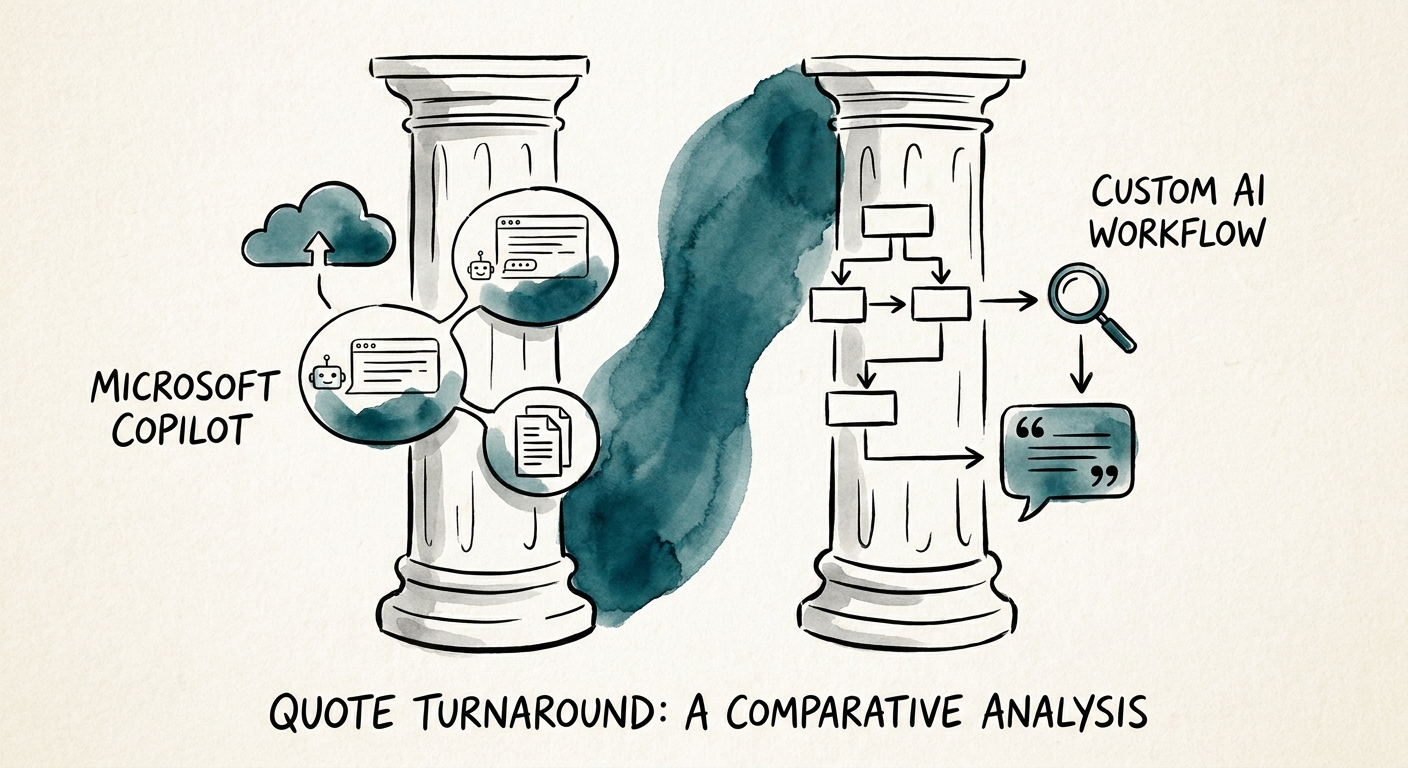
Don't frame this as Copilot versus a custom build. Most quoting orgs end up running both: Copilot accelerates the knowledge and drafting layer for every rep, and a custom workflow governs the small set of steps where money and commitments are on the line. Your real job is drawing the line in the right place. Do it with one exercise: list every step from "quote requested" to "quote sent," and tag each one read or commit. Everything tagged read is a Copilot candidate you can pilot now. Everything tagged commit — price rules, margin gates, approval routing, system-of-record writes — is where you scope a workflow, because getting those wrong costs margin, not just time.
Then instrument it so the decision is settled by numbers instead of opinions. Track quote cycle time, revision rate (how often a quote bounces back for a fix), the share of quotes that breach margin floor, and adoption by both reps and finance — because a quote tool that finance doesn't trust gets routed around. PwC's 2025 Responsible AI survey makes the point that the controls have to live with the people doing the work; a margin check no one sees isn't a control, it's a slide.
If you want a structured starting point, run the AI Opportunity Score to see whether your quote process is a near-term Copilot win or warrants a governed workflow, and pressure-test the build with the AI ROI Calculator against the cycle-time and margin-leakage numbers you already have. The output you want is a one-page map: which quoting steps Copilot speeds up Monday, and which one or two steps justify the engineering to control end to end.
