The lead didn't go cold. It went to nobody.
Picture a 140-person software company. A VP of Operations at a perfect-fit prospect fills out the demo form at 4:52 PM on a Thursday. By Monday, no one has called. The lead sat in a "New" status because the round-robin assigned it to an SDR who was out, the territory was ambiguous between two AEs, and the enrichment that would have flagged it as a top-decile account never ran. The marketing team will report it as a delivered MQL. Sales will swear they never saw it. Both are right.
That is the real lead-qualification problem at this size, and it is almost never the part AI demos are good at. A summary of the account is easy. Deciding who owns this, right now, with what priority, and proving the handoff happened is the hard part. RSM's middle-market AI survey shows how much pressure mid-market teams feel to adopt AI, and the San Francisco Fed's analysis of AI and small businesses confirms smaller firms reach for the lowest-friction tool first. For most companies already paying for Microsoft 365, that tool is Copilot. The question is whether the leak you actually have is one Copilot can plug.
So name the leak before you pick the tool. Is it slow MQL-to-SQL movement? Good-fit leads routed to the wrong rep? Two reps claiming the same logo? High-intent inbound that no one follows up on inside a day? Those are four different failures, and only one of them is "the rep needs a faster way to read the account."
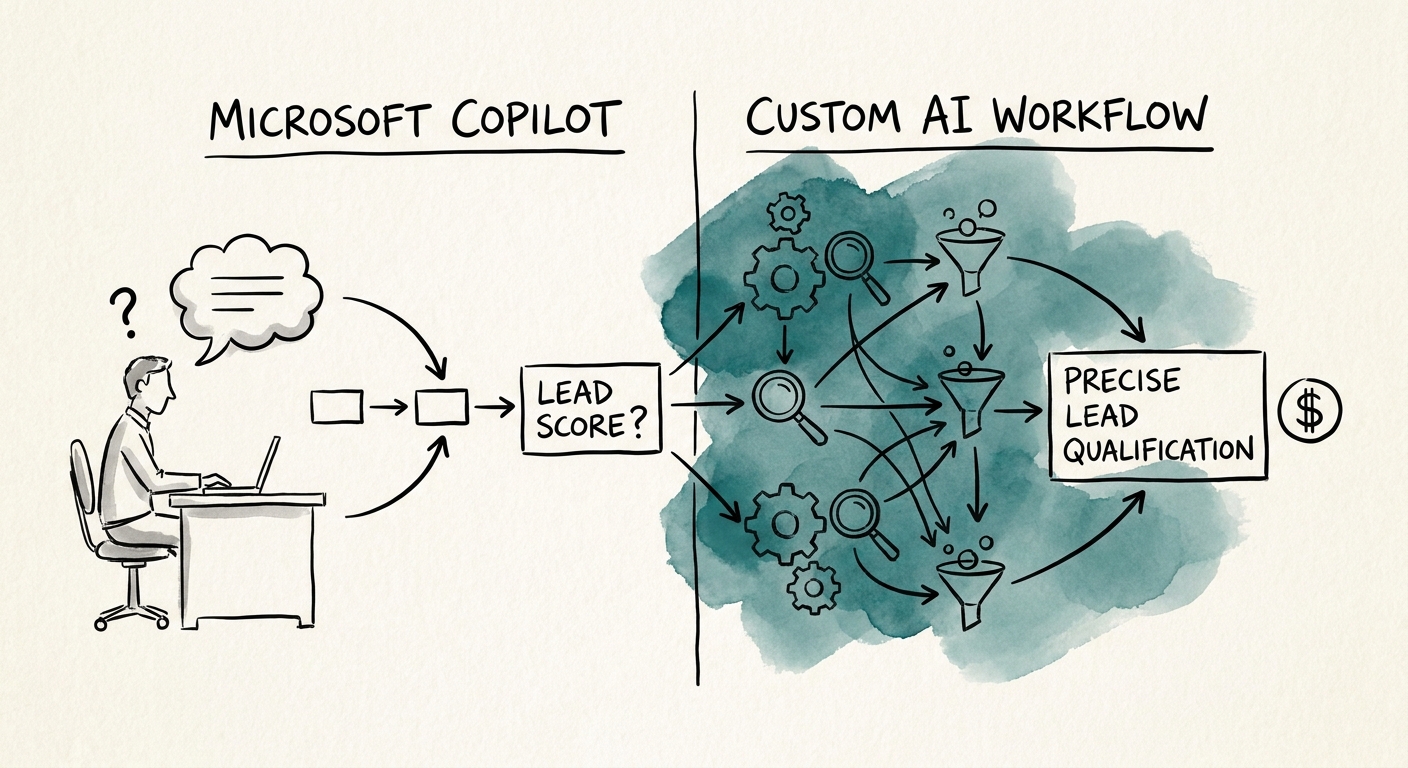
Copilot for the read. A custom workflow for the routing decision.
Here is the clean dividing line. Copilot is excellent at the read: an SDR opens an account, and Copilot pulls together the email thread in Outlook, the meeting notes in Teams, and the related files to produce a call-prep brief in thirty seconds instead of fifteen minutes of digging. It does this safely because, per Microsoft 365 Copilot's privacy documentation and its architecture documentation, it only surfaces what the signed-in user already has permission to see. That permission-bound behavior is exactly what you want for a rep reading their own pipeline — and exactly what makes Copilot the wrong owner of the routing decision.
Why? Because the routing decision needs to act on things that live outside one user's mailbox and apply rules across reps: an enrichment lookup that scores the account, a territory map that says this logo belongs to the East AE regardless of who opened the form, a write back into the CRM that stamps the lead's qualification reason and timestamp, and a trigger that fires a follow-up SLA the moment ownership lands. A chat assistant that answers inside one person's context cannot enforce a rule that spans the whole team. A custom workflow can, deterministically, every time, with a logged reason you can audit later.
That is where the build earns its budget. And it is where governance stops being a checkbox: the NIST AI Risk Management Framework gives you the structure to define who reviews disputed scores and how overrides get monitored, while CISA's AI data security guidance matters the instant prospect and customer data starts moving between your enrichment provider, your CRM, and your outreach tool. A scoring rule that quietly trains on data it shouldn't touch is a problem you find in an audit, not a demo. The OECD's research on AI adoption among small and medium-sized enterprises keeps landing on the same point: the tools are accessible, but the operating discipline around them is what separates value from noise.
Measure accepted opportunities, not impressive scores
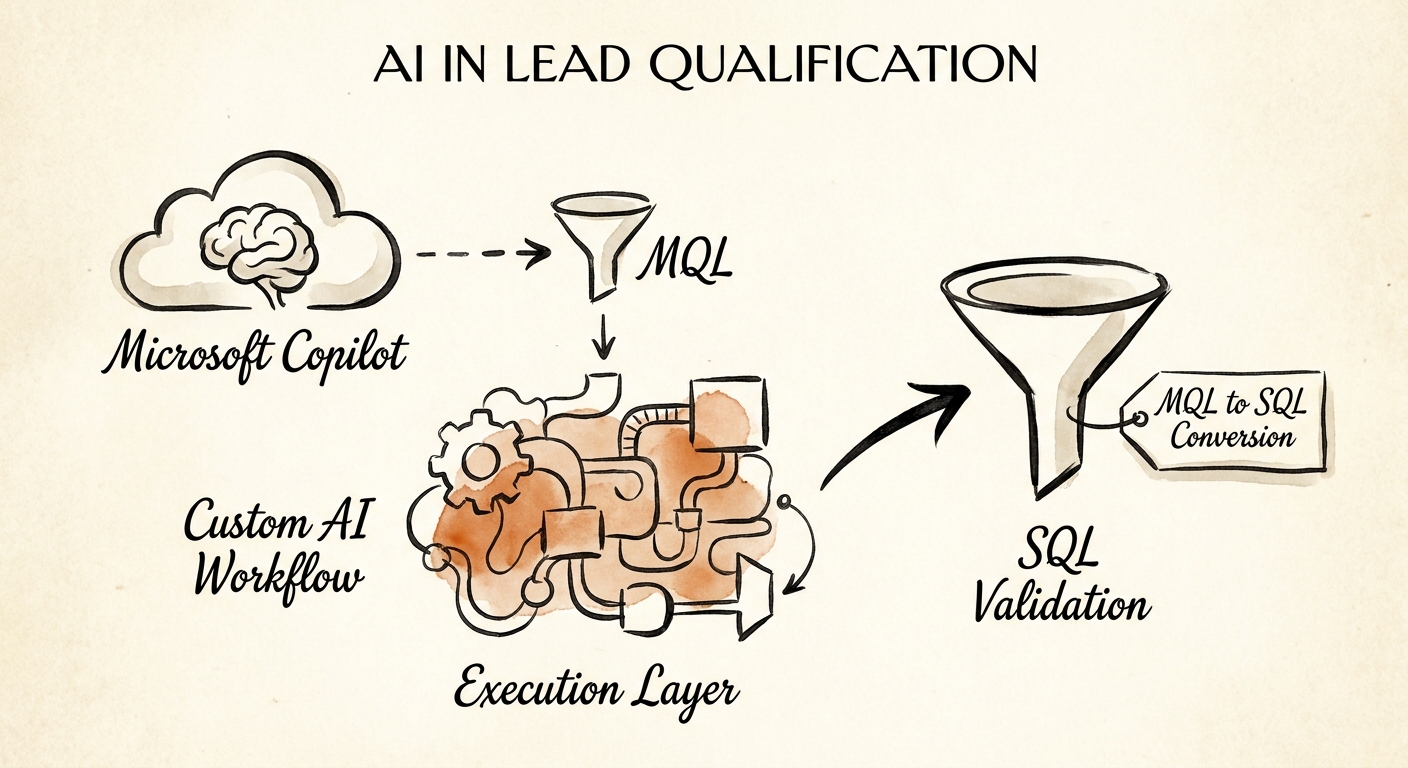
The trap with lead-qualification AI is grading the wrong thing. A model that scores 5,000 leads with a slick confidence percentage is not success. Deloitte's State of AI in the Enterprise 2026 frames the gap bluntly as the distance between pilots and production value. For qualification, production value is simple: more good-fit prospects reach the right rep fast, and fewer fall through the crack between marketing and sales.
So run a 90-day pilot on one segment and instrument it for the handoff, not the scorecard. Track six numbers: MQL-to-SQL cycle time, the bad-fit routing rate, how often SDRs override the AI's territory or priority call, the sales acceptance rate (the AE confirms "yes, I own this and it's real"), the missed-follow-up rate against your SLA, and conversion-to-opportunity from the pilot cohort versus your baseline. If SDR override rates stay high, your rules are wrong, not your tool — fix the rules before you blame the model.
Then decide on evidence, not vibes. If reps mostly need help reading accounts they already touch, keep human judgment in control and let Copilot be the analyst layer — you may not need to build anything. If your leak is the silent Thursday-afternoon lead that goes to nobody, that is deterministic routing, CRM writes, and a logged acceptance trail, and Copilot will not get you there. Map your six metrics to the failure you actually have, and the build-vs-buy answer usually stops being a debate. If you'd rather sequence that decision into a concrete plan, that is what the AI roadmap is for.