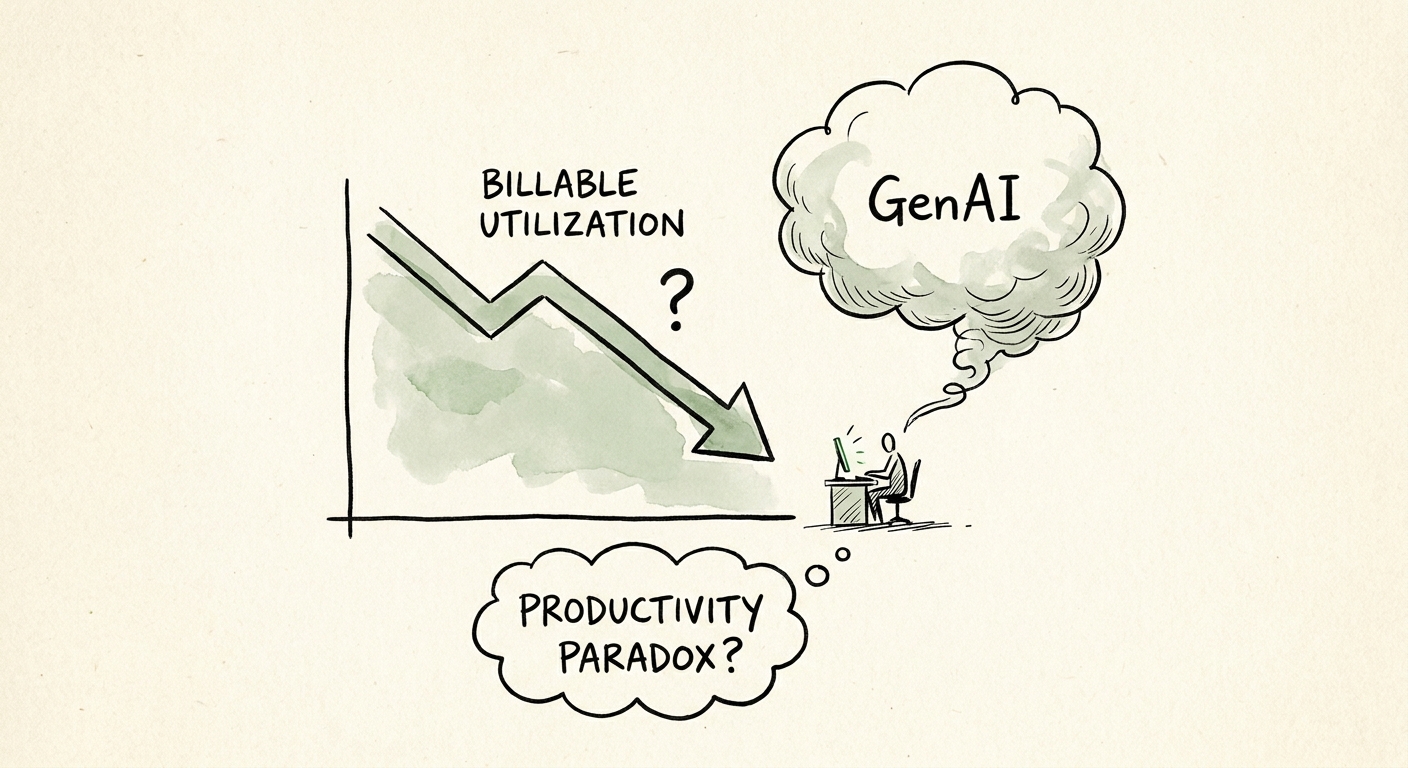
The associate who finished a 30-hour deliverable in 9
Picture a 40-person consultancy. An associate used to spend 30 billed hours assembling a market analysis deck. With an AI assistant pulling first drafts and synthesizing notes, she now ships the same deck in 9 hours. Everyone applauds. Then the engagement manager logs the time, the invoice goes out for 9 hours instead of 30, and the firm has just handed two-thirds of that line item back to the client for free.
That is the trap no productivity demo warns you about. If you sell time and time gets shorter, the gain doesn't land in your margin by default. It evaporates into lower invoices. Deloitte's 2026 AI research is worth reading precisely because it tracks the shift from experimentation toward production value, and for a services firm "value" is not minutes saved. It's whether realization, capacity, or margin actually moved. Faster delivery is an input. None of those three outcomes is automatic.
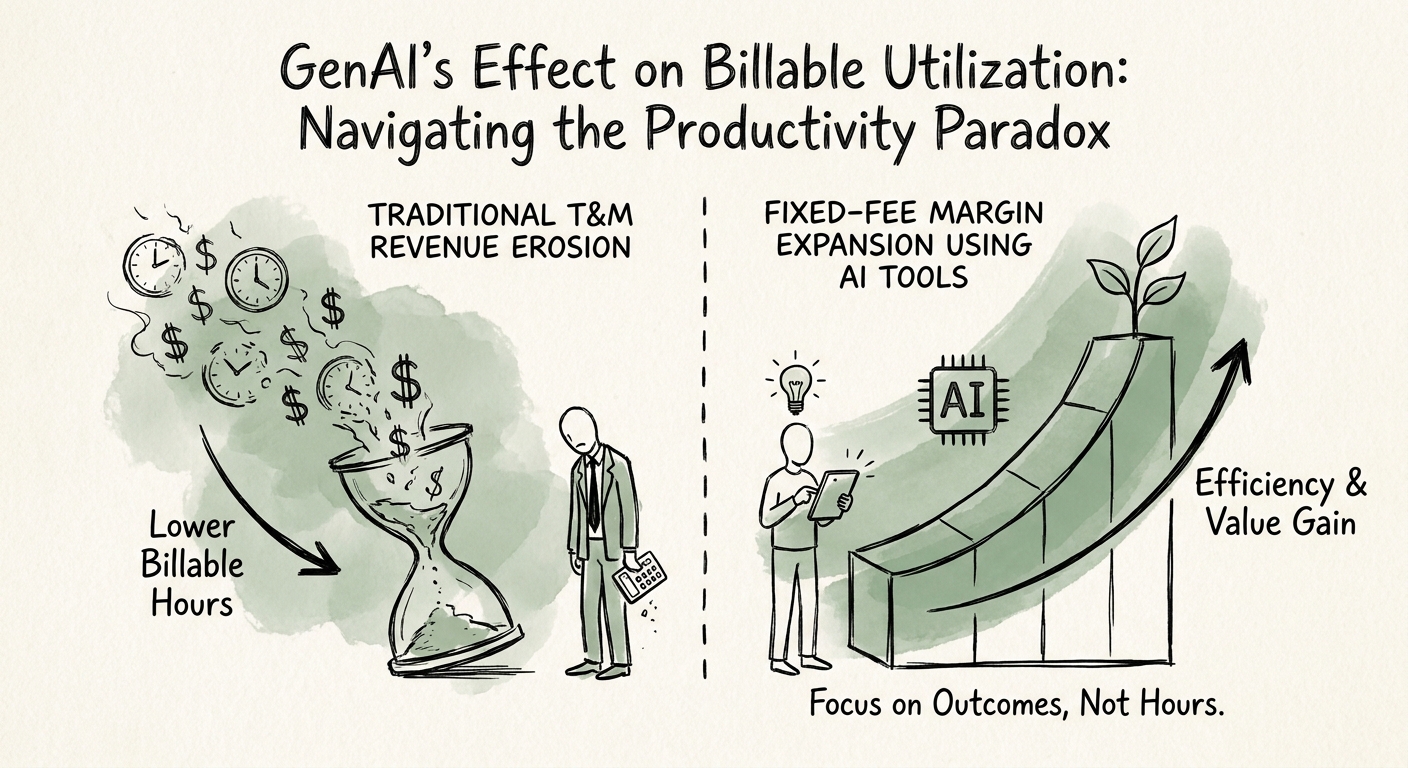
The uncomfortable part for IT services and consulting shops is that the firms most exposed are the ones running pure time-and-materials. Every hour AI removes is an hour you used to bill. The firms least exposed are running fixed-fee and outcome work, where speed quietly becomes profit. Before you scale a single tool, you have to know which side of that line each engagement sits on.
The number to watch is realization, not utilization
Most leaders reach for utilization first, and that's the wrong gauge here. Utilization tells you how busy people are. It can stay flat or even climb while your economics quietly bleed, because the associate fills her freed hours with more discounted work. The line that exposes the paradox is realization: billed revenue divided by the value of hours worked at standard rate. When AI shrinks the hours behind a fixed deliverable, realization on time-and-materials work is the first thing to crack.
So instrument that first. You need timesheet categories clean enough to tag AI-assisted work, project-margin reporting that survives a faster delivery curve, and a scope-change trigger that fires when "we'll do it faster" silently becomes "we'll bill less." A worked check: take one repeatable deliverable, record the pre-AI billed hours, the post-AI billed hours, and the rate. If billed revenue dropped and nothing in the contract changed, you've found the leak. NIST's AI Risk Management Framework is useful for keeping that pilot anchored to intended use and measurable outcomes rather than to how impressive the tool feels in a Tuesday standup.
The second gauge most firms skip is rework. A draft produced in a third of the time but kicked back twice in QA didn't save anything; it moved the cost from drafting to review and probably annoyed a client. Track edit volume and review hours alongside cycle time. And because consulting deliverables routinely carry client documents, confidential analysis, credentials, or regulated data, the workflow has to define which client materials may go into a tool and which outputs require human sign-off. CISA's data-security guidance is the floor here the moment an associate pastes a client's confidential file into a prompt.
What a services leader does this week
Don't roll AI across the practice. Pick one repeatable delivery motion where you can count the hours: first-draft analysis, meeting-note synthesis, test-plan creation, status reporting, or reusable research. Run the same deliverable with and without the assistant for a handful of engagements and capture five numbers each time. Billed hours before. Billed hours after. Review and rework hours. Standard rate. And the one that forces the real decision: did the saved time become margin, become added capacity you can sell, or become a smaller invoice?
Then have the pricing conversation before the rollout, not after. This is the move that separates firms that profit from AI from firms that subsidize their clients with it. Fixed-fee, managed-services, and outcome-based engagements capture productivity gains automatically, because the price doesn't move when the hours do. Pure time-and-materials does the opposite. For your most repeatable, AI-amenable work, that's often the trigger to shift commercial terms toward fixed scope or a productized package, so faster delivery shows up on your P&L instead of the client's.
Scale only when realization holds or improves, when freed capacity is genuinely sellable, and when you can prove that saved hours are not silently converting into lower revenue. If those don't hold in the pilot, the fix is usually not more tooling. It's clean timesheet categories, a real scope-change discipline, and a decision about who keeps the money. When the economics can absorb the speed, formalize it in a 90-day implementation plan and the broader AI transformation blueprint.