The triage tool becomes an audit of your knowledge base
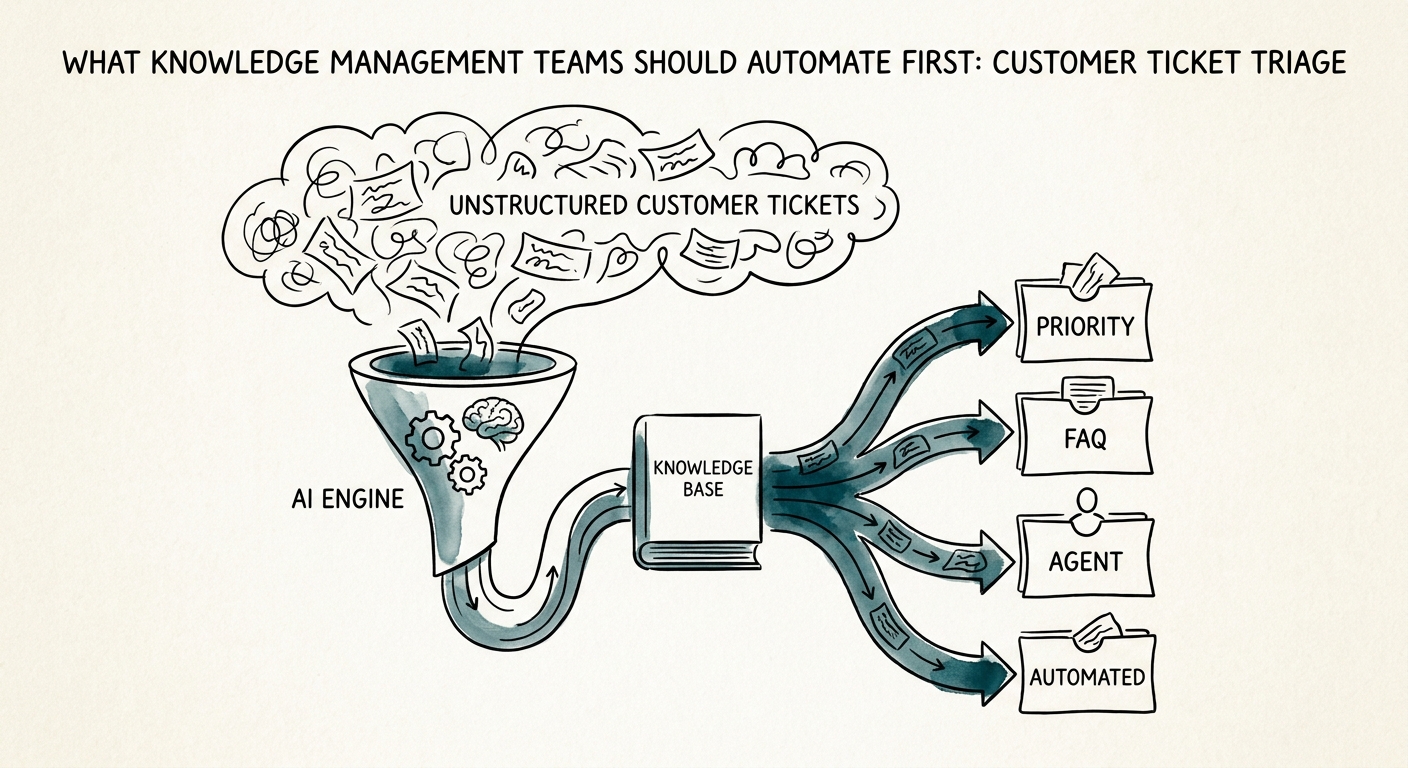
Here is what nobody warns the knowledge-management team about. You stand up AI to triage incoming tickets — classify the issue, pull the likely source article, summarize, suggest a priority — and within two weeks the retrieval logs hand you something you did not ask for: a brutally honest map of your knowledge base. Three articles describing the same password-reset flow, two of them contradicting each other. A "known issues" doc last touched fourteen months ago. A whole category of billing questions the model keeps routing to a human because there is simply no article behind it.
That is the real first win, and it is why ticket triage is such a good opening move for a KM team specifically. Other functions automate to save minutes. You automate and, almost as a side effect, you finally get told which of your 400 articles actually answer the questions customers send. Salesforce State of Service and IBM's research on trusted AI capabilities both land on the same point from different angles: the constraint is rarely response speed, it is the quality and trustworthiness of the context feeding the answer. AI triage makes that context measurable for the first time.
So build the first version to classify, retrieve, summarize, and propose a priority — then stop. Route every case to a human-owned queue with the suggested article attached. Do not let it answer a customer unsupervised. You are not buying deflection yet. You are buying a daily report on where your knowledge actually breaks.
Two numbers that tell you whether the base or the model is wrong
Say a 50-person SaaS support org turns this on. By the end of week one, agents are accepting roughly 80% of the AI's category guesses but rejecting the suggested article almost half the time. The instinct is to blame the model. It is almost never the model. When classification is good and retrieval is bad, the article does not exist, is duplicated, or is too stale for the model to trust over a newer one. When classification itself is shaky, your taxonomy is the problem — you have categories that overlap so much a human could not separate them either.
Track those two acceptance rates separately and you have a weekly worklist that writes itself. Low article-acceptance on "refund eligibility"? That is a content gap or a contradiction to fix this sprint. Low category-acceptance on "account / billing"? Merge or redefine the categories. The triage system stops being a routing tool and becomes the thing that tells your writers exactly which article to fix next, ranked by how many tickets hit it.
Then govern the route the way PwC's Responsible AI survey and the NIST AI Risk Management Framework describe: every suggestion shows its evidence — which article, which passage, why this priority — so a reviewer can overrule it in seconds. And wire a hard fallback. The moment a ticket touches a named outage, a refund, legal language, a flagged account, or two source articles that disagree, the system routes straight to a human without proposing a resolution. A model that cheerfully cites a contradicted doc is worse than one that admits it does not know.
What to put on the wall Monday
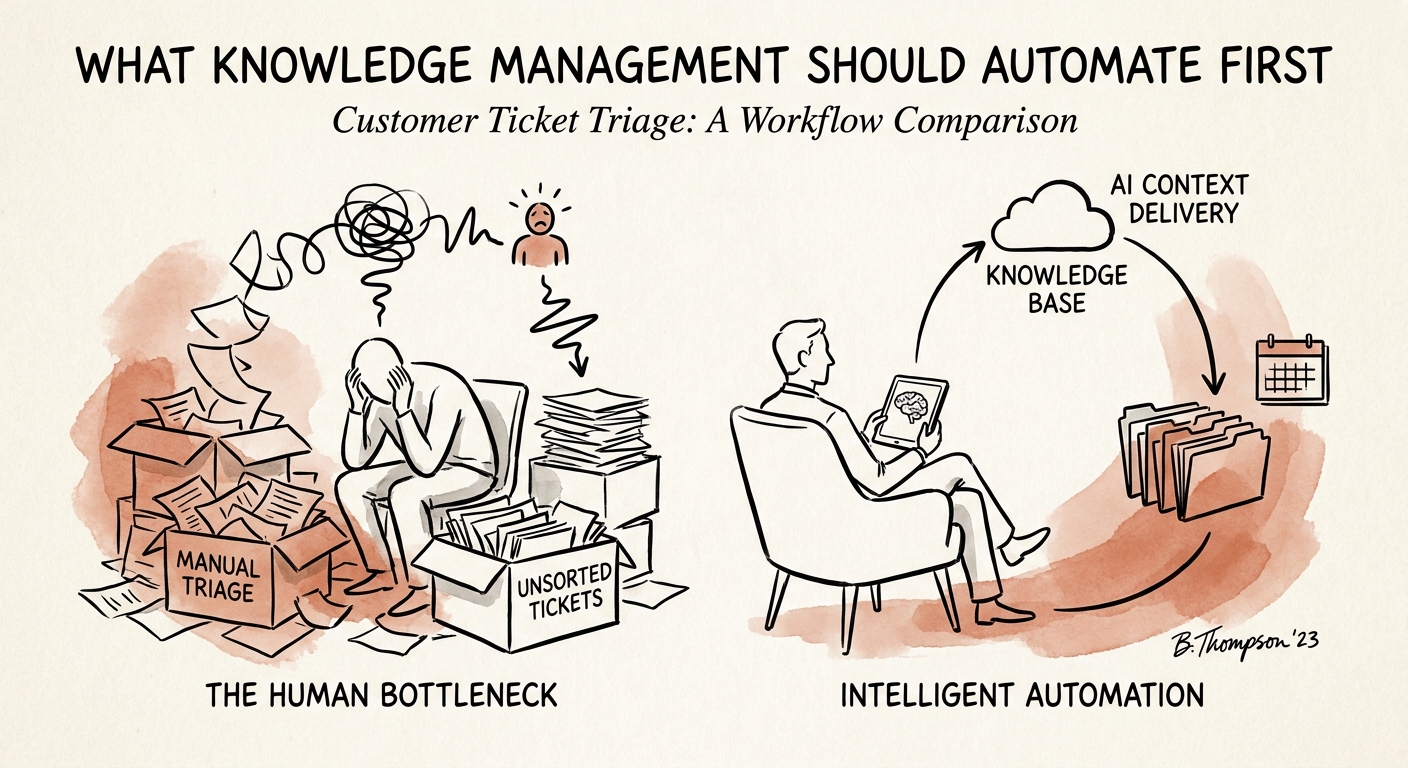
Build one dashboard, two halves. The left half is routing health — time to first owner, correct-routing rate, reopened cases, escalation aging. The right half, the one that matters for a KM team, is knowledge health derived from the same triage logs: most-retrieved articles, articles the model keeps rejecting, queries that returned nothing usable, and reviewer acceptance of AI suggestions trending over time. McKinsey's State of AI work keeps finding that the value shows up when the work itself is redesigned, not when a tool is bolted on — and for you the redesign is concrete: your content backlog becomes evidence-ranked instead of opinion-ranked.
Spend the first month doing nothing but improving the articles the logs flag and tightening the taxonomy the rejections expose. Watch the article-acceptance rate climb. Only when it holds steady and high do you let AI draft customer-facing answers — and then only for the categories where the underlying knowledge has earned that trust. Routing first, content second, automation last.
If you want to map this against your own ticket volume and article inventory, see AI for customer service and AI knowledge systems, then run your queue through the AI Opportunity Score to see whether triage is the right first workflow for your team.