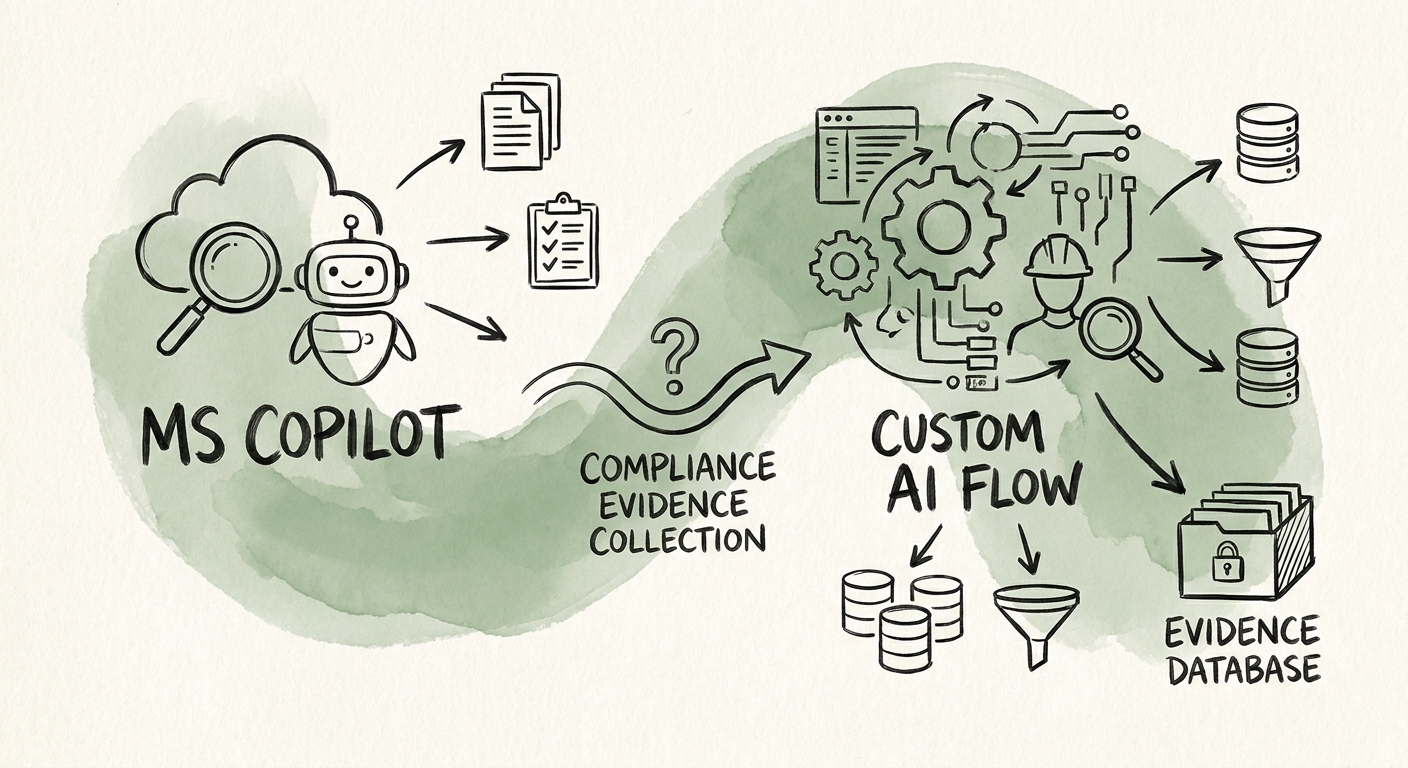
The question Copilot can't answer
Picture the moment a SOC 2 auditor points at one of your controls and says: "Show me the evidence that access reviews happened in Q2." Someone on your team opens Microsoft Copilot, types a prompt, and ninety seconds later has the access review export, a tidy summary, and a draft narrative. Impressive. The auditor then asks the second question, the one that actually decides the finding: "Who reviewed this, when, and how do I know it hasn't been altered since?" Now the room goes quiet.
That gap is the whole decision. Copilot is genuinely good at the first question — locating, summarizing, and drafting against documents your employee already has permission to see. For an individual analyst preparing for a meeting or hunting down a policy clause, it removes real friction. But compliance evidence isn't a document you find. It's an artifact with a chain of custody: it was requested, assigned, pulled from a system of record, verified, approved, packaged, retained for a defined period, and must be re-explainable long after the person who collected it changed jobs.
The pattern across McKinsey's 2025 State of AI, the IBM Institute for Business Value, and PwC's 2025 Responsible AI survey is consistent: giving people AI access is easy and quick to value; changing how a governed process runs is a different and slower kind of project. Evidence collection lives squarely on the second side of that line.
Where Copilot is the right answer — and where it quietly isn't
Be honest about the wins. If a compliance lead needs to find last quarter's vendor risk policy, summarize a 40-page DPA, or draft a first-pass response to a customer security questionnaire, Copilot earns its seat. It inherits the Microsoft 365 permission model and surfaces only content the user can already access — Microsoft's own data protection and auditing documentation spells out how that inheritance and the audit logging work. For individual-scale knowledge work, that's often enough, and standing up a custom system would be overkill.
The trouble starts when the same team uses Copilot as the system of record for the control itself. Say a 120-person B2B software company is collecting evidence for thirty controls across Okta, GitHub, Jira, and a cloud provider's console. The work isn't "find a document." It's: assign each control to an owner, pull the right export from the right system on the right date, confirm the export covers the full audit window, route it for reviewer sign-off, flag the three controls where the evidence is incomplete, and freeze the package so it can't drift. Copilot can assist any single keystroke in that chain. What it does not do is hold the chain — the assignment state, the approval record, the source lineage, the exception that says "this control had a gap in May and here's the remediation ticket."
A custom workflow exists to hold exactly that. Permissions, deterministic routing rules, and a human approval gate wrap around the model so the AI drafts and retrieves while the system enforces who-did-what. If you're not yet sure which of your AI ideas need that wrapper, the pilot-vs-production workflow guide draws the same line in more detail.
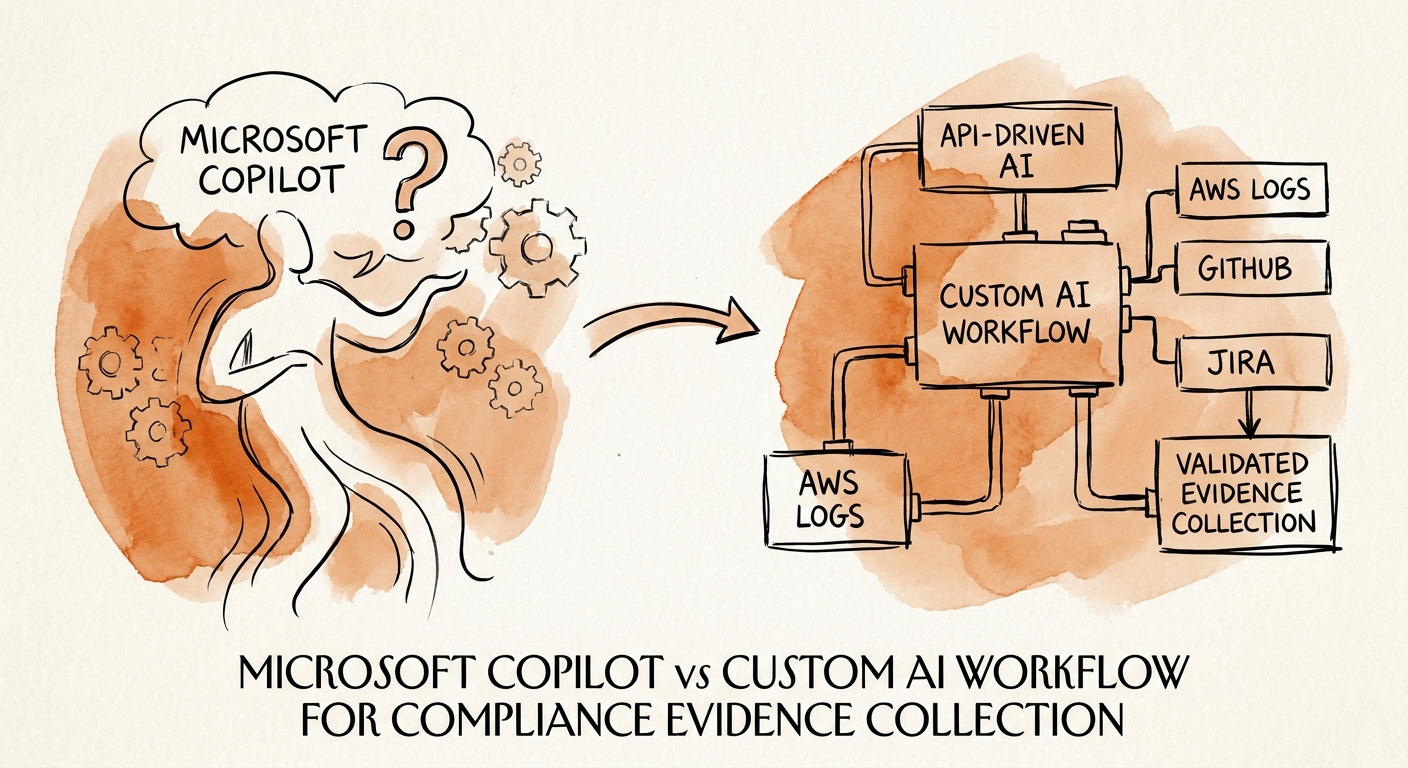
Map one evidence request before you buy anything
Don't decide this abstractly. Pick a single control you'll have to evidence next cycle — access reviews is the classic one — and trace it end to end on a whiteboard. Write down the source systems the evidence comes from, who's allowed to pull it, who has to approve it, what the finished artifact looks like, how long you must retain it, and what happens when the evidence is missing or wrong. That one map tells you the answer faster than any vendor pitch.
Here's the test: if every box on the map is "one person, one document, one moment," Copilot is your tool and you're done. The instant the map shows handoffs, multi-system pulls, sign-offs, retention clocks, or exception handling, you're looking at a control process that needs orchestration around the model — not a smarter search box. The NIST AI Risk Management Framework is a useful spine for deciding which of those controls actually need to be engineered versus assisted.
The realistic outcome is usually both: Copilot for the individual retrieval and drafting, a governed workflow for the parts an auditor will interrogate. When you're ready to design that control layer, start with AI Governance and Training, or go straight to AI Workflow Automation if your evidence collection already needs the routing, approval, and audit logging stitched together.
