The question that breaks AI-written board commentary
Picture a board meeting at a 180-person company. The operating report says gross margin fell 300 basis points. A director leans in: "Is that the blended number or the services line? And does it include the price increase that landed mid-quarter?" If the person presenting can't answer in one breath, the room stops trusting the whole pack — not just that slide.
That is the real test for AI in executive reporting, and it has almost nothing to do with how well the prose reads. Microsoft 365 Copilot is genuinely good at the prose. It will read last month's deck, your Teams threads, and the finance folder it has permission to see, and produce fluent commentary in seconds. The danger is precisely that fluency: a clean paragraph can sit on top of a margin figure that was pulled from a stale tab, defined differently than last quarter, or reconciled by nobody. RSM's middle-market AI survey shows how hard the adoption pressure is pushing; the board pack is the one document where moving fast on a wrong number costs you the most.
So the decision is not "Copilot or custom AI." It is: who owns the number when a director pushes back, and can your tool point to where that number came from?
Draw the line at metric truth
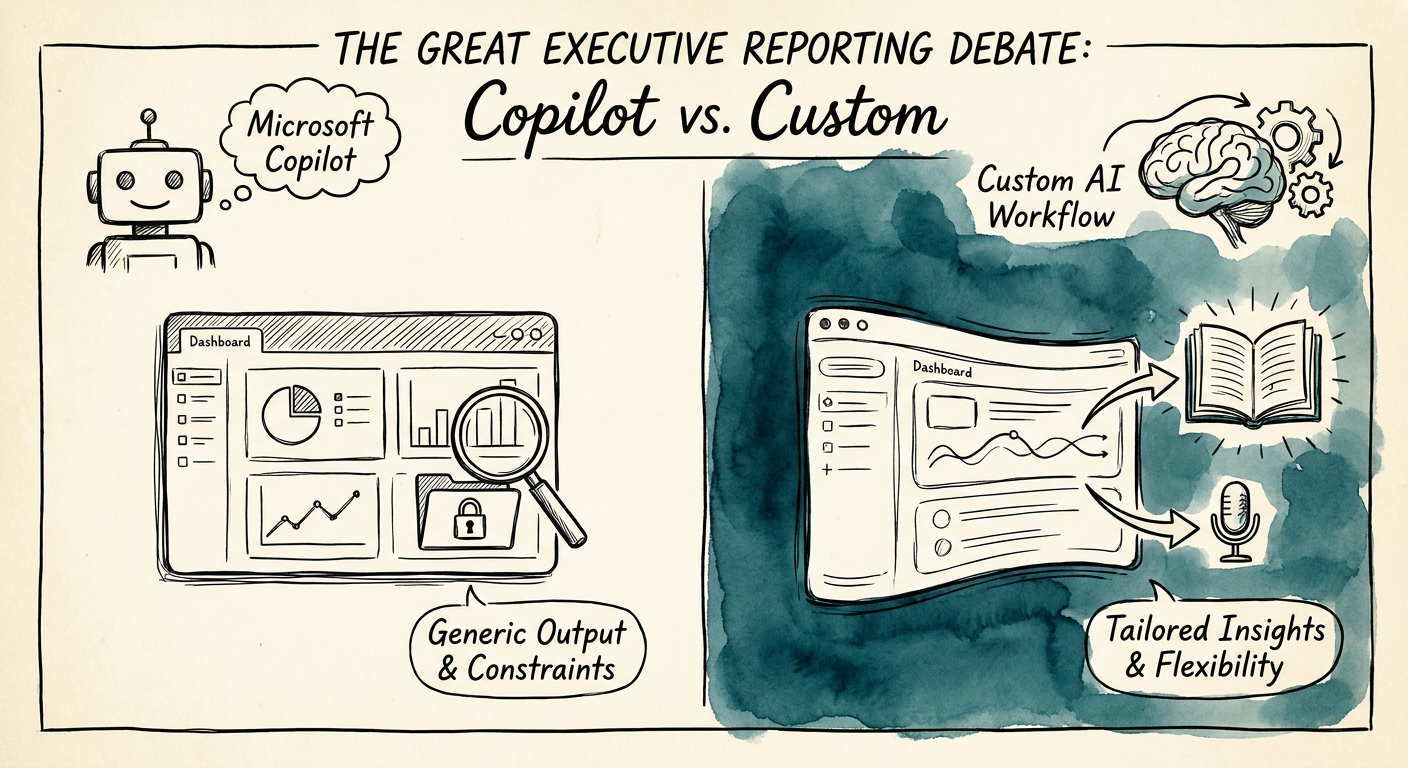
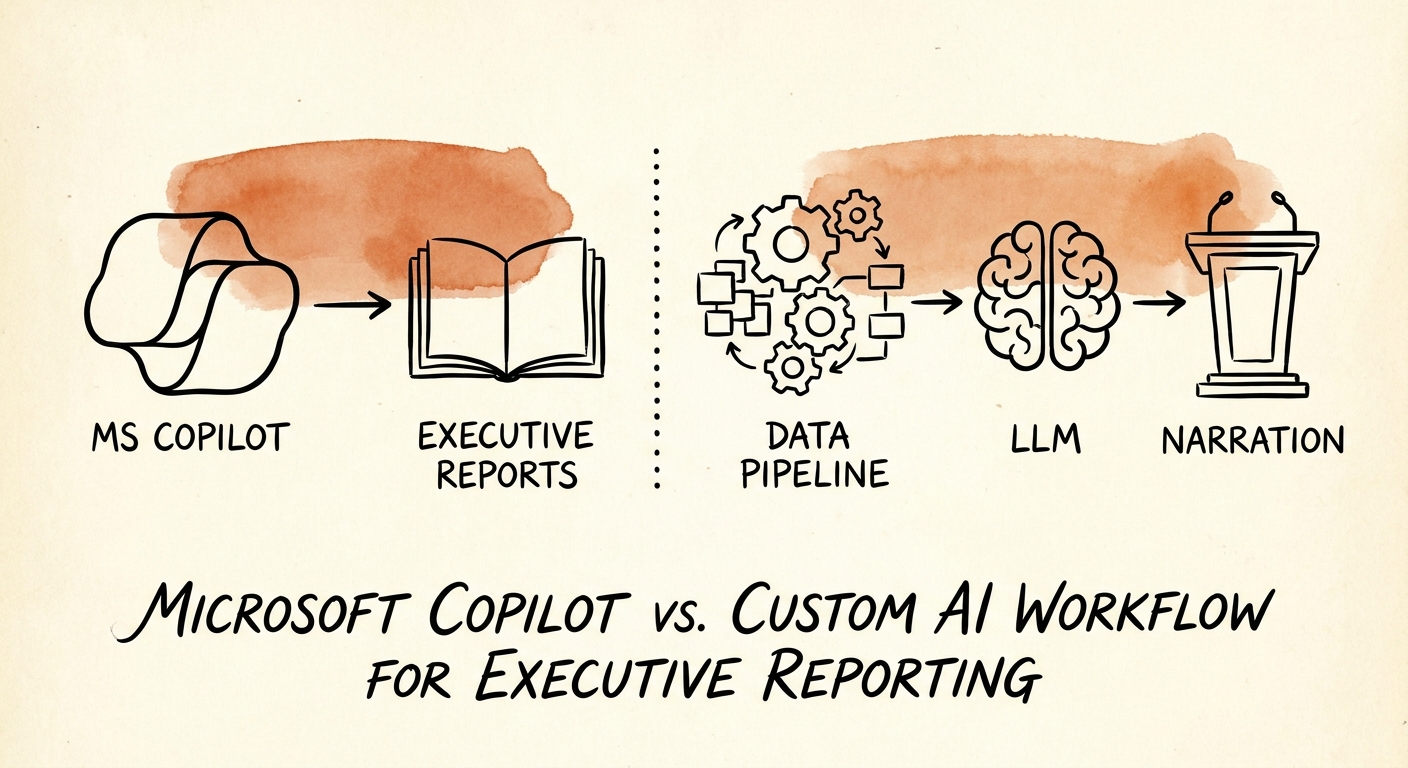
Here is the split that actually holds up. Use Copilot for everything downstream of an approved number — and a custom workflow for everything that establishes the number.
Copilot earns its seat on the writing side. Hand it a finalized variance table and it will draft the "what changed and why" commentary, turn six department updates into a tight executive summary, and prep the CEO's talking points from the deck. Because it is grounded in user-permitted Microsoft 365 content, it stays inside what the presenter is already allowed to see — Microsoft's privacy and architecture guidance covers how that grounding works. For a 50-300 person company, that alone can cut hours of narrative drudgery off every close.
What Copilot does not do is enforce that gross margin means the same thing in March as it did in February. It won't refuse to publish when the revenue figure in the ERP disagrees with the figure in the CRM. It can't attach a source link to every line so the CFO can defend it live, or flag that one segment moved three standard deviations and needs a human explanation before the pack goes out. That is the custom-workflow job: pull from the systems of record, hold the KPI definitions, run the anomaly check, and stamp each number with provenance and an owner. Lean on the NIST AI Risk Management Framework for reviewer accountability, and CISA's AI data security practices for the financial and employee data that ends up as reporting evidence. The simplest way to say it: let Copilot write the explanation, but never let it invent the number being explained.
Prove it on one month's pack, not the whole stack
Do not buy a reporting platform on a theory. Take next month's operating report and run it twice — once your current way, once with the line drawn above — and compare. Deloitte's 2026 research keeps landing on the same point: the gap is activation, not ambition. Activation here is narrow and checkable. Did the close-to-report cycle shrink? Did the number of figures someone had to hand-reconcile drop toward zero? When a director asks where a number came from, can you click straight to the source instead of promising to "follow up after the meeting"?
Track six things across that one pack: cycle time from close to distributed report, count of manual reconciliations, quality of variance explanations, how many metric-definition conflicts surfaced (you want this number to go up at first — it means you're catching them), source-link completeness, and whether the CFO would sign the pack without a nervous second read. If Copilot-drafted commentary on approved numbers wins on cycle time without losing trust, keep it there and stop. Only build the custom workflow once you can name the specific control — definition enforcement, governed data pulls, provenance on every line — that the off-the-shelf assistant structurally cannot give you. Most middle-market companies need both, in that order, and almost none need a six-figure platform to start.