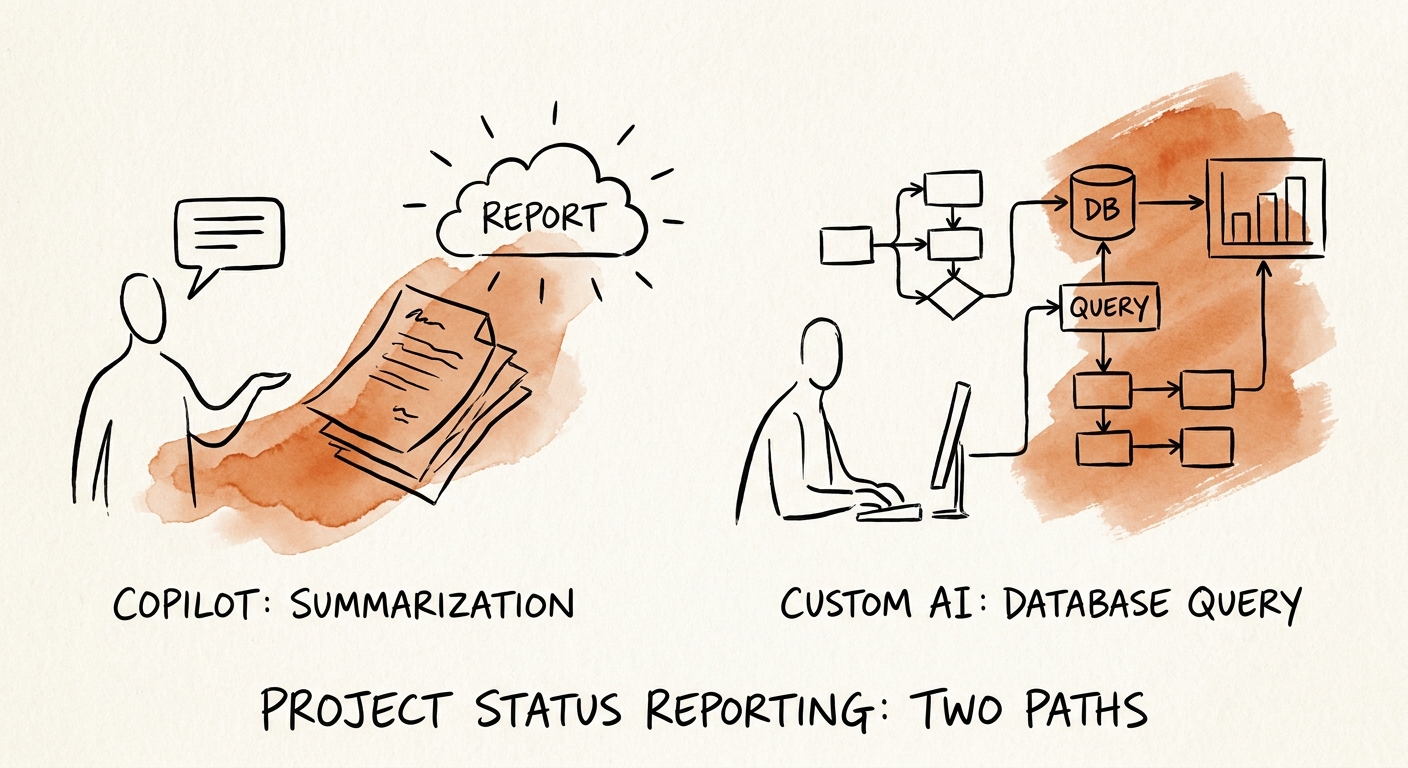
The status said green. The customer was already escalating.
Picture a 70-person services firm running 30 client engagements at once. Friday's portfolio review shows mostly green. The following Tuesday, a client emails the partner directly: the milestone they were promised in March slipped, nobody told them, and they're "reconsidering the renewal." The status deck was wrong — not because anyone lied, but because the PM who wrote it pulled from a standup recap while the real signal lived in a CRM commitment, a Jira burndown, and an unbilled-hours line in the PSA tool nobody cross-checked. That gap between the slide and the systems is the entire problem you're actually trying to solve. The question of Copilot versus a custom workflow only matters because of it.
Microsoft Copilot is genuinely good at one half of that picture: it summarizes the meetings, Teams threads, and documents that already live inside Microsoft 365. If your status truth is mostly "what got said in the project sync," Copilot will draft a clean recap faster than your PMs can. Microsoft 365 Copilot's privacy and data controls explain how it scopes to a user's existing permissions — which is exactly why it can't see the Jira ticket aging past its due date or the CRM promise that never made it into delivery notes. Those systems sit outside the suite.
So the real fork is not "which AI is smarter." It's: does your status live in one place, or does it have to be reconciled across several that routinely disagree? For a services delivery org, it's almost always the latter. That tilts the answer toward a custom workflow — not for the summary, but for the reconciliation.
The job isn't summarizing status. It's catching the contradiction.
A summary tool that turns five updates into one paragraph has done nothing useful if all five updates were copied from the same optimistic standup. What a delivery leader actually needs is the AI equivalent of a skeptical PMO analyst — something that holds the project plan next to the CRM next to the client's last email and says: these three don't agree. Concretely, a custom workflow for status reporting should fire when the plan shows a date that the customer thread contradicts, when a CRM-committed scope item has no matching delivery task, when a risk is rated "low" with zero evidence behind it, or when an owner's update is two weeks stale on a project tagged active. That's the difference between a longer report and a truer one.
Pulling status across those systems means the workflow is now touching customer obligations, commercial commitments, and confidential delivery problems in one pipe — so the controls matter more here than they would for, say, an internal meeting recap. CISA's AI Data Security Best Practices are the right reference for keeping a sensitive at-risk project note from bleeding into a broad executive rollup that the wrong people can read. And the NIST AI Risk Management Framework gives you the operating loop in plain terms: map every place status is sourced from, measure how often those sources disagree, and manage the disagreement with explicit escalation rules. With adoption climbing across mid-market firms per the Deloitte State of AI report, the firms that win aren't the ones reporting fastest — they're the ones whose reports they can trust enough to act on without re-checking.
Don't try to wire up all 30 projects at once. Pick one portfolio slice and one cadence — say, the weekly review for your top-ten revenue accounts — and run the workflow there for 90 days. The review meeting then inspects four things: mismatches the AI caught, summaries managers accepted, claims they rejected, and owners who went dark. That meeting is where you learn whether the thing is earning trust.
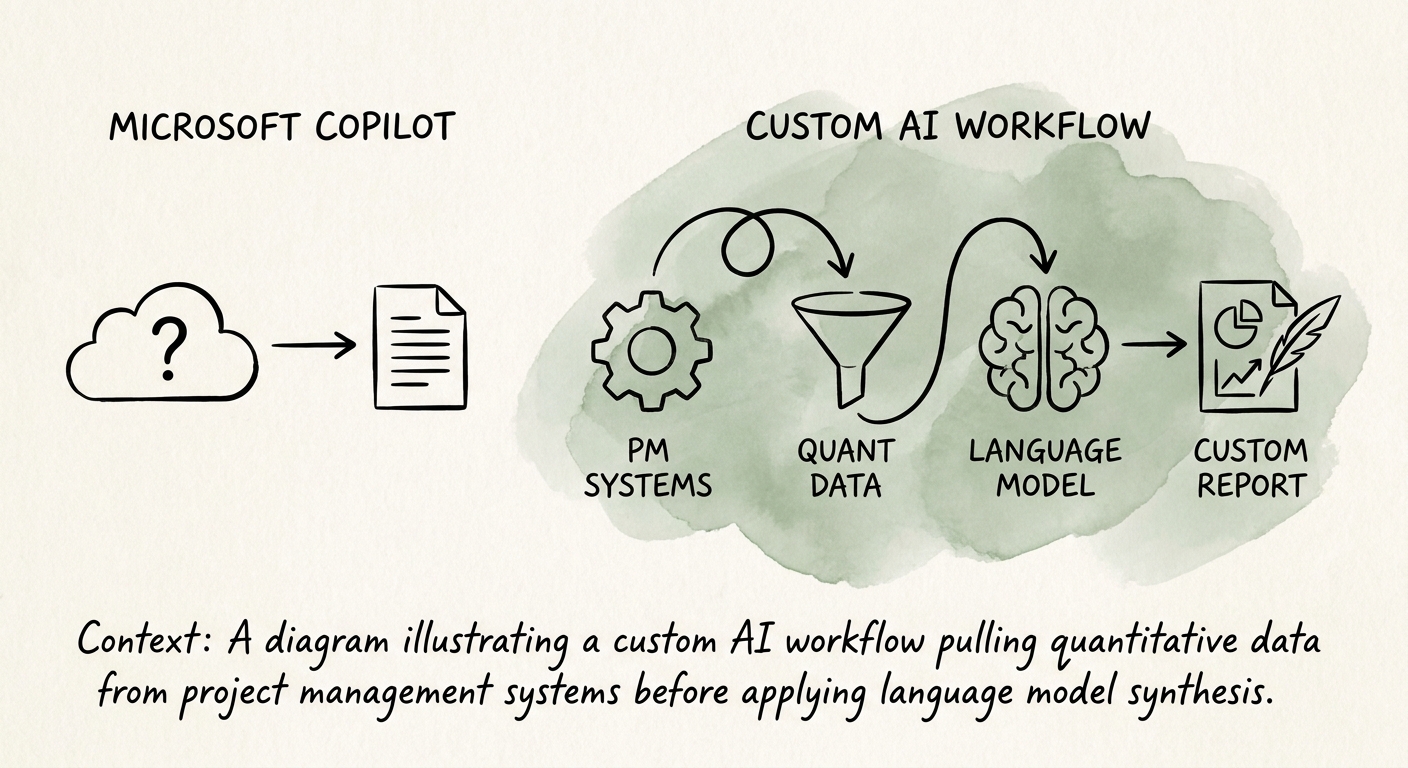
The metric isn't reports generated. It's surprises prevented.
Most status-AI pilots get measured on the wrong number: how many summaries it produced, or how many minutes of PM writing time it saved. Those are inputs. The output that matters for a delivery org is whether the surprise escalations went down — the Tuesday-morning client email that nobody saw coming. Track it directly: how much earlier risks now surface, how many at-risk projects got caught before the client noticed, how much tighter delivery, sales, and finance now agree on the same status word. If your reports got longer but the surprises kept coming, you built a better summarizer and a worse early-warning system.
Keep a human in the seat for the calls that are genuinely ambiguous. When the systems disagree or a customer commitment is fuzzy, the workflow's job is to surface the contradiction and draft the question — "Jira shows this slipping two weeks; the SOW says hard date; which is real?" — not to declare an official status. A delivery leader signs off on what goes to the client and the board. The AI hands them a sharper starting point, not a verdict.
When you connect this to the business case, anchor it in avoided rework, faster management action, and fewer late surprises rather than headline automation claims — the discipline laid out in measuring AI ROI without fake savings. If you want help mapping which of your status sources actually need to talk to each other, that's the first hour of an AI roadmap.