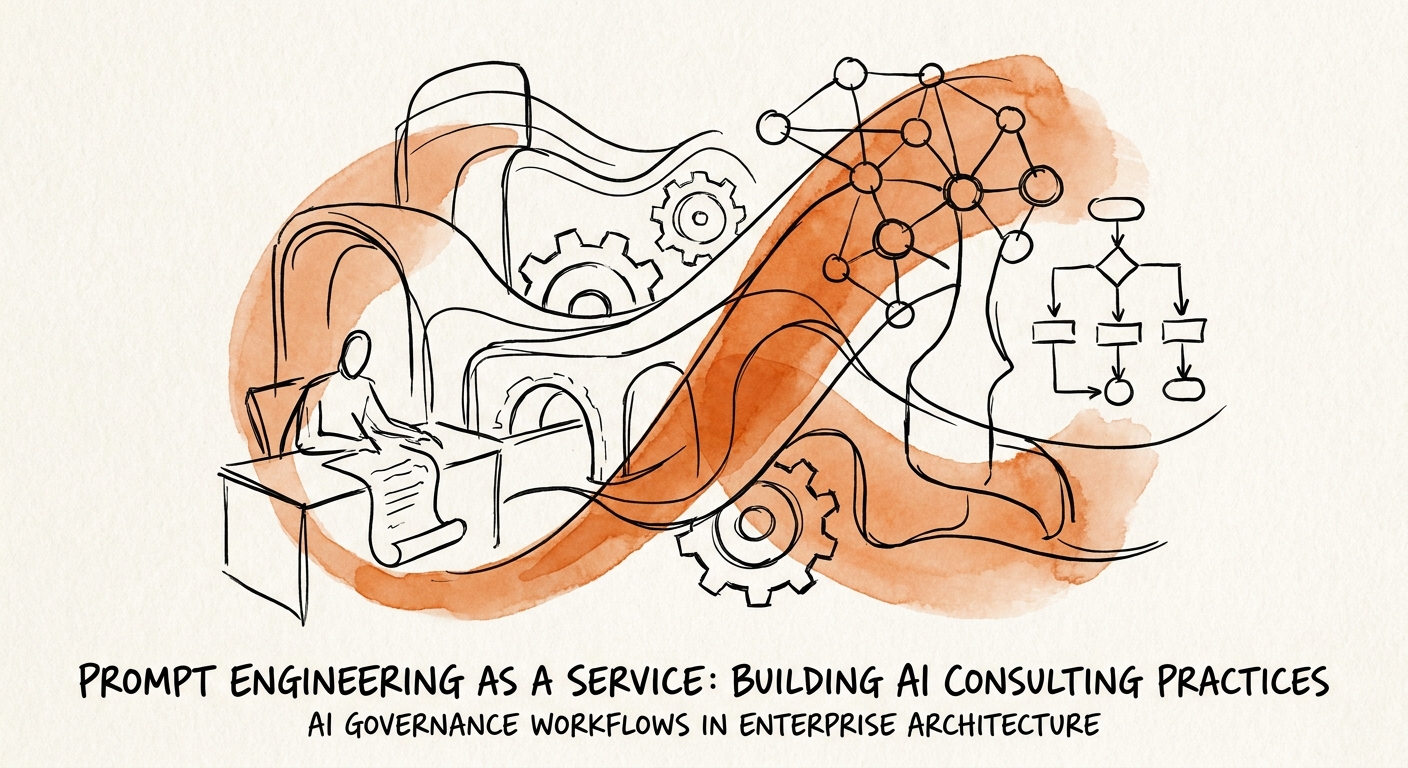
The $12,000 prompt pack that was worthless in six weeks
Picture a 30-person technology services firm that lands a deal: "engineer us a library of prompts for our proposals, support replies, and QBR decks." They deliver a polished doc, 40 prompts, nicely organized. Invoice paid. Six weeks later the client's model provider ships a new version, the old prompts drift, the one person who knew how to tweak them leaves, and the binder is dead. There is no renewal because there is nothing to renew. That is the structural problem with selling prompt engineering as a deliverable: you are billing for a snapshot of a thing that moves.
The craft itself is real. The OpenAI prompt engineering guide is genuinely good — it frames the work as clear instructions, supplied reference context, task decomposition, tool calls, and systematic testing. Learn it. But notice what that list actually describes: it is the recipe for one reliable workflow, not a product catalog. The instructions and context are inputs; the value lives in the testing and the tools, which are the parts a client cannot keep alive on their own.
This matters most if your firm sells time and wants to sell retainers. The McKinsey State of AI 2025 read is blunt about where the money has gone: the returns concentrate in organizations that redesign whole workflows, not in those that bolt clever prompting onto an unchanged process. So the question for a services owner is not "are we good at prompts." It is: what are we selling that the client still needs us for in month seven?
The four assets that turn a one-time invoice into a retainer
Here is the reframe. The deliverable is not the prompt. The deliverable is a governed workflow that happens to use prompts inside it — and a governed workflow has four assets the prompt pack never had. Reusable context that lives in one maintained place. A control layer that respects who is allowed to see what. An evaluation suite that tells you when output degraded. And an owner-training plus escalation path so the thing survives staff turnover. Those four are what you bill for monthly, because all four decay without you.
The control layer is where most prompt sellers expose themselves. A prompt that pulls from a client's documents has to honor identity and permissions, or it will happily summarize a file the requester was never cleared to read. The Microsoft 365 Copilot data protection architecture is worth studying precisely as a model of this: the system inherits the user's existing access boundaries rather than creating a new, leaky one. If your "prompt engineering service" cannot answer "whose permissions govern this output," you are not selling a production capability — you are selling a liability with good wording.
The evaluation and ownership assets get their spine from the NIST AI Risk Management Framework: map the specific use case, measure the failure modes, manage the controls around them, and govern who owns the result. Run that loop on a single recurring task — say, drafting renewal emails for a client's account team — and you stop having a prompt and start having a measured workflow with a named owner and a documented answer for when it produces something wrong. That documented answer is the single most under-sold line item in this entire category, and it is the one clients pay to keep.
What to put on the invoice Monday
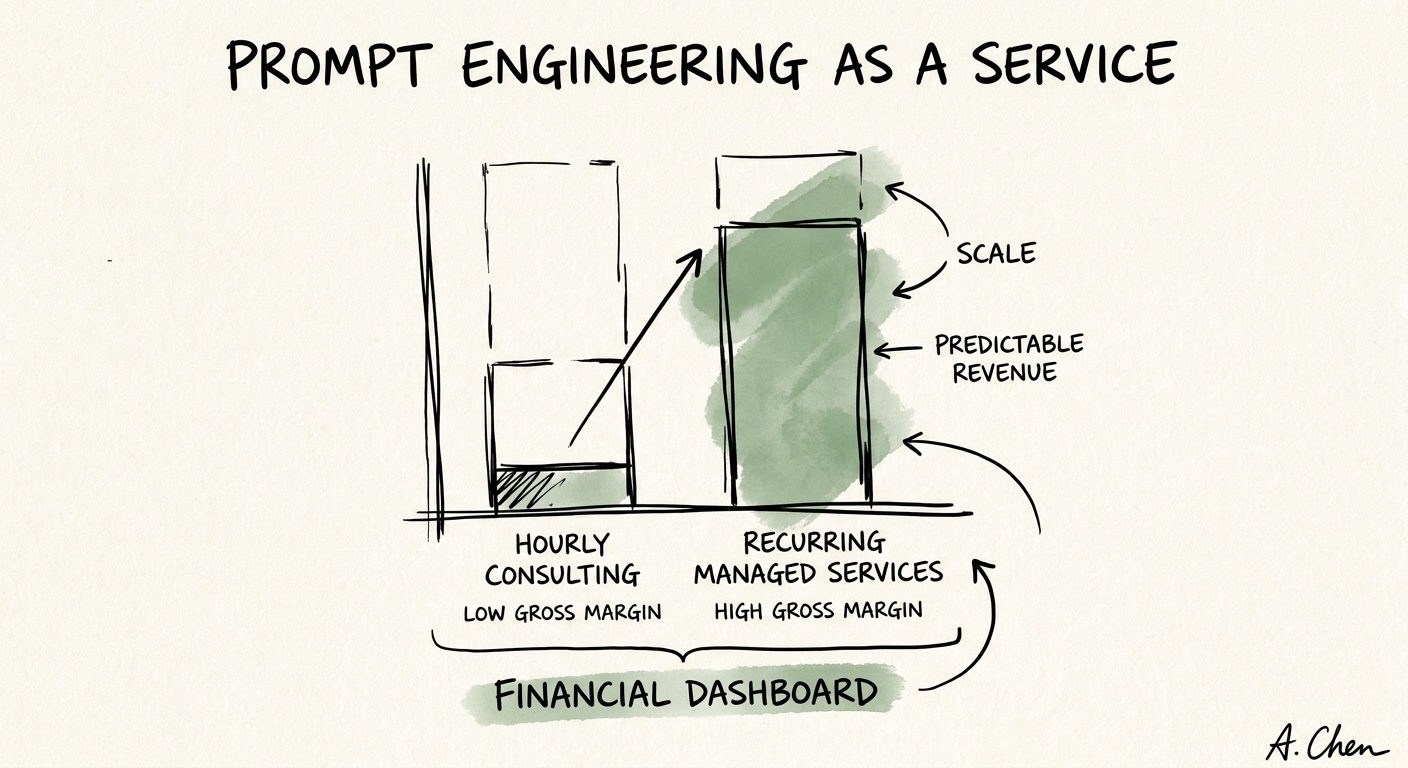
If you run a services firm and want to reshape this into a line that recurs, do one concrete thing this week: pick a single client workflow you already prompt for, and write down its four assets explicitly. Where does the reusable context live and who updates it. Which permission model governs the inputs. What three acceptance tests must pass before output ships, and what is the measured pass rate today. Who on the client side owns it, and what happens — exactly — when an output is wrong. The moment those four are written, you have something to put on a monthly invoice instead of a one-time one.
The IBM Institute for Business Value AI capabilities research tracks why initiatives stick or die: it comes down to data discipline, an operating model, real adoption, and measurement — not model cleverness. None of those four are a prompt. All of them are billable, renewable work. Price the audit and build as a project; price the context maintenance, the eval runs, and the owner support as the retainer. The cleverness is your loss leader; the survival is your margin.
If you want this packaged as governed workflow improvement rather than isolated language-model tuning, that is exactly the shape of Human Renaissance AI transformation services — we help service firms turn prompt work into a capability a client cannot quietly let lapse.
