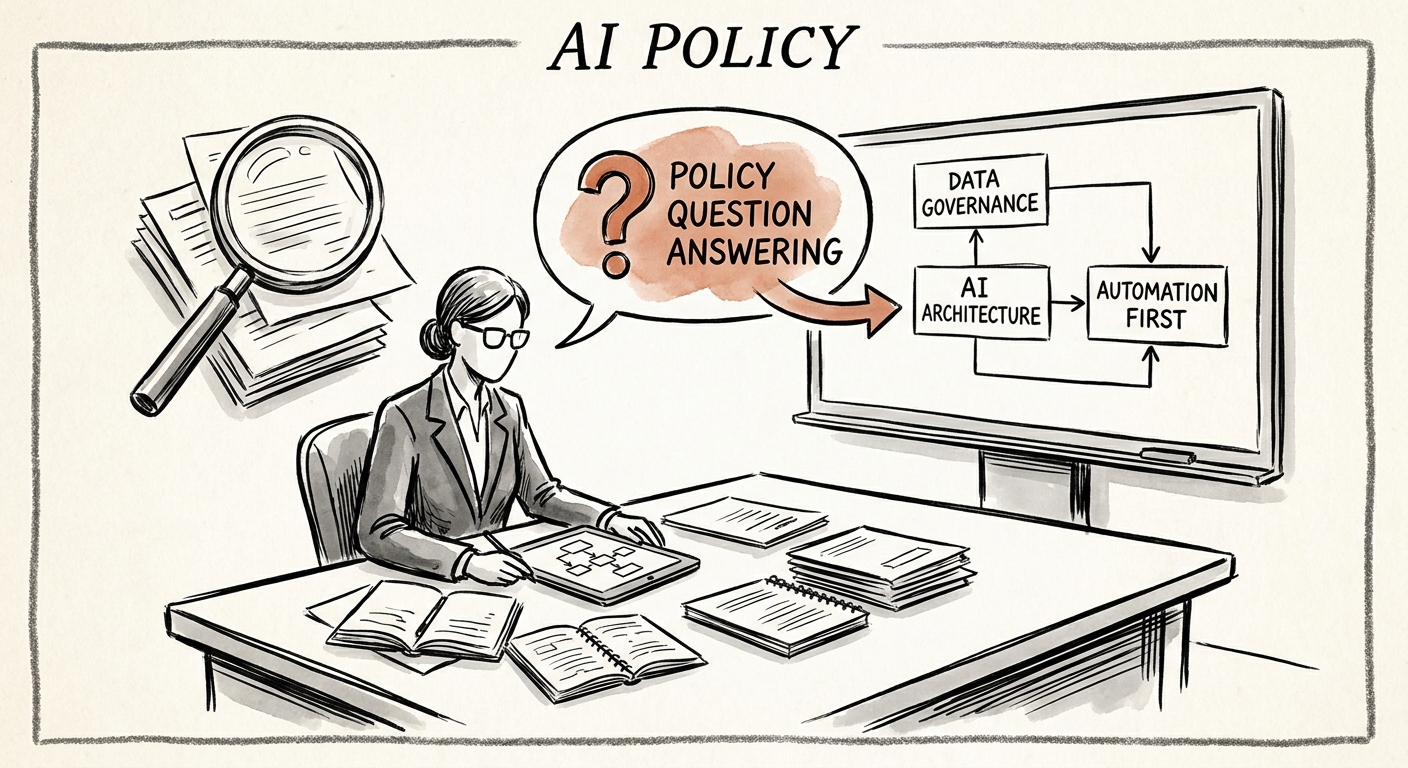
The questions your team answers on repeat — and why they're dangerous to guess at
Open the IT or data team's Slack channel on any given Tuesday and you'll see the same five questions rephrased a hundred ways. "Can I put this customer export in my personal Drive for the weekend?" "Is this vendor approved to handle PII?" "What classification is the pricing deck?" "Can I use my own laptop for the migration?" "Are we allowed to paste this into ChatGPT?" Someone answers from memory, the requester proceeds, and three months later a data classification policy gets quoted in an incident review that nobody actually checked.
That repetition is exactly why policy question answering is the right first AI workflow for IT and data teams — and exactly why it's the most dangerous one to do casually. A wrong answer here isn't a typo; it's an access decision, a handling rule, or a shadow-IT green light. The RSM middle-market AI survey, the San Francisco Fed small-business AI analysis, and the OECD SME AI adoption report all point to the same starting logic: pick a use case where you own the source material, the answers are bounded, and the volume is real. Internal policy Q&A checks all three for a team that already maintains the access matrix, the data handling standard, and the acceptable-use policy.
The trap is treating this like a customer chatbot. A chatbot that hedges is annoying. An IT policy assistant that hedges — or worse, confidently invents a rule — gets someone to ship regulated data somewhere it shouldn't go. Before you build, walk a real week of questions through the workflow automation screen to confirm volume, how often the underlying policies actually change, and who owns the edge cases.
For IT and data, the retrieval is the easy part. Permissions and the audit trail are the product.
Most teams obsess over whether the model gives a good answer. For IT and data policy Q&A, that's the second problem. The first is: who is allowed to ask, and what is the assistant allowed to see on their behalf? A contractor asking "what's our break-glass procedure for the prod database" should not get the same retrieval scope as the platform lead. If your assistant indexes every policy doc and answers everyone identically, you've built a permissions leak with a friendly interface.
So design it the way you'd design any system that touches sensitive data — because it is one. The NIST AI Risk Management Framework gives you the spine: map the context (which policy families, which audiences), assign accountable controls, and build the measure-and-manage loop. The CISA AI Data Security Best Practices guidance is more pointed for your stack: control what the system trains and retrieves on, enforce access on both input and output, and monitor what comes out.
Concretely, the assistant should do four things, and the four are the deliverable: retrieve only from the current approved policy set (not last quarter's PDF someone re-uploaded), display the exact clause and document it pulled from so the asker can verify, respect the asker's actual permission scope so a junior analyst can't surface restricted runbooks, and drop every "I don't have an approved answer for that" into a logged queue routed to a named policy owner — not into a silent shrug. Score the build against value-versus-risk using the AI use-case scoring model before you wire it to anything live. Say you're a 120-person SaaS company: the acceptable-use and data-classification policies are stable and high-volume — great first scope. The vendor-approval list changes weekly and overlaps with procurement — that one waits.
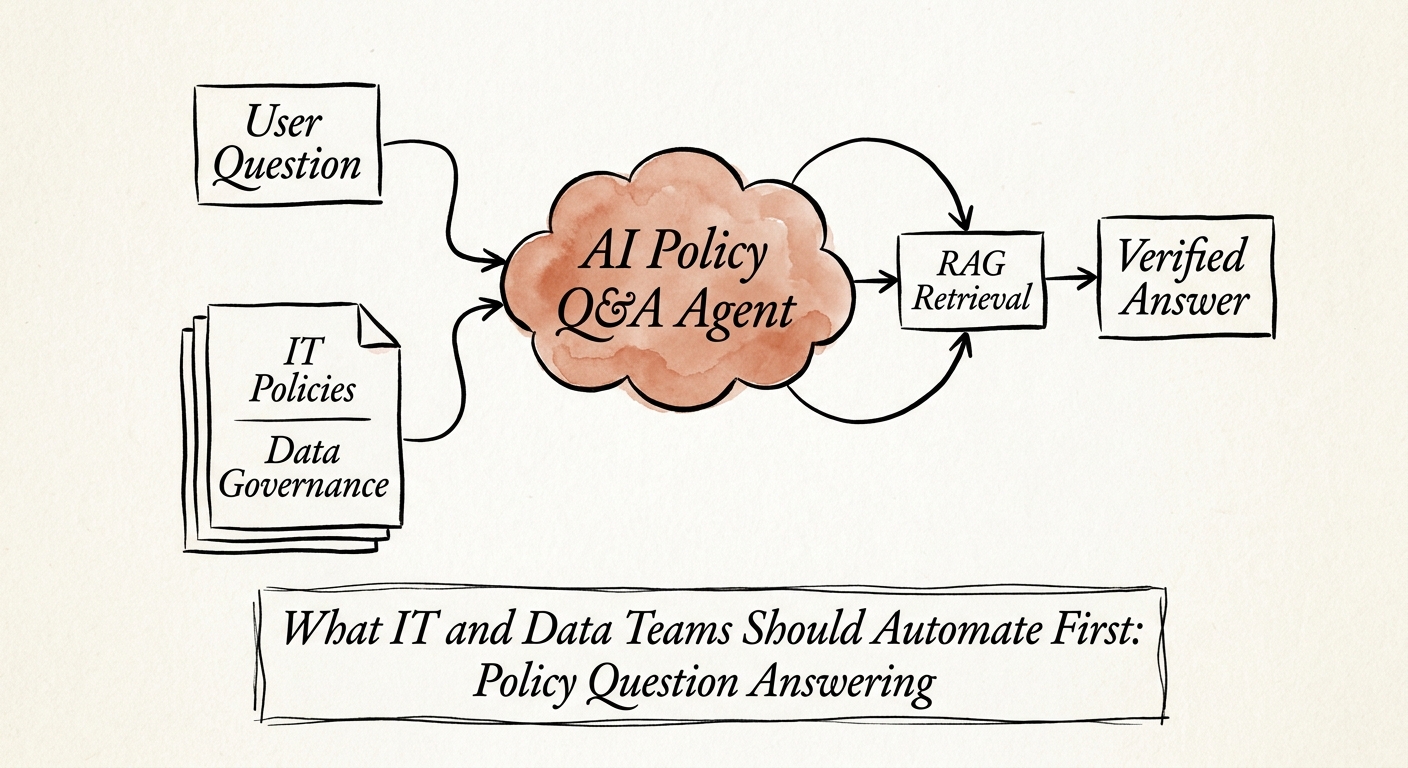
The metric that proves it worked: shadow requests go quiet
The Deloitte State of AI in the Enterprise 2026 report keeps circling one distinction — the gap between an AI pilot that demos well and one that produces value people can feel. For IT and data policy Q&A, the value isn't "the bot answered." It's that the awkward private DM to a senior engineer — "hey, is it cool if I just..." — stops happening, because people can get a source-backed answer in ten seconds and they trust it.
Track that directly. Count deflected policy tickets, yes, but the sharper signals are: how often the logged "no approved answer" queue surfaces a gap in your actual policies (that's the assistant doing your governance audit for free), how many answers a policy owner had to correct, the time-to-find-the-right-clause before versus after, and — the one that matters most for a data team — whether informal "can I just do X" requests for risky data handling actually decline. If they don't, your assistant is being ignored or routed around, and you need to know that in week two, not quarter two.
Don't boil the ocean. Pick one policy family you fully own — acceptable use is the classic starting point — prove the source citations are accurate and the permission scoping holds, and only then add data classification, then access, then device rules. Use the 90-day AI implementation plan to sequence source governance, permission testing, log review, and rollout so the review loop is load-bearing before you widen the scope.