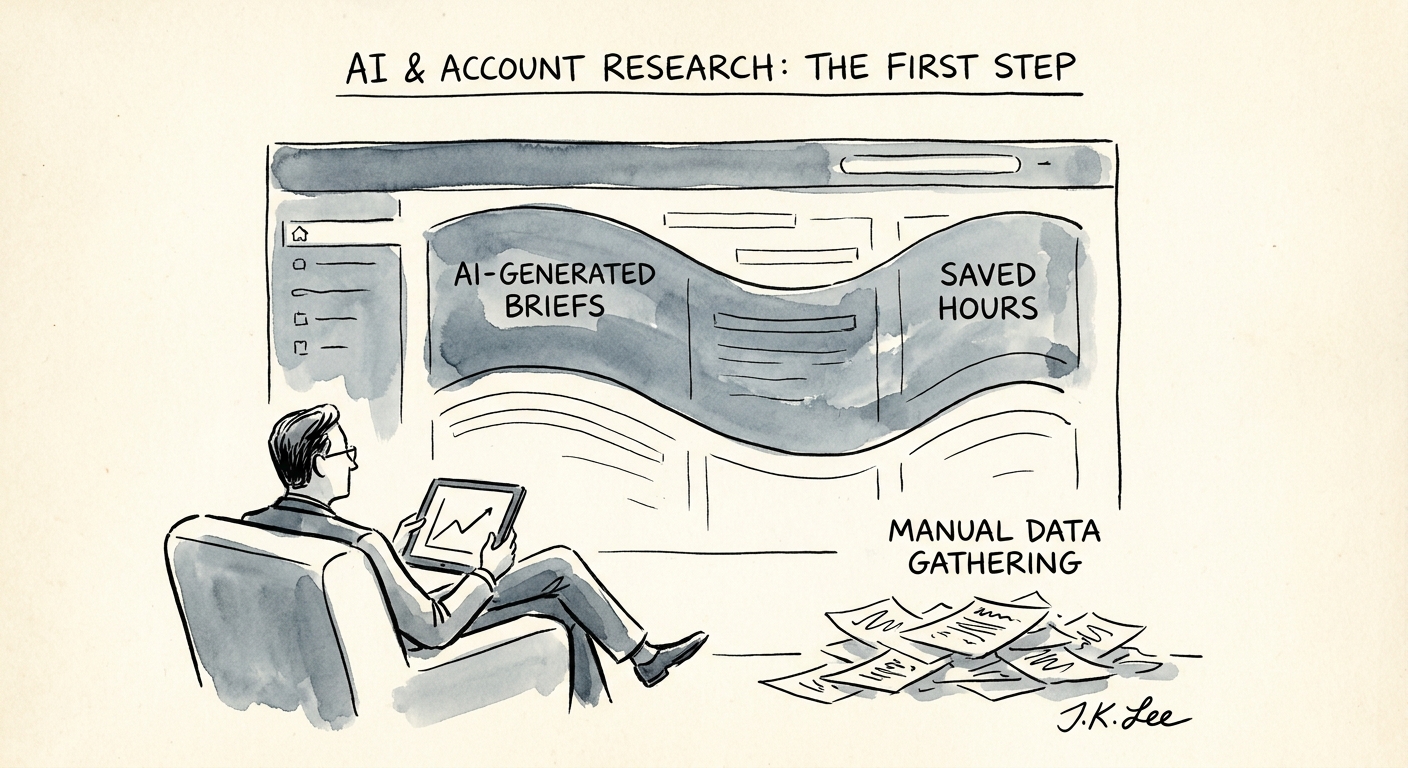
The 20 minutes before every account call
Picture a 60-person B2B software firm. Twenty minutes before a renewal call, the account exec is doing what account execs always do: clicking through CRM notes from two reps ago, hunting for the original proposal in a shared drive, skimming the support queue to check whether anything blew up last quarter, and pulling up the customer's funding announcement someone half-remembered. By the time the call starts, they've assembled maybe 70% of the context and they're winging the rest.
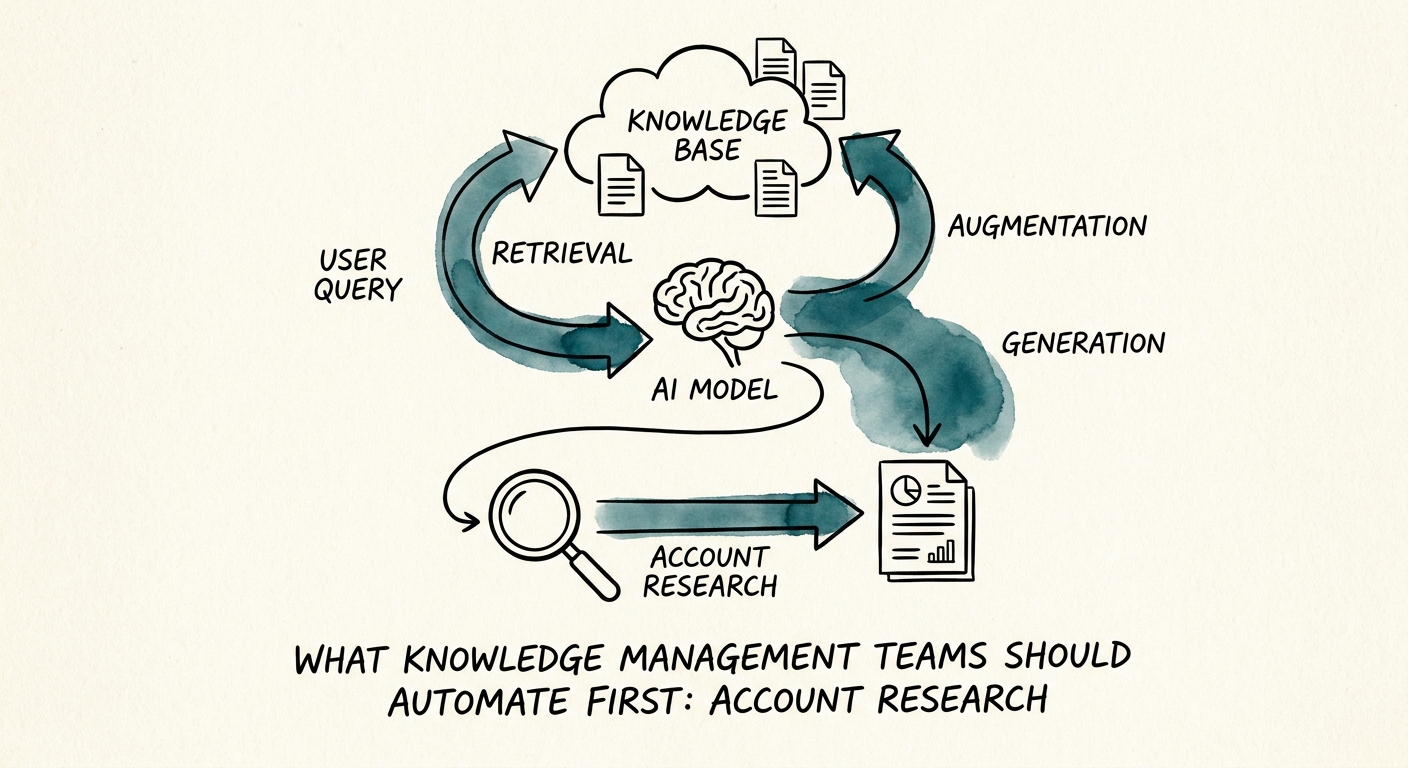
This is exactly why account research is the right first AI workflow for a knowledge-management team — and why so many teams skip it for something flashier. The job isn't to invent an opinion about the account. It's to gather scattered facts that already exist across CRM notes, service history, prior proposals, usage signals, and public context, then hand a human a brief with the sources still attached. Five disconnected inputs become one sourced page. Salesforce's State of Sales shows sales orgs are already leaning on AI for this kind of account work — but the version that earns trust is the one where every claim links back to where it came from.
The trap is treating the brief as a destination. McKinsey's State of AI 2025 is blunt that scaled value comes from redesigning the workflow, not bolting a summary onto it. An account brief that nobody reads inside a meeting-prep cadence is just another tab. The win is when it feeds directly into prep and action planning.
The part most teams get wrong: where the data lives
Here's what separates account research that works from account research that gets quietly shut off after a month. In a B2B tech or professional-services firm, the context for a single account is scattered across email threads, Teams chats, SharePoint folders, a CRM export, and three versions of a proposal deck — and not everyone is allowed to see all of it. The deal-desk notes on a renegotiation aren't meant for the whole sales floor. The legal redlines on a contract aren't general reading.
So the retrieval layer has to respect permissions and keep source links pinned to every claim. Microsoft's 365 Copilot data-protection architecture exists precisely because account context spans all those systems with different access rules. If your AI brief surfaces a number from a document the reader couldn't otherwise open, you don't have a research tool — you have a data-leak incident with good formatting.
The second line is judgment. NIST's AI Risk Management Framework draws the boundary cleanly: research can inform strategy, but it can't own it. The account brief assembles context. The account owner still decides how to treat the customer, what to pitch, and when to push. Say the brief flags "usage down 30% this quarter" — that's a fact worth surfacing. Whether it means the customer is churning or just took a holiday freeze is a human call, made by the person who knows the relationship.
How to know it's actually working — and what comes next
Don't measure this workflow by how impressive the output looks. Measure it by whether the account owner trusts it enough to walk into the call cold. Four numbers tell you that: source coverage (does the brief cite real documents, or is it confidently empty?), stale-source rate (how often is it pulling a proposal from a closed-out deal?), owner correction rate (how much do reps rewrite?), and prep time saved. The simplest red flag: if your team rebuilds every brief from scratch before a meeting, the workflow isn't ready to scale — it's just generating homework.
The honest version of "AI account research" is a faster, more complete version of what your best rep already does manually before a call. That's why it's a safe first build: low judgment, high gather, sources visible the whole way. Sequence it ahead of riskier moves like outreach or proposal automation, where the AI starts making decisions instead of assembling facts.
Before you green-light it, pressure-test where the line sits. Read when not to automate lead qualification with AI for the boundary between gathering context and making the call, then run the workflow through the AI Opportunity Score to confirm account research belongs first in your queue.