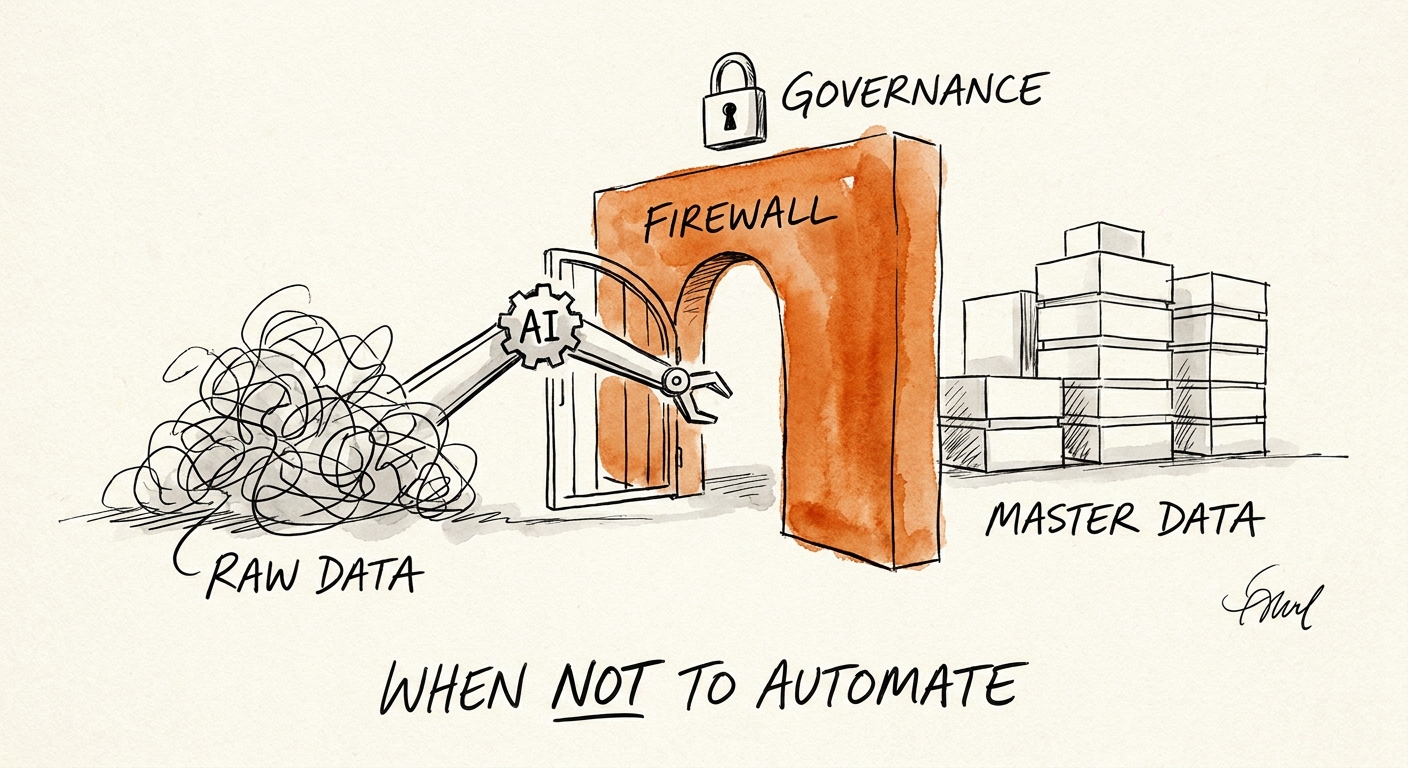
The bug isn't dirty data. It's that nobody can say which record is right.
Picture the moment a cleanup pilot looks like a win. Someone points an assistant at 80,000 account records, and within a day it has merged duplicates, fixed casing, normalized phone formats, and reconciled addresses. The dashboard turns green. Then finance opens a report and the revenue rolls up to the wrong parent company, because the model collapsed two subsidiaries that accounting tracks separately for a reason nobody told it.
That is the trap with data cleanup specifically: it feels like formatting, so it gets treated like formatting. But underneath, most "messy data" is actually three departments disagreeing about what a correct record means. Sales calls the holding company the account. Finance bills the operating entity. Service tickets attach to the regional branch. The records aren't dirty — they're three valid views that were never reconciled. Run a model across that disagreement at speed and you don't clean it; you pick a winner silently and propagate it into every downstream system before anyone with the authority to object has seen it.
This is why the first question for a data or operations leader isn't "which tool" — it's "who is allowed to decide which record wins, and have they decided yet?" If the honest answer is nobody, the right AI decision is to not automate. Adoption research across the middle market and SMB segment — the RSM middle-market AI survey, the San Francisco Fed small-business AI analysis, and the OECD SME AI adoption report — keeps surfacing the same pattern: the teams that get burned aren't the ones who adopted slowly. They're the ones who automated a process that had no owner.
Three gates that decide stop, fix, or automate
Before a model is allowed to write to a single production record, walk one field family — say, account-to-parent mapping, or vendor master records — through three gates. Not three steps. Three checkpoints where the honest answer can be "stop."
Gate 1 — Definition. Can one named person write down, in a sentence, what a correct record looks like? "The account is the legal billing entity; subsidiaries are child records, never merged into the parent." If you cannot get that sentence agreed in a room, the model has no rule to enforce — it will invent one. The NIST AI Risk Management Framework is useful here precisely because it forces you to fix context and accountability before measuring anything; a cleanup pilot with no agreed definition has no measurable risk because nobody knows what "wrong" means yet.
Gate 2 — Conflict rule and exposure. When two systems disagree, which one wins, and who hears the exception? Vendor records that touch payment details, project identifiers tied to contracts, customer service history with personal data — these are not all safe to feed a model the same way. CISA's AI Data Security Best Practices is the reference for deciding what gets exposed, retained, logged, or excluded before a single field is touched, and the same discipline appears in vendor commitments like OpenAI's enterprise privacy terms — read them as a checklist, not a comfort blanket.
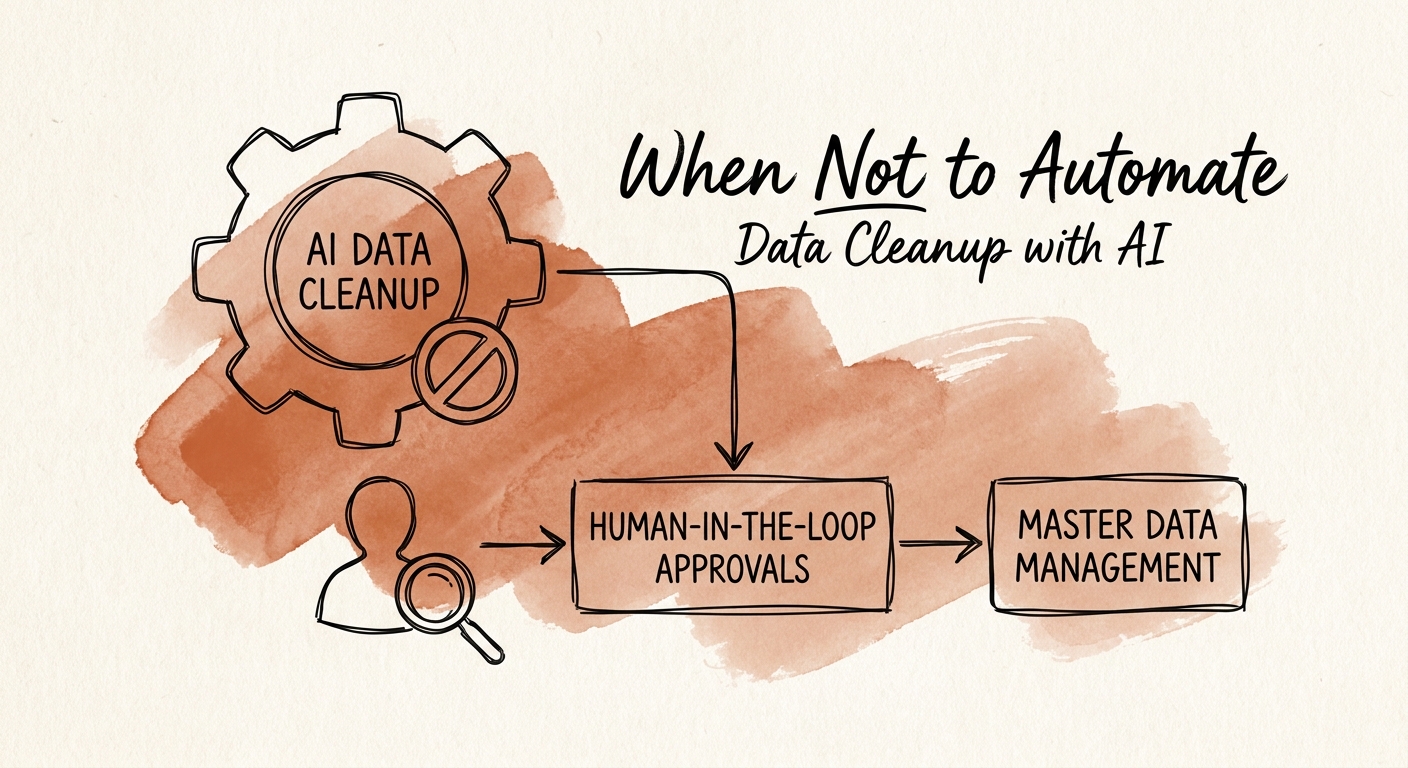
Gate 3 — Reversibility. If the rule is wrong, can you roll it back, and will you know within a day rather than a quarter? An overwrite with no rollback path and no sample-review threshold is the most expensive kind of cleanup, because the damage surfaces in a board report three weeks later. The control packet for any field family should fit on one page: source owner, definition of correct, conflict rule, approval owner, sample-review threshold, rollback path, and the explicit stop condition. Until that page exists, the model drafts and ranks candidates — a human signs. It does not write.
A documented refusal is the most valuable output of the pilot
Here is the counterintuitive part most teams miss. The Deloitte State of AI in the Enterprise 2026 reporting keeps pushing the conversation from "did we launch a pilot" to "did it produce production value." For data cleanup, the highest-value pilot outcome is often a written decision to NOT automate — because that document names the gap. "We stopped vendor-record cleanup because there is no owner who can resolve a finance-versus-procurement conflict" is the single sentence that finally gets an owner assigned. The model didn't fix your data. It exposed that you had an org-chart hole pretending to be a data problem.
So measure the right things. Not records-cleaned-per-hour — that number rewards confident wrongness. Measure: how many records have a named owner, how many definition conflicts are still unresolved, sample-review accuracy on a reviewed batch, rollback events, exception rate, and downstream report corrections traced back to a cleanup write. If unresolved conflicts are rising while throughput looks great, you are scaling errors, not fixing them.
Monday, do this: pick one field family — not the whole CRM, one family, like duplicate accounts or vendor masters. Use the manual-work scoring guide to confirm it's worth touching at all, then get the one-sentence definition agreed and write the conflict rule. Run the model on a reviewed sample, read every exception by hand, and only then let it write to production — and only that one family. Stage the rest with the 90-day AI implementation plan so source cleanup, reviewer training, and scale decisions land in order. Cleanup automation should expand outward from one proven rule, never inward from a backlog of mess.