The brief is where the bad campaign was born
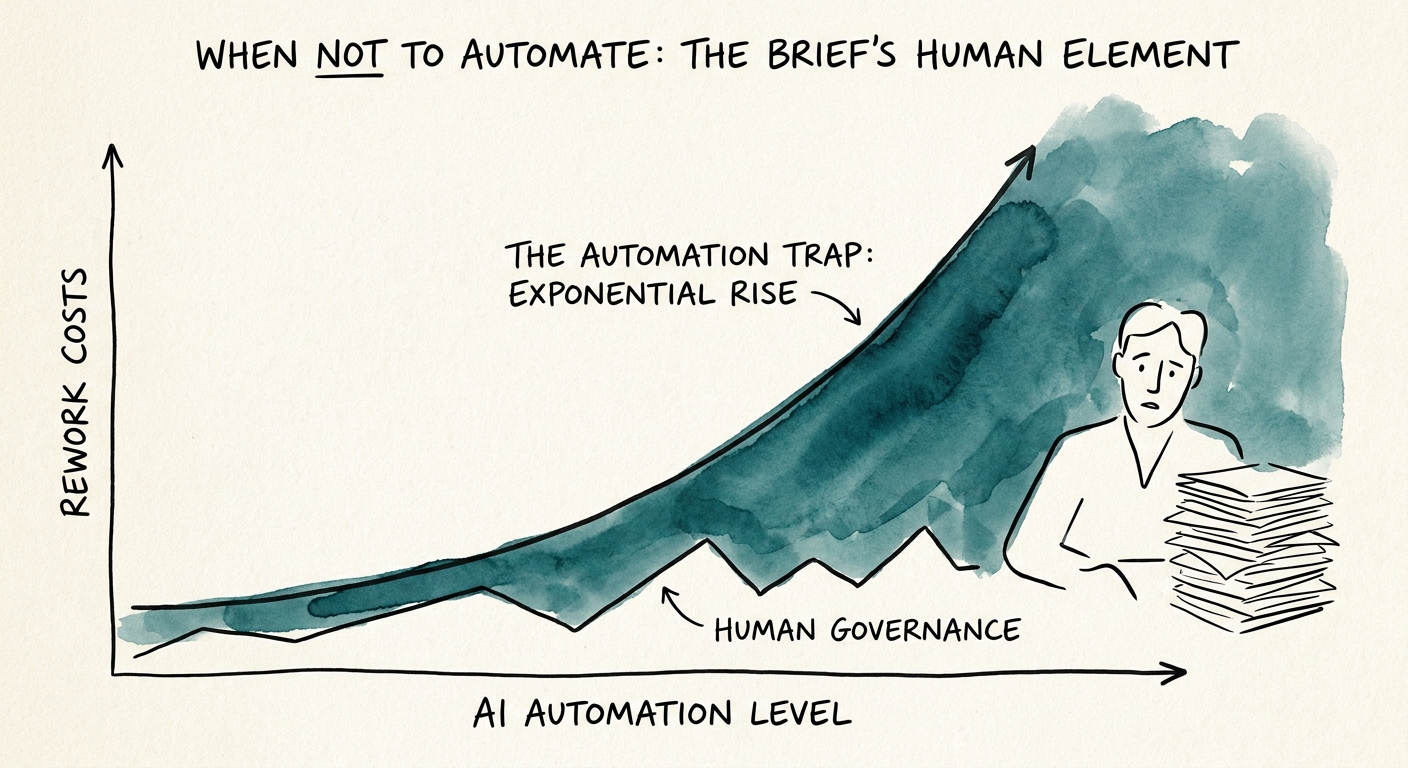
Picture the autopsy on a campaign that flopped. The creative was sharp, the media buy was fine, the landing page converted at a normal rate for the wrong traffic. Trace it back far enough and you almost always land in the same place: the brief. It named the wrong audience, or it buried the offer in three competing messages, or it cited a "key proof point" that was actually a marketing wish. The brief is not paperwork. It is the moment a fuzzy strategy gets compressed into instructions a designer, a writer, and a media buyer will follow literally. That is exactly why teams want to automate it, and exactly why most of them should not yet.
An AI brief generator does not make your positioning clearer. It makes your existing positioning faster. If a marketing director and a sales leader still disagree about who the ideal buyer is, the model will not resolve that argument. It will pick whichever framing shows up most often in the documents you feed it, write it with total confidence, and hand it to a freelancer who has no idea a debate was ever happening. The Salesforce State of Marketing report tracks AI spreading across content, data, and personalization workflows, and the trend is real. But adoption velocity is not a readiness signal. The question is not whether AI can draft a brief; it is whether your team has a brief worth drafting the same way twice.
The cleanest tell: ask three of your marketers to write a brief for the same campaign, separately, today. If you get three different audiences, three different primary messages, and three different definitions of success, you have a judgment problem, not a throughput problem. The McKinsey State of AI 2025 finding holds here precisely: value comes from redesigning the workflow, not bolting a model onto a process that was never standardized. Automate a habit, and you get reliability. Automate a coin flip, and you get a faster coin flip.
What goes into the brief is the part that bites you
Marketing briefs are unusual among documents you might automate because their inputs are messy by nature. A brief pulls from the sales call notes, last quarter's win/loss themes, a half-finished persona deck, a Slack thread where someone declared the new tagline, and whatever the founder said in the last all-hands. When a human writes the brief, they silently filter that pile: they know the persona deck is stale, they know the founder was riffing, they know one rep's "the buyers love feature X" is anecdote, not data. Point an AI at the same folder and it loses that filter. It will weight a confident-sounding stale doc exactly like a current, vetted one.
This is where it stops being a quality annoyance and becomes a risk question. Briefs increasingly carry claims that end up in public copy: a retention number, a "trusted by" logo, a competitive comparison, a customer quote. Get one wrong and you are not editing a draft, you are issuing a correction. The NIST AI Risk Management Framework gives you the discipline to handle this before you scale generation: map where factual, brand, and compliance exposure actually live in the brief, measure how often the draft introduces an unsupported claim, and put a human checkpoint on those specific fields rather than trusting the whole output. Most briefs do not need heavy governance. The two or three lines that make a public claim do.
Then there is the data plumbing, which teams discover the hard way. If your brief generator reads from customer call recordings, CRM notes, and shared research drives, it inherits every permission and freshness problem in those systems. The Microsoft 365 Copilot data protection architecture spells out the failure mode plainly: a tool that surfaces whatever a user can technically access will happily pull a confidential pricing deck or a sensitive customer transcript into a brief meant for an external agency. Say a 60-person SaaS marketing team wires a brief bot to their entire Google Drive on a Friday and lets a contractor run it Monday. The contractor now has a brief seasoned with three deals that have not closed and one customer who explicitly asked not to be referenced. Permission scoping and source freshness are not nice-to-haves here; they are the difference between a helpful draft and a leak.
The readiness test, and what to automate first
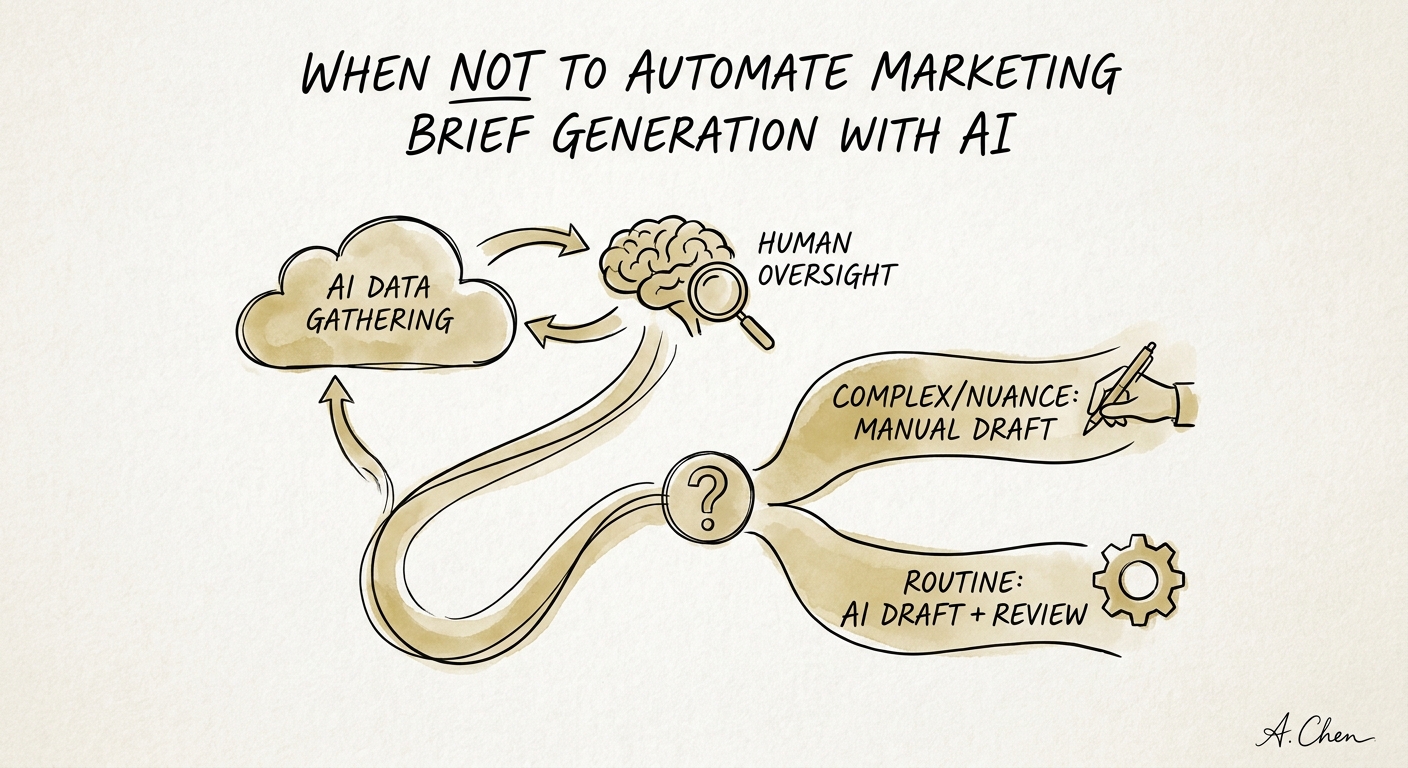
Here is the version of automation that works, and it is more boring than the demo. Do not start by generating the whole brief. Start by standardizing the brief template and automating the assembly of vetted inputs into it: pull the approved persona, the current quarter's offer, the cleared proof points, and the named success metric into a structured starting point, then make a human write the strategic core. You automate the gathering and the formatting, which is genuinely tedious, and you keep the human on the audience-offer-message decision, which is the whole job. That sequencing is the spirit of the IBM Institute for Business Value AI capabilities research: data, operating model, adoption, and measurement have to move together, not one tool ahead of the rest.
Run these five checks before you let AI draft a marketing brief end to end. One: can two marketers independently write near-identical briefs for the same campaign, because the framework is that clear? Two: is there a single ranked source of truth for personas, offers, and proof points, with stale material visibly retired? Three: is there a named approver for the lines that make public claims, and do they actually review before the brief leaves the building? Four: are the systems the tool reads scoped so an external collaborator never sees what they should not? Five: do you measure whether briefs improve the work — fewer creative revisions, faster sign-off, better campaign performance — or are you just producing them faster? If you cannot clear four of these, you are not automating a brief. You are scaling whatever ambiguity is already in your process.
The honest answer for a lot of teams is that the briefing standard does not exist yet, and that is the project before the AI project. Build the template, name the sources, name the approver, and run it manually for a quarter. Then automate the parts that have earned it. If you want a structured read on whether this specific workflow is ready, the AI Opportunity Score walks the readiness questions, and Human Renaissance AI transformation services can help you build the briefing standard worth automating in the first place.
